Summary
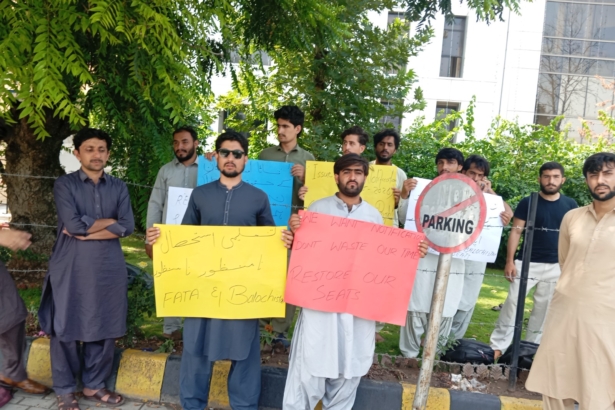
- Islamabad: Students from former FATA and Balochistan have been protesting outside the Pakistan Medical and Dental Council (PMDC) for around a week, stating their medical and dental seat issue remains unresolved despite repeated meetings, provincial proposals and a PMDC decision allowing increased intake in public medical colleges.
- The PMDC decision further stated that where the approved capacity of a public medical college is increased, the relevant provincial or regional government may reserve an appropriate quota within those additional seats for students under the HEC scholarship programme for former FATA and Balochistan.
- Rehan also claimed that a PMDC Council meeting had agreed to approve 300 seats for students of former FATA and Balochistan.
Islamabad: Students from former FATA and Balochistan have been protesting outside the Pakistan Medical and Dental Council (PMDC) for around a week, stating their medical and dental seat issue remains unresolved despite repeated meetings, provincial proposals and a PMDC decision allowing increased intake in public medical colleges. Protesters say they expected hundreds of seats under a federal education programme but are still waiting for a clear notification covering their admissions.
Among the protesting students named are Usman Afridi, Allah Yar and Shafi ud Din. Muhammad Rehan, a student from South Waziristan, said the federal government through the Higher Education Commission had been providing medical and dental education opportunities to students from former FATA and Balochistan.
He said 333 MBBS and BDS seats had been provided each year under the programme in previous years. Rehan claimed that the same number of seats had not been made available to students this time.
According to his account, PMDC initially told the students that it did not hold a separate quota of 333 seats and that provincial governments would have to identify available seats before PMDC could consider approval.
Students then approached the governments and medical education authorities in Khyber Pakhtunkhwa and Balochistan. Rehan said Khyber Pakhtunkhwa identified 375 additional seats while Balochistan proposed another 36 medical seats.
He said the students expected PMDC to approve these seats for their current admission session but the matter had still not been settled. Official documents in the file support that Khyber Medical University submitted a proposal for a major increase in seats for students from former FATA.
The KMU proposal listed additional seats in several public medical colleges. It proposed 50 additional seats each at Saidu Medical College, Gomal Medical College, Bannu Medical College, Bacha Khan Medical College, Nowshera Medical College, Gajju Khan Medical College and KMU Institute of Medical Sciences.
It also proposed 25 additional seats at KMU Institute of Dental Sciences. The total proposed increase under the KMU plan was 375 seats. Khyber Medical University said the colleges proposed for increased intake had been examined for faculty, infrastructure, teaching hospitals, equipment and other requirements.
KMU stated that the institutions were capable of supporting the proposed increase and asked PMDC to approve the seats for the relevant session. Balochistan also submitted a separate proposal for 36 additional MBBS seats. According to the document, Bolan Medical College was proposed for 21 additional seats.
Five seats each were proposed at Jhalawan Medical College, Loralai Medical College and Kech Medical College. The Balochistan Health Department said the proposal would support educational equality and help address the shortage of medical professionals in underserved regions.
The combined proposals from Khyber Pakhtunkhwa and Balochistan therefore amount to 411 additional seats. However, whether all of those seats must be reserved specifically for students from former FATA and Balochistan is a central issue in the dispute.
Students say they were expecting a fixed quota under the HEC programme. PMDC documents in the file show a somewhat different arrangement. PMDC approved an increase in student intake capacity across recognised public medical colleges, subject to inspections and compliance with its standards.
The regulator said colleges seeking increased intake would have to meet requirements on infrastructure, faculty and accreditation. It also made clear that the increased intake was not a relaxation of minimum medical education standards.
The PMDC decision further stated that where the approved capacity of a public medical college is increased, the relevant provincial or regional government may reserve an appropriate quota within those additional seats for students under the HEC scholarship programme for former FATA and Balochistan.
The document says the provincial government and HEC would determine the method for nomination, allocation and admission under the quota. The PMDC notification therefore does not state in the provided text that every province must reserve a fixed number of 333 or 300 seats.
Instead, it allows provincial governments to earmark an appropriate quota from approved enhanced capacity. This difference appears to be at the heart of the current dispute. Students say they were promised a specific number of seats.
The formal PMDC notification in the provided documents speaks more broadly about increased capacity and allows provinces to determine an appropriate HEC quota within that capacity.
Rehan also claimed that a PMDC Council meeting had agreed to approve 300 seats for students of former FATA and Balochistan. He said students were later repeatedly told that a notification would be issued soon but it did not come in the form they expected.
He also claimed that students have recordings of conversations with senior PMDC officials regarding promises about the notification. These claims are statements made by the protesting student and the provided documents do not independently establish the contents of the alleged recordings.
Official PMDC documents do confirm that the Council approved increased intake capacity in recognised public medical colleges across Pakistan. The decision stated that expanding capacity would give more deserving students access to medical education and strengthen Pakistan’s future health workforce.
However, this approval remained subject to PMDC assessment and compliance with required standards. An earlier Khyber Pakhtunkhwa meeting regarding former FATA students also shows that the issue had been under discussion for some time.
The meeting reviewed an overall capacity figure of 333 seats and discussed how additional opportunities could be created for students from former FATA. Officials were told that PMDC was willing in principle to consider increased seats if the required documents and formal requests were completed.
KMU was directed to survey medical colleges and submit the required information to PMDC. The meeting record dacuments also states that the support initiative for former FATA students was described as continuing until 2031.
Students are now demanding that PMDC issue a clear decision and allow the enhanced seats to apply to their current admission session. They argue that provincial governments and universities have already carried out the work required to identify additional capacity and that further delay could cost them an academic year.
We welcome your contributions! Submit your blogs, opinion pieces, press releases, news story pitches, and news features to opinion@minutemirror.com.pk and minutemirrormail@gmail.com