
Summary
- One of Pakistan’s most respected journalists, Abbas was invited to share not headlines, but memories — of his early days in newsrooms, of stories that shaped him, and of a career spent chasing truth in an era when journalism meant typewriters, landlines, and courage.
- The editor has become a traffic manager, not a teacher.” The Culture of Debate For Abbas, Dawn, The Star, Jang, and Bombay Building weren’t just offices.
- We were told: get the news, don’t become the news.” What He Misses Most When asked what he misses most about old journalism, Abbas didn’t say money or fame.
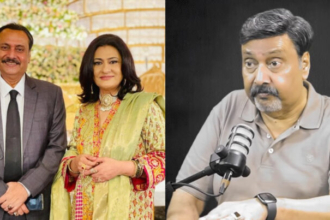
Karachi Press Club’s Najeeb Terrace was packed, but the noise fell silent the moment Mazhar Abbas picked up the mic. One of Pakistan’s most respected journalists, Abbas was invited to share not headlines, but memories — of his early days in newsrooms, of stories that shaped him, and of a career spent chasing truth in an era when journalism meant typewriters, landlines, and courage. For younger reporters in the audience, it was a masterclass. For veterans, it was nostalgia.
The session was part of KPC’s ongoing series “Jo Hum Pe Guzri: What We Lived Through” — an initiative by KPC General Secretary Aslam Khan and the governing body to document the oral history of senior journalists. The idea is simple: before archives go digital and newsrooms go virtual, record the lived experience of those who built Pakistani journalism. Veterans pass on context. New journalists hear what textbooks don’t teach — how news was gathered, how power was challenged, and what it cost.
A large number of politicians, civil society members, and the journalist fraternity attended. Among the prominent were Senator Waqar Mehdi, Nasreen Jalil, Raza Haroon, Khushbakht Shujat, Khawaja Rizvi, veteran journalist Wusatullah Khan, and many seniors and young journalists.
A Childhood in Hyderabad
Abbas began far from Karachi, in Hyderabad. “I grew up with my three brothers,” he recalled. “Our father, Mirza Abid Abbas, an educationist, was held in very high regard in the community. The muhalla was connected. People knew each other, they looked out for each other. That teaches you ethics before you learn journalism.”
For young reporters in the audience who grew up on WhatsApp groups and Twitter threads, it was a different picture of community — one where reputation mattered on your street before it mattered on page one.
Karachi: When Newsrooms Spilled onto Streets
Then came Karachi. Abbas studied journalism at the University of Karachi. “Coffee shops, cinemas, bookstores — that was our standard culture,” he said. “And Karachi journalism was alive in Bombay Building. From The Star newspaper office to Jang Street, you would find a crowd of newspaper workers. Reporters, sub-editors, press workers, hawkers. It was noisy, it was chaotic, but it was alive.”
He described an era when you filed from a landline, argued on the desk, and then walked to a nearby café to argue some more. Journalism wasn’t a 9-to-5 job. It was a way of life embedded in the city’s streets.
Abbas also recalled covering major cases early in his career, including the kidnapping and murder of Daniel Pearl, Bureau Chief of The Wall Street Journal, in 2002.
Witness to History
That street-level journalism put Abbas in the middle of Pakistan’s political turbulence.
“I saw politicians like Benazir Bhutto Shaheed, Asif Zardari, Nawaz Sharif attending court,” he said. “You would wait for hours in corridors for one line. And when you got it, you knew it would lead the next day’s paper.”
He spoke of covering the evolution of MQM over two decades — watching it grow from a student and urban movement into one of Karachi’s dominant political forces.
“You saw the city change with it,” he noted. “Riots, strikes, negotiations, elections. We reported it from the ground. There was no Twitter, no WhatsApp. The notebook, the tape recorder, and the phone booth were your tools.”
The Cost: Threats and Raids
Then his tone changed. Abbas spoke of the price journalists paid for that reporting.
“I was threatened. I saw a bullet meant for me,” he told the audience quietly. “And I remember the day my home in Gulshan-e-Iqbal was raided by the militia of a political party. My maid and my younger brother were harmed in that raid.”
The hall went silent. Everyone in KPC understood what those years in Karachi meant.
“That was the time when reporting was not just about getting the story,” he said. “It was about getting home safely. But we kept going, because if we stopped, who would tell the story?”
“While talking to senior journalist Rafiq Sheikh, who was also part of Jang, he told me it was such a horrific time,” Mr Sheikh recalled. “Whenever a threat or warning came, it would point directly or indirectly toward MQM, without any solid evidence.”
Rafiq Sheikh said that climate of suspicion made reporting even harder. Every incident became politicized instantly, and journalists were caught in the middle — pressured to name, to blame, and to file fast, even when facts were missing.
The Newsroom as Family
“In those days the newsroom was your second home,” Abbas said. He recalled how senior editors acted like gatekeepers and mentors at once. They would cut your copy hard, but they would also stand by you if pressure came from outside. “Now that relationship is gone. The editor has become a traffic manager, not a teacher.”
The Culture of Debate
For Abbas, Dawn, The Star, Jang, and Bombay Building weren’t just offices. They were an ecosystem.
“You’d finish work at The Star, walk to Jang Street, and stop at 3 tea stalls on the way,” he said. “Every stall had a debate. Afghan war, Zia, PPP, MQM. Reporters from different papers argued, and then went back and wrote better stories because of it.”
He said that culture of cross-paper debate is missing today. “Now we are in silos. We tweet, we post, but we don’t argue face to face over chai.”
Get the News, Don’t Become the News
Covering political upheavals, martial laws, and Karachi’s ethnic politics meant living with fear, he admitted.
“There were days we couldn’t put our bylines, on our own”, it was purely Editor’s preregotive”. he said. “ And There were days we wrote ‘Staff Reporter’ because the story was too sensitive. But we still wrote it.”
He told young reporters that courage then didn’t mean being reckless. It meant being responsible. “You had to get the facts right, because one wrong line could start a riot or get someone killed. We were told: get the news, don’t become the news.”
What He Misses Most
When asked what he misses most about old journalism, Abbas didn’t say money or fame.
“I miss the time,” he said. “Time to think, time to verify, time to sit with a source for 2 hours. Today we don’t have time. We have notifications.”
He added that he also misses bookstores near newsrooms. “After filing, we’d buy a book. Now after filing, we scroll.”
The Breaking of Trade Unions
Abbas also turned to the decline of press unions.
“We had strong trade unions once,” he said. “They fought for wages, for safety, for press freedom. But they were deliberately divided by a plan. Once the unity broke, the bargaining power of journalists weakened.”
He argued that fragmentation didn’t just hurt salaries. It hurt solidarity. When journalists stopped speaking with one voice, it became easier to pressure them individually.
He also noted the decline of student unions. “Today there is no ban on student unions, but you won’t find one in any educational institution. Fear and our own motives have cultivated that silence over the years.”
The Editor Is Gone, And So Is the Time to Think
Abbas’s sharpest critique was reserved for the present.
“Today journalism has eliminated the institution of the editor and gatekeeping,” he said. “Every news today is breaking news. The competition to be first has killed the discipline to be right.”
He worried about young reporters working without newsroom debate or editorial pushback.
“We used to kill 10 stories for every one we published,” he recalled. “Now we publish 10 to get one right. That’s the reversal.”
His advice was simple: go back to basics. Talk to people. Sit in courts. Walk the muhalla. Verify before you post. Protect credibility, because once lost, it takes generations to rebuild.
Censorship Itself Spreads Disinformation
Abbas also spoke about censorship and its unintended consequences.
“Censorship itself spreads disinformation,” he said. “Every government must learn to avoid misinformation by letting the correct and true story flow. The more bans you put, the more disinformation will disseminate.”
He argued that attempts to control news only create a vacuum that rumors fill. “If you want people to trust the news, don’t hide it. Let journalism do its job of verification.”
An Evening with Mazhar Abbas
Senior journalist Rana Aqeel of Geo TV summed up the mood:
“Mazhar spoke of spending his childhood in Hyderabad, of the friends and teachers he had in school. He recalled how, after moving to Karachi, an actor became his college fellow and another his peer at Karachi University. He talked about his active role in student politics, and his continued support for it even today.”
For an audience used to hearing his political and social analysis on TV channels, these personal memories were a refreshing change. It turned a hot summer evening into a pleasant breeze.”
Reporting from the Ground, Not from X
Abbas also announced to publish books on his memoirs which would be treasure in history for generations to come. As people filed out of the KPC Najeeb Terrace, the conversation continued in small groups. Some talked about Mazhar’s art of speaking. Others about Benazir’s court appearances. A few asked him about his first story or took selfies with him.
What lingered wasn’t just politics or headlines. It was the image of a Karachi where coffee, books, and newsrooms were part of one culture. And the reminder that journalism is not just about reporting what happened today. It’s about remembering what we lived through — including the threats, the raids, and the resilience — so we don’t lose the values that made the work worth doing.
The writer is a senior journalist and columnist, having experience of working with all major English media houses. Feedback: mediawomen2014@gmail.com
We welcome your contributions! Submit your blogs, opinion pieces, press releases, news story pitches, and news features to opinion@minutemirror.com.pk and minutemirrormail@gmail.com