Summary
- The government on Monday decided to discontinue fuel subsidies provided to motorcyclists, small farmers, and public transport, following a sharp decline in global fuel prices triggered by the US-Iran agreement to end the Middle East conflict.
- Noting the sharp decline in global fuel prices and that the benefit had already been passed on to consumers, the committee agreed that the subsidy was no longer necessary.
- The government has emphasized that the benefit of lower global prices has already been fully passed on to the public, and that the discontinuation of the subsidy will not result in any immediate price increases.
The government on Monday decided to discontinue fuel subsidies provided to motorcyclists, small farmers, and public transport, following a sharp decline in global fuel prices triggered by the US-Iran agreement to end the Middle East conflict.
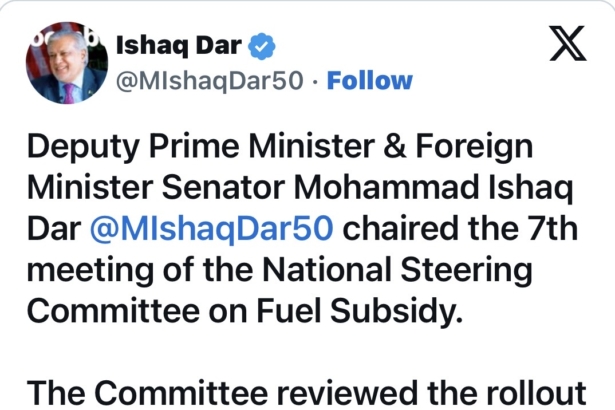
The decision was taken during the seventh meeting of the National Steering Committee on Fuel Subsidy, chaired by Deputy Prime Minister and Foreign Minister Ishaq Dar. The committee reviewed the rollout of fuel subsidies across all provinces, Gilgit-Baltistan, and Azad Jammu and Kashmir before agreeing to discontinue the programme, subject to the prime minister’s approval.
The development comes after recent reductions in petroleum prices, under which petrol was cut by Rs74 per litre and diesel by Rs67 per litre, bringing them down to Rs299 per litre and Rs311 per litre respectively. The price drop followed a decline in international oil markets after the United States and Iran reached a landmark agreement to end a conflict that had lasted over three months.
Noting the sharp decline in global fuel prices and that the benefit had already been passed on to consumers, the committee agreed that the subsidy was no longer necessary. The subsidy programme had been introduced to provide relief to vulnerable segments of society during a period of elevated global energy prices. With prices now stabilising, the government has determined that continued subsidisation would place an unnecessary burden on the national exchequer.
The decision reflects the broader economic benefits of the diplomatic breakthrough between Washington and Tehran. The US-Iran agreement has not only de-escalated regional tensions but has also contributed to stabilizing global energy markets. The reopening of the Strait of Hormuz to tanker traffic and the easing of sanctions on Iranian oil exports have increased supply, driving prices down and providing relief to import-dependent economies like Pakistan.
For consumers, the reduction in fuel prices will continue to provide relief at the pump, even as the subsidy is withdrawn. The government has emphasized that the benefit of lower global prices has already been fully passed on to the public, and that the discontinuation of the subsidy will not result in any immediate price increases.
The decision marks a significant shift in Pakistan’s fiscal policy, as the government redirects resources toward other priorities while maintaining the benefits of lower energy costs. As the US-Iran agreement continues to shape regional dynamics, Pakistani consumers stand to gain from the broader economic stabilization that the deal has facilitated.
We welcome your contributions! Submit your blogs, opinion pieces, press releases, news story pitches, and news features to [email protected] and [email protected]