Summary
- By Muhammad Imran, Staff Member, SAHSOL-LUMS and Sadia Hammad, Advocate & Internship Coordinator at AGHS, Lahore and Muhammad Abdullah, Law Student, SAHSOL-LUMS Introduction: Article 11 of the Constitution of the Islamic Republic of Pakistan, 1973, enshrines one of the most fundamental guarantees of human dignity by unequivocally prohibiting slavery, forced labour, human trafficking, and the exploitation of children.
- Scope and Constitutional Character of Article 11: Article 11 prohibits slavery, forced labour, and trafficking in human beings.
- Article 3 seeks to eliminate exploitation in all its manifestations; Article 4 guarantees the right to be treated in accordance with law; Article 9 protects life and liberty; Article 10A guarantees due process and a fair trial; Article 11 abolishes slavery and forced labour; Article 14 safeguards human dignity; and Article 25A guarantees free and compulsory education.
By Muhammad Imran, Staff Member, SAHSOL-LUMS and Sadia Hammad, Advocate & Internship Coordinator at AGHS, Lahore and Muhammad Abdullah, Law Student, SAHSOL-LUMS
Introduction: Article 11 of the Constitution of the Islamic Republic of Pakistan, 1973, enshrines one of the most fundamental guarantees of human dignity by unequivocally prohibiting slavery, forced labour, human trafficking, and the exploitation of children. It declares that slavery is non-existent and forever prohibited within Pakistan while simultaneously outlawing all forms of forced labour and trafficking in human beings. The constitutional prohibition reflects not merely a legal norm but a profound moral and civilizational commitment to safeguarding human freedom, dignity, and equality. It embodies the universal principle that no individual may be treated as the property of another or compelled to labour against his or her free will.
In contemporary constitutional democracies and under international human rights law, slavery has been universally condemned as one of the gravest violations of human rights. Accordingly, the Constitution places Article 11 within the Chapter on Fundamental Rights, thereby elevating freedom from slavery and forced labour to the status of an inviolable constitutional guarantee.
Islamic Foundations of Article 11: The constitutional prohibition is deeply rooted in Islamic jurisprudence. Islam fundamentally transformed the institution of slavery by encouraging emancipation, prohibiting oppression and exploitation, and affirming the equality of all human beings before Allah. The Holy Qur’an and the Sunnah of the Prophet Muhammad (peace be upon him) consistently emphasize justice, compassion, and the liberation of human beings from servitude. Since Article 227 of the Constitution mandates that no law shall be enacted which is repugnant to the injunctions of Islam, Article 11 represents not merely a constitutional guarantee but also the constitutional manifestation of Islamic principles concerning liberty, equality, and human dignity.
Scope and Constitutional Character of Article 11: Article 11 prohibits slavery, forced labour, and trafficking in human beings. Although the Constitution does not expressly define “forced labour,” it generally includes work extracted against a person’s free will through coercion, intimidation, abuse of authority, economic compulsion, or without adequate remuneration. Judicial developments have also recognized that persistent non-payment or unreasonable delay in wages may, in appropriate circumstances, amount to forced labour because it creates conditions of economic dependency.
Clause (1) employs categorical constitutional language by declaring slavery to be non-existent and prohibiting all forms of forced labour and trafficking. The emphatic wording demonstrates the framers’ intention to leave no room for legislative or executive action that legitimizes involuntary servitude. Consequently, Article 11 possesses a near-absolute constitutional character.
Constitutional Obligations of the State: Article 11 imposes both negative and positive obligations upon the State. Negatively, the State itself is prohibited from authorizing, encouraging, or tolerating slavery and forced labour. Positively, it must protect individuals from exploitation by private employers, industrial enterprises, landlords, traffickers, and other non-state actors. This dual obligation requires the enactment of effective legislation, robust enforcement mechanisms, and meaningful judicial remedies to eradicate all forms of involuntary labour and human exploitation.
Judicial Interpretation: The Supreme Court of Pakistan significantly expanded the scope of Article 11 in Darshan Masih v. The State (PLD 1990 SC 513). Acting upon a telegram received from bonded labourers employed at brick kilns, the Court exercised its constitutional jurisdiction to investigate widespread bonded labour practices. Recognizing bonded labour as a direct violation of Articles 9, 11, and 14 of the Constitution, the Court adopted a purposive approach by issuing comprehensive directions for the eradication of bonded labour and the protection of vulnerable workers. The judgment remains a landmark example of public interest litigation and constitutional activism in Pakistan.
Comparative Constitutional Perspective: Comparative constitutional jurisprudence reveals a similar constitutional commitment in the United States. The Thirteenth Amendment abolished slavery and involuntary servitude following the American Civil War. Section 1 prohibits slavery and involuntary servitude, except as punishment following lawful conviction, while Section 2 empowers Congress to enforce the Amendment through appropriate legislation. This constitutional framework enabled the enactment of extensive federal laws against slavery, peonage, human trafficking, and forced labour.
Honorable Justice Fazal Karim (late), in his Access to Justice in Pakistan: A Sine Qua Non for district judiciary practice, and Opus Magnum Judicial Review of Public Action, has quoted legal scholar Moyle, who aptly describes slavery as “a condition of absolute rightlessness,” emphasizing that slavery deprives an individual of legal personality and fundamental rights. This understanding stands in sharp contrast to the notorious decision in Dred Scott v. Sandford (1857), where the United States Supreme Court denied citizenship to persons of African descent. The ratification of the Thirteenth Amendment in 1865 decisively repudiated that reasoning and firmly established the constitutional principle of human liberty.
Provincial Legislation after the Eighteenth Amendment: Following the Eighteenth Amendment, labour became a provincial subject predominantly, enabling the provinces to enact legislation implementing Article 11. Punjab enacted the Punjab Restriction on Employment of Children Act, 2016, together with other labour welfare statutes. Sindh enacted the Sindh Bonded Labour System (Abolition) Act and comprehensive child labour legislation. Khyber Pakhtunkhwa introduced the Khyber Pakhtunkhwa Prohibition of Employment of Children Act, 2015, while Balochistan enacted legislation regulating and prohibiting child employment in hazardous occupations alongside other labour laws.
Notwithstanding provincial legislative competence, bonded labour continues to be principally governed by the Bonded Labour System (Abolition) Act, 1992, a federal statute enacted before the Eighteenth Amendment. Following constitutional devolution, responsibility for its implementation largely rests with the provincial governments, which are obligated to establish Vigilance Committees, enforce labour laws, prosecute offenders, rescue bonded labourers, and ensure their rehabilitation.
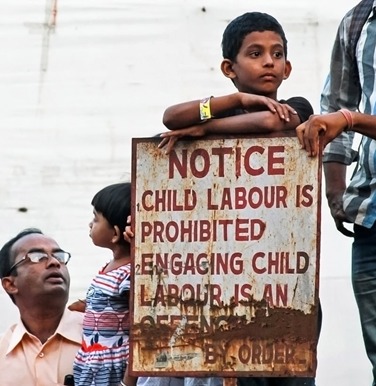
Protection of Children: Article 11 also provides special constitutional protection for children by prohibiting the employment of children below fourteen years of age in factories, mines, and other hazardous occupations. When read together with Article 25A, which guarantees free and compulsory education for children between the ages of five and sixteen years, the Constitution clearly envisages education rather than labour as the primary occupation of every child. Effective implementation of Article 25A would substantially reduce child labour and promote children’s physical, intellectual, and social development.
Constitutional Exception: Article 11 recognizes a limited exception permitting compulsory labour as part of a lawful sentence imposed upon a convicted person. A similar exception exists under the Thirteenth Amendment to the United States Constitution. However, this exception does not authorize degrading or inhuman treatment; there may be other statutory legislation to prohibit cruelty. Even convicted prisoners remain entitled to the protection of Articles 9, 10A, and 14 of the Constitution. Accordingly, prison labour must always respect human dignity and constitutional safeguards. In Article 11, the labour or punishment that is inflicted to the Military perssonnel is also excluded from the operation of Article 11.
Constitutional Nexus: Article 11 cannot be interpreted in isolation. It forms part of an integrated constitutional framework comprising Articles 3, 4, 9, 10A, 11, 14, and 25A. Article 3 seeks to eliminate exploitation in all its manifestations; Article 4 guarantees the right to be treated in accordance with law; Article 9 protects life and liberty; Article 10A guarantees due process and a fair trial; Article 11 abolishes slavery and forced labour; Article 14 safeguards human dignity; and Article 25A guarantees free and compulsory education. Collectively, these provisions establish a coherent constitutional framework dedicated to liberty, equality, social justice, and the protection of human dignity.
Conclusion: Article 11 represents one of the Constitution’s strongest commitments to human dignity and social justice. Its language is categorical, making slavery and forced labour virtually non-derogable constitutional prohibitions. Nevertheless, constitutional recognition alone cannot eradicate exploitation. The continued existence of bonded labour, child labour, and human trafficking demonstrates that the principal challenge lies not in constitutional design but in effective implementation. The State must therefore discharge its positive constitutional obligation by enforcing labour laws, strengthening institutional oversight, prosecuting offenders, and rehabilitating victims. Ultimately, the true effectiveness of Article 11 will be measured not by the breadth of its constitutional language but by its practical ability to eliminate all contemporary forms of human exploitation. Though Pakistan is taking steps to improve its human rights scoreboard but there is need to accerlate it. It will help us to maintain the GSP Plus state – that is necessary to our export, apart from moral alleviation.
We welcome your contributions! Submit your blogs, opinion pieces, press releases, news story pitches, and news features to opinion@minutemirror.com.pk and minutemirrormail@gmail.com