Summary
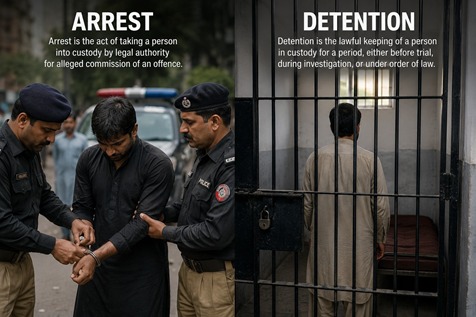
- By Muhammad Imran, Staff Member, SAHSOL-LUMS and Asma Rahmat, Final Year Law Student, SLC Superior University and Wafa Sarfraz, Law Student, SAHSOL-LUMS Introduction: Article 10 of the Constitution of the Islamic Republic of Pakistan enshrines the fundamental constitutional safeguards against arbitrary arrest and detention, thereby giving concrete procedural effect to the broader guarantee of personal liberty contained in Article 9.
- Critical Appraisal – Article 10 as a Constitutional Mini-Code of Criminal Procedure: Article 10 may appropriately be characterized as a constitutional mini-code of criminal procedure, as it constitutionalizes the essential procedural safeguards governing arrest and detention.
- Unlike the Code of Criminal Procedure, which regulates the mechanics of criminal investigation and prosecution through ordinary legislation, Article 10 elevates the most fundamental procedural guarantees—including notification of the grounds of arrest, access to legal counsel, judicial oversight, and protection against arbitrary detention—to the status of enforceable constitutional rights.
By Muhammad Imran, Staff Member, SAHSOL-LUMS and Asma Rahmat, Final Year Law Student, SLC Superior University and Wafa Sarfraz, Law Student, SAHSOL-LUMS
Introduction: Article 10 of the Constitution of the Islamic Republic of Pakistan enshrines the fundamental constitutional safeguards against arbitrary arrest and detention, thereby giving concrete procedural effect to the broader guarantee of personal liberty contained in Article 9. Rather than leaving these protections to ordinary legislation—such as Sections 60, 61, and 81 of the Code of Criminal Procedure (Cr.P.C.)—the Constitution elevates them to the status of entrenched fundamental rights. Consequently, these guarantees cannot be diluted or abrogated through ordinary legislative enactments, and any executive action or statutory provision inconsistent with Article 10 is liable to be declared void under Article 8 of the Constitution.
Structurally, Article 10 establishes two distinct constitutional regimes. Clauses (1) and (2) prescribe procedural safeguards applicable to ordinary arrests and detention, whereas clauses (3) to (9) regulate the exceptional constitutional framework governing preventive detention. Therefore, the Honorable Mr. Justice Fazal Karim (Late) in his magic book for district judiciary practice, ‘Access to Justice in Pakistan’, described it as a Mini-Criminal Code, and has rightly described it so.
Interplay with the Constitutional Scheme of Fundamental Rights: Article 10 does not operate in isolation; rather, it forms an integral part of Pakistan’s constitutional framework for the protection of liberty, dignity, and due process. Read together with Articles 9, 10A, and 14, it establishes a comprehensive constitutional guarantee against arbitrary deprivation of liberty.
Article 9 guarantees that no person shall be deprived of life or liberty except in accordance with law, while Article 14 protects the inviolability of the dignity of man. Article 10 operationalizes these guarantees by regulating the manner in which the State may lawfully arrest and detain individuals. Consequently, arbitrary arrest, unlawful detention, and custodial abuse constitute violations not only of Article 10 but also of Articles 9 and 14.
The relationship between Article 10 and Article 10A is equally significant. Introduced through the Eighteenth Constitutional Amendment, Article 10A constitutionalizes the rights to due process and a fair trial. Jurisprudentially, Article 10 governs the investigative stage by ensuring lawful arrest, prompt notification of the grounds of arrest, immediate access to legal counsel, and judicial supervision within twenty-four hours. Article 10A, by contrast, safeguards the adjudicatory process through guarantees of an impartial tribunal, equality of arms, open justice, and procedural fairness. Together, these provisions establish a continuous constitutional guarantee of due process extending from arrest until the conclusion of criminal proceedings.
Constitutional Safeguards under Clauses (1) and (2): Clauses (1) and (2) prescribe the minimum constitutional standards governing every lawful arrest.
An arrested person must be informed, as soon as may be, of the grounds of arrest in a manner sufficient to enable an effective challenge to the legality of detention. The Constitution further guarantees an unfettered right to consult and be defended by a legal practitioner of one’s own choice, thereby ensuring meaningful legal assistance from the earliest stage of criminal proceedings.
Additionally, every arrested person must be produced before the nearest Magistrate within twenty-four hours of arrest, excluding the time reasonably required for the journey from the place of arrest to the court. Continued detention beyond this constitutional period is permissible only upon the authority of a Magistrate through a valid judicial remand order.
Collectively, these guarantees subject executive power to immediate judicial scrutiny and minimize the risk of arbitrary or prolonged detention.
Implied Constitutional Rights under Article 10: Apart from its express guarantees, Article 10 also incorporates several implied constitutional rights arising from constitutional principle, comparative jurisprudence, and judicial interpretation.
The obligation to communicate the grounds of arrest necessarily presupposes that lawful and objectively justifiable grounds must exist before an arrest is effected. Accordingly, an arrest cannot lawfully be undertaken on mere suspicion or with reasons manufactured retrospectively. This reflects the common law doctrine of reasonable or probable cause and has been affirmed by the Supreme Court of Pakistan, particularly in Mst. Sughran Bibi v. The State, which held that mere nomination in an FIR does not, by itself, justify immediate arrest.
Similarly, the constitutional right to “consult” legal counsel necessarily extends beyond representation during trial. It attaches immediately upon arrest, including during police custody, investigation, and interrogation, thereby ensuring legal assistance at the earliest and most vulnerable stage of the criminal process.
Preventive Detention: The Constitutional Exception: Although Article 10 principally governs ordinary arrests, clauses (3) to (9) establish a distinct constitutional framework for preventive detention.
Preventive detention differs fundamentally from ordinary criminal detention. It is preventive rather than punitive, aiming to avert threats to national security, public order, or defence rather than punish past conduct. Recognizing the extraordinary nature of such detention, the Constitution subjects it to stringent procedural safeguards.
The detaining authority must ordinarily communicate the grounds of detention within fifteen days unless disclosure would be contrary to the public interest. Furthermore, detention extending beyond three months requires approval from an independent Review Board comprising serving or former Judges of the High Court or Supreme Court.
The Supreme Court has consistently held that the executive’s “satisfaction” justifying preventive detention is not immune from judicial review. Rather, it must be supported by objective and relevant material establishing a reasonable apprehension of harm. Preventive detention therefore remains subject to constitutional principles of legality, proportionality, and procedural fairness.
Constitutional Remedies and Judicial Enforcement: The principal constitutional mechanism for enforcing Article 10 is the jurisdiction of the High Courts under Article 199.
The writ of habeas corpus provides an effective constitutional remedy where an individual is unlawfully arrested or detained. If a detainee is not informed of the grounds of arrest, denied access to legal counsel, or detained beyond twenty-four hours without judicial authorization, the High Court may require the production of the detainee and determine the legality of the detention. Upon finding a violation of Article 10, the Court may order immediate release and grant appropriate constitutional relief.
Except where expressly suspended during a constitutionally proclaimed emergency under Part X of the Constitution, the guarantees contained in Article 10 remain binding upon every organ of the State. Pakistani courts have consistently maintained that executive necessity can never justify bypassing the mandatory requirement of prompt judicial supervision.
Consequences of Non-Compliance: Failure to comply with Article 10 carries significant constitutional and legal consequences.
An arrest becomes unlawful where the detainee is not informed of the grounds of arrest, denied access to legal counsel, or not produced before a Magistrate within twenty-four hours. Such violations expose the arresting authorities to constitutional remedies and potential civil liability, including actions for false imprisonment.
Comparative jurisprudence, particularly R v. Horseferry Road Magistrates’ Court, ex parte Bennett, illustrates that courts possess inherent authority to prevent prosecutions tainted by serious executive abuse. Nevertheless, both Pakistani and comparative jurisprudence generally recognize that an unlawful initial arrest or detention does not automatically invalidate a subsequent criminal trial or conviction where the prosecution is otherwise lawfully maintainable.
Constitutional Tensions with Special Security Legislation: The constitutional guarantees embodied in Article 10 have frequently come into tension with special security legislation, including the Anti-Terrorism Act, 1997, and, historically, the Protection of Pakistan Act.
Such legislation often authorizes extended periods of physical remand or preventive internment in response to terrorism and national security concerns. However, the constitutional position remains that ordinary legislation cannot override entrenched fundamental rights. Consequently, even under special security statutes, the essential guarantees of Article 10—timely communication of the grounds of arrest, meaningful access to legal counsel, and effective judicial supervision—remain constitutionally binding unless the Constitution itself expressly provides otherwise.
Accordingly, judicial decisions have consistently affirmed that national security considerations cannot justify the complete exclusion of constitutional safeguards. Rather, Article 10 ensures that extraordinary executive powers remain firmly anchored in the rule of law.
Critical Appraisal – Article 10 as a Constitutional Mini-Code of Criminal Procedure: Article 10 may appropriately be characterized as a constitutional mini-code of criminal procedure, as it constitutionalizes the essential procedural safeguards governing arrest and detention. Unlike the Code of Criminal Procedure, which regulates the mechanics of criminal investigation and prosecution through ordinary legislation, Article 10 elevates the most fundamental procedural guarantees—including notification of the grounds of arrest, access to legal counsel, judicial oversight, and protection against arbitrary detention—to the status of enforceable constitutional rights.
Nevertheless, the expression “mini-code” should be understood in a qualified sense. Article 10 neither regulates the entirety of criminal procedure nor constitutes a comprehensive procedural code. Matters relating to investigation, search and seizure, bail, evidence, trial procedure, sentencing, and appeals remain governed by ordinary legislation. Instead, Article 10 establishes the irreducible constitutional minimum below which neither Parliament nor the executive may descend. Its function is therefore supervisory rather than exhaustive.
The Constitutionalization of these safeguards has profound normative significance. By incorporating them into the chapter on Fundamental Rights, the Constitution removes them from ordinary legislative discretion. Parliament may supplement these protections, but it cannot diminish or abrogate them without offending Articles 8 and 239 of the Constitution. Consequently, Article 10 transforms procedural safeguards from statutory privileges into constitutional entitlements enforceable before the superior judiciary.
From a comparative constitutional perspective, Article 10 resembles Article 5 of the European Convention on Human Rights, the Fourth, Fifth, and Sixth Amendments to the United States Constitution, and Article 22 of the Constitution of India. However, the Pakistani provision remains comparatively concise, leaving substantial procedural detail to legislation and judicial interpretation. This constitutional brevity has enabled the superior courts to develop an evolving jurisprudence concerning reasonable grounds for arrest, access to legal counsel, and judicial control over executive detention.
Despite its constitutional significance, Article 10 continues to face challenges in practical implementation. Unlawful arrests, delayed production before Magistrates, denial of prompt legal assistance, and routine mechanical remands remain persistent concerns. Consequently, the effectiveness of Article 10 ultimately depends not merely upon its constitutional text but upon robust judicial enforcement, professional policing, and unwavering institutional commitment to constitutionalism and the rule of law.
Ultimately, Article 10 embodies the constitutional balance between the legitimate interests of the State in maintaining public order and the inviolable right of the individual to personal liberty. It ensures that the constitutional protection of liberty commences not at trial, but from the very moment an individual is deprived of freedom, thereby making it one of the most significant procedural guarantees within Pakistan’s constitutional order.
We welcome your contributions! Submit your blogs, opinion pieces, press releases, news story pitches, and news features to opinion@minutemirror.com.pk and minutemirrormail@gmail.com