Summary
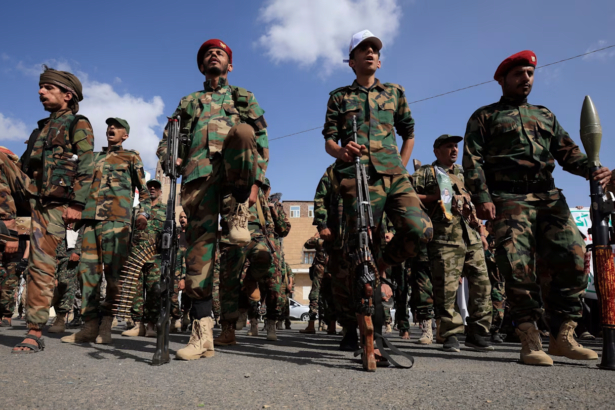
- Yemen’s Houthi movement launched a fresh wave of attacks on Saudi Arabia and pushed further into positions along Yemen’s Red Sea coast on Monday, as Saudi officials held urgent talks in Riyadh over how to respond to the group’s rapid advance and Gulf states pulled out of planned negotiations with Iran.
- In response to the Houthi offensive, Saudi and Yemeni air forces have intensified bombing runs against Houthi positions, including around the historic Red Sea port of Mocha, but Yemeni officials aligned with the country’s internationally recognized government said the Houthis continue to hold effective control over nearly the entire western coastline.
- Saudi Arabia has led a military coalition against the Houthis since 2015, though the conflict had largely settled into a ceasefire in recent years before fighting reignited this month, with Houthi forces pushing back troops loyal to Yemen’s internationally recognized government.
Yemen’s Houthi movement launched a fresh wave of attacks on Saudi Arabia and pushed further into positions along Yemen’s Red Sea coast on Monday, as Saudi officials held urgent talks in Riyadh over how to respond to the group’s rapid advance and Gulf states pulled out of planned negotiations with Iran.
The Houthis said they fired dozens of missiles and drones at a military airbase in Khamis Mushait in southern Saudi Arabia, targeting aircraft hangars, radar systems, runways and ammunition depots in what they described as retaliation for Saudi airstrikes inside Yemen. Saudi authorities issued emergency alerts in that city and three other locations in the south, and the Saudi led coalition operating in Yemen said thirteen civilians were wounded in the strikes.
The escalation follows the Houthi seizure of Perim Island at the mouth of the Red Sea in recent days, adding further strain on Saudi oil exports already reeling from an aerial attack last Thursday that knocked out the kingdom’s east west pipeline. Saudi officials blamed that attack on Iranian backed militias operating in Iraq. Riyadh built the 1,200 kilometer pipeline across its territory in the 1980s specifically to move crude from the Gulf to the Red Sea and bypass the Strait of Hormuz during an earlier period of regional conflict. Traders said a prolonged outage could remove as much as 4 percent of global oil supply at a time when the strait itself remains largely blocked, and Saudi authorities have given no timeline for restoring the pipeline.
In response to the Houthi offensive, Saudi and Yemeni air forces have intensified bombing runs against Houthi positions, including around the historic Red Sea port of Mocha, but Yemeni officials aligned with the country’s internationally recognized government said the Houthis continue to hold effective control over nearly the entire western coastline. One Yemeni official said the group is under heavy pressure and is responding by escalating its own campaign of missile and drone strikes. Crude prices rose more than 4 percent during Monday’s trading before settling roughly 1 percent higher on the day.
The renewed fighting presents a fresh dilemma for the United States. Three people familiar with the matter said Washington has so far resisted Saudi requests for direct military involvement beyond intelligence sharing. Trump said over the weekend that he had spoken with the Saudi crown prince and that the Houthis had separately reached out to Washington asking that it stay out of the conflict. Saudi state media reported that Crown Prince Mohammed bin Salman met with the top American regional military commander, Admiral Brad Cooper, in Jeddah on Monday. Saudi Arabia has led a military coalition against the Houthis since 2015, though the conflict had largely settled into a ceasefire in recent years before fighting reignited this month, with Houthi forces pushing back troops loyal to Yemen’s internationally recognized government.
Diplomatic efforts aimed at easing the broader crisis also stalled. Oman had been set to host a meeting on Monday bringing together Iran and Gulf Arab states to discuss reopening the Strait of Hormuz, a waterway that carried a fifth of the world’s oil exports before the war began. Oman announced the meeting had been postponed, and Iran said the delay came at Saudi Arabia’s request. Trump repeated his frequent claim that Iran wants to reach a deal quickly, but Mohsen Rezaei, secretary of Iran’s Supreme National Security Council, dismissed the president’s comments as a distraction, writing on social media that no talks would take place until Iran’s conditions are met.
The volatility of shipping through the region was underscored by conflicting accounts of how an oil tanker came to be damaged. Iran’s Revolutionary Guard Corps said, without specifying a date, that the Panamanian flagged tanker El Gaia was struck by sea mines while passing through a restricted zone south of the Strait of Hormuz. The United States military’s Central Command disputed that account, saying the vessel had instead been hit by an Iranian missile the previous month and left inoperable. The United Nations’ International Maritime Organization confirmed the tanker was damaged on Saturday but did not specify the cause, adding that two crew members remain missing. The vessel’s owners in Dubai could not immediately be reached to clarify the circumstances.
The Strait of Hormuz, the world’s most important oil shipping route, has remained largely shut since the war began on February 28, with Iran threatening any vessel that attempts to pass without its authorization. Iran’s Revolutionary Guard Navy reiterated its position on Monday, stating that the strait remains closed and under its control.
We welcome your contributions! Submit your blogs, opinion pieces, press releases, news story pitches, and news features to opinion@minutemirror.com.pk and minutemirrormail@gmail.com