Summary
- The most enduring myth of Agincourt is that English longbows easily pierced the premium steel armor worn by French knights.
- The French army’s greatest enemy was not the English archer.
- The moving English soldiers swarmed the immobilized French knights.
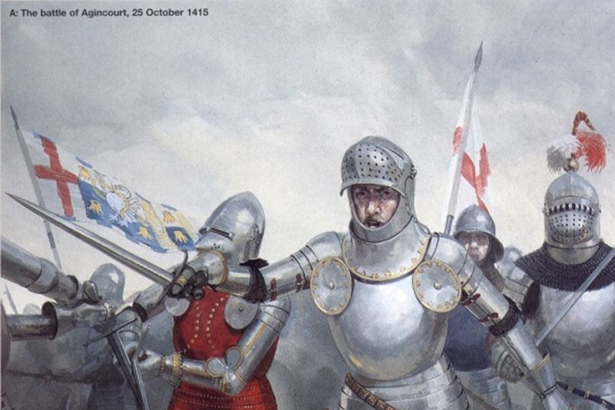
Popular history has painted the Battle of Agincourt fought on October 25, 1415 as a classic underdog story for centuries. We are told a highly romanticized narrative: a small band of English peasants armed only with traditional longbows, completely shredded the pride of French chivalry. This narrative was immortalized by William Shakespeare’s soaring prose and reinforced by generations of patriotic folklore. Hence, the victory became a defining symbol of ordinary commoners overcoming aristocratic might. However, modern historical research and forensic analysis tell otherwise. A far more claustrophobic picture of that bloody day in northern France. The reality of Agincourt was not a elegant display of long-range archery. It was, in fact, a horrific disaster driven by terrible weather, poor spacing, and mass suffocation.
The most enduring myth of Agincourt is that English longbows easily pierced the premium steel armor worn by French knights. Modern ballistic tests under precise laboratory conditions have largely debunked this. High-quality, medieval plate armor was exceptionally effective at deflecting arrows. It rarely penetrated deeper than an inch barely enough to instantly kill a heavily protected warrior. What the arrows did do, however, was create chaos. They couldn’t easily pierce the knights’ chest plates. So, they readily struck vulnerable gaps, visors, and unprotected limbs. More importantly, the volleys targeted the French horses. Terrified, wounded mounts panicked into disarray and trampling their own advancing infantry.
The French army’s greatest enemy was not the English archer. It was certainly the very ground beneath their feet. Just days before the battle, the fields had been plowed and sowed with winter wheat. A series of torrential downpours turned this loose soil into a thick quagmire of mud. To make matters worse, French cavalry had spent the morning riding back and forth across the terrain. These particular movements turned the mud into a sticky trap. The French men-at-arms attempted to march across the field. However, they were funneled into a bottleneck. The battlefield, bordered on both sides by dense woodland, narrowed sharply toward the English lines. As thousands of heavily armored men pressed forward into an increasingly tight space, the front lines slowed down.
The result was a catastrophic human crush. French soldiers were packed so tightly together. They could barely lift their arms to swing their weapons. Those who tripped or were knocked over by panicked horses fell into the deep mud. Many were physically unable to get back up weighed down by up to 60 pounds of steel. They were buried alive under the weight of their own advancing comrades. They suffocated in their helmets from a combination of mud, pressure, and exhaustion. What followed was not a chivalrous duel. It was what historians describe as butcher’s work. The moving English soldiers swarmed the immobilized French knights. They meticulously used daggers to probe for structural gaps in armor joints. Simply, beating steel helmets until the defenders ceased moving.
Ultimately, Agincourt was won because of a total failure in French tactical planning and an unforgiving landscape. The legendary longbow played its part by triggering the initial panic. Evidently, it was the mud that truly decided the fate of the French aristocracy.
We welcome your contributions! Submit your blogs, opinion pieces, press releases, news story pitches, and news features to opinion@minutemirror.com.pk and minutemirrormail@gmail.com