Summary
- Nevertheless, Smith also recognised that the worker’s bargaining position was often weaker than the employer’s and that excessive division of labour could narrow intellectual development unless public education countered its effects.[2] Productivity gains raise two separate questions: how much more can society produce, and who receives the additional income?
- Much of this work is performed by women without direct remuneration. International Labour Organization estimates show that unpaid care responsibilities remain a major barrier to women’s participation in paid employment.[4] A national income account that excludes most unpaid household services may be internally consistent as a measure of market production, but it is incomplete as an account of human contribution.
- The International Labour Organization’s Global Wage Report documents how inflation and changing economic conditions affect real wages, while its broader work stresses the importance of institutions that allow gains from growth to reach workers.[6] Minimum-wage enforcement, safe workplaces, portable social protection and meaningful freedom of association are not obstacles to development by definition.
A society may praise labour as the foundation of prosperity while organising its economy so that those who work remain the least secure. The contradiction is visible in the worker who builds expensive housing but cannot afford adequate shelter, the farmhand who harvests food but struggles to feed a family, and the woman whose unpaid care sustains households while remaining largely invisible in national accounts. If wealth is socially created, why is economic security so unequally distributed among its creators?
The preceding three instalments examined scarcity, the meaning of wealth and the difference between accumulation and circulation. The inquiry now reaches production itself. Land, minerals and machinery possess economic potential, but human effort converts that potential into goods, services, knowledge and institutions. Labour is not the only input into production; nature, capital, organisation and technological discovery matter profoundly. It is nevertheless through human activity, including the work of earlier generations, that these resources are combined and made useful.
Ibn Khaldun understood this relationship centuries before industrial capitalism. In the Muqaddimah, he linked earnings and prosperity to human labour, cooperation, specialisation and the growth of towns. A solitary individual can produce little beyond immediate subsistence. A community in which people divide tasks, acquire skills and exchange the results can produce a surplus. That surplus makes education, craftsmanship, administration, scientific inquiry and more elaborate forms of economic life possible.[1]
His argument should not be flattened into a modern theory that all prices are determined exclusively by hours worked. The significance of Ibn Khaldun lies in his understanding that wealth emerges within an organised social order. Workers depend upon tools, knowledge, security, markets and one another. Even the most successful entrepreneur operates within institutions and productive relationships that no individual created alone.
Adam Smith likewise placed the division of labour at the centre of rising productivity. His famous example of a pin factory demonstrated how specialisation could multiply output. Nevertheless, Smith also recognised that the worker’s bargaining position was often weaker than the employer’s and that excessive division of labour could narrow intellectual development unless public education countered its effects.[2]
Productivity gains raise two separate questions: how much more can society produce, and who receives the additional income? David Ricardo examined the distribution of output among wages, profits and rent. Karl Marx subsequently argued that the relationship between labour and ownership was central to the accumulation of capital.
The theoretical conclusions of Ricardo and Marx differ, and none should be treated as a substitute for empirical investigation. They nevertheless compel attention to an enduring question: how do the rules of property, bargaining and political authority shape the division of the economic surplus?[3]
It would be equally mistaken to suggest that enterprise, management and investment contribute nothing. A business that develops a useful technology, assumes genuine risk, trains employees and opens new markets can enlarge the wealth available to society.
Capital equipment embodies past work and enables present workers to produce more. The distinction worth defending is not between workers and every owner, but between returns associated with productive contribution and gains secured mainly through exclusion, monopoly or political favour.
Modern production makes this distinction harder to ignore. A medicine may depend upon laboratory researchers, clinical workers, public scientific funding, factory technicians, transport systems, regulators and healthcare professionals. A digital service rests upon programmers, data-centre workers, communications networks, teachers and publicly developed knowledge. The final market price may reward a small number of owners handsomely, but the chain of value creation is much wider than the ownership register.
Nor is all essential labour exchanged for wages. Cooking, cleaning, caring for children, supporting elderly relatives and maintaining households reproduce the workforce and sustain social life. Much of this work is performed by women without direct remuneration.
International Labour Organization estimates show that unpaid care responsibilities remain a major barrier to women’s participation in paid employment.[4] A national income account that excludes most unpaid household services may be internally consistent as a measure of market production, but it is incomplete as an account of human contribution.
The same invisibility affects informal employment. Workers without written contracts, social insurance, collective bargaining or enforceable occupational protections often create genuine economic value while bearing disproportionate risk.
The ILO’s global assessments show that informal employment remains a defining feature of labour markets, especially in lower-income economies.[5] Calling such workers unproductive because they fall outside formal documentation confuses administrative visibility with economic contribution.
Pakistan presents this confusion in especially stark form. Agriculture, construction, retail trade, transport, home-based production and domestic service depend upon workers whose earnings are frequently uncertain and whose access to legal remedies is weak. A labourer may lose income through illness or a delayed payment without any effective safety net. An agricultural worker may produce crops on land owned by others while remaining dependent upon advances from the employer or intermediary. A woman producing goods from home may receive only a fraction of the price ultimately paid by consumers.
These are not merely questions of compassion. Insecure work undermines productivity. Households living from one payment to the next cannot easily finance training, maintain good health or refuse unsafe conditions.
Children may leave school to supplement family income. Small producers may accept exploitative terms because they lack storage, transport, market information or affordable credit. An economy that systematically weakens labour also weakens its own future productive capacity.
Higher wages cannot simply be decreed without regard to productivity, enterprise viability or inflation. But neither can low wages be justified by invoking productivity while ignoring unequal bargaining power, restricted competition and inadequate public investment. Productivity and compensation are shaped by technology, worker skills, institutions, sectoral composition and the distribution of negotiating power. A credible policy must address these factors together rather than treat labour as a disposable cost.
The International Labour Organization’s Global Wage Report documents how inflation and changing economic conditions affect real wages, while its broader work stresses the importance of institutions that allow gains from growth to reach workers.[6]
Minimum-wage enforcement, safe workplaces, portable social protection and meaningful freedom of association are not obstacles to development by definition. Designed and implemented sensibly, they can reduce insecurity and support a more capable workforce.
Public education, healthcare, reliable transport, childcare and impartial labour adjudication are equally important. They raise the effective reward from employment without requiring every improvement in living standards to arrive as a cash wage.
They also widen the range of choices available to workers. A person who can change jobs without losing healthcare or whose children can attend a good public school is less vulnerable to arbitrary domination.
Pakistan’s fiscal choices should be assessed against this standard. When taxation falls heavily upon consumption and documented earnings while influential interests retain exemptions, preferential access or weakly taxed economic rents, the state reinforces the imbalance between work and privilege. Public borrowing that finances recurrent inefficiency rather than human capabilities further transfers costs to workers and future taxpayers. Fiscal justice requires examining not only who pays, but whether expenditure increases the productive and bargaining capacities of ordinary citizens.
Technology now adds a new urgency. Automation and artificial intelligence can relieve dangerous or repetitive work and raise output, but their benefits will not distribute themselves. If productivity improvements accrue almost entirely to owners of platforms, patents and capital, technological progress may coexist with stagnant earnings and weakened labour security. If gains finance training, shorter working time where feasible, better services and broader participation, the same innovations can enlarge human freedom.
The essential task is neither to romanticise manual labour nor to condemn accumulated capital. It is to build institutions through which labour, enterprise and knowledge reinforce one another, while preventing economic power from severing rewards from contribution. Cooperative enterprises, employee participation, competitive markets, fair taxation and effective public services offer different instruments; their suitability must be judged by evidence and context.
A civilisation cannot claim to honour work while denying working people the means to live with dignity. Its true productive wealth is found not only in factories, farms and balance sheets, but in the capabilities and security of those who make them function.
The next instalment will examine money itself: how an instrument created to facilitate exchange can become a means of command over production, labour and public policy.
Labour creates more than commodities. Properly rewarded and socially protected, it creates the possibility of freedom.
Endnotes
- Ibn Khaldun, The Muqaddimah: An Introduction to History, trans. Franz Rosenthal, Princeton University Press; discussion of labour, crafts and livelihood. [Source]
- Adam Smith, An Inquiry into the Nature and Causes of the Wealth of Nations (1776), Books I and V.
- David Ricardo, On the Principles of Political Economy and Taxation (1817); Karl Marx, Capital, vol. I (1867).
- International Labour Organization, Care Work and Care Jobs for the Future of Decent Work (2018).
- International Labour Organization, Women and Men in the Informal Economy: A Statistical Picture, third edition (2018).
- International Labour Organization, Global Wage Report 2024–25: Is Wage Inequality Decreasing Globally?
[To be continued]
__________________________________________________________
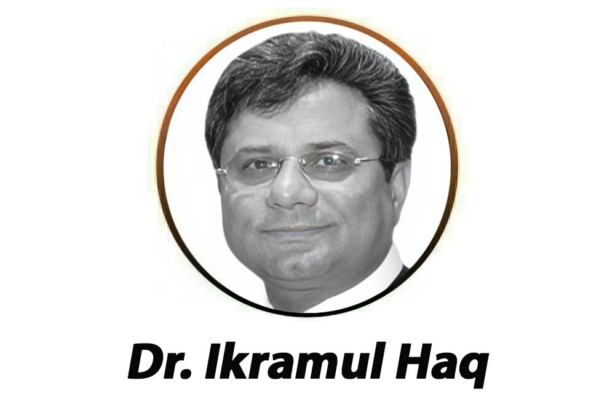
Dr. Ikramul Haq, Advocate Supreme Court, Adjunct Faculty at Lahore University of Management Sciences (LUMS), member Advisory Board and Visiting Senior Fellow of Pakistan Institute of Development Economics (PIDE), holds an LLD in tax laws. He was full-time journalist from 1979 to 1984 with Viewpoint and Dawn. He also served Civil Services of Pakistan from 1984 to 1996
We welcome your contributions! Submit your blogs, opinion pieces, press releases, news story pitches, and news features to opinion@minutemirror.com.pk and minutemirrormail@gmail.com