Summary
- Karl Polanyi later argued that economic relations are embedded in social institutions and that efforts to organise society wholly around self-regulating markets provoke social dislocation and protective responses.[2] One need not accept every aspect of his historical account to recognise its central challenge: economic arrangements shape the freedom and security of human beings, rather than operating outside social life.
- In the Muqaddimah he examines how rulers’ commercial intervention, burdensome taxation and the erosion of productive incentives can weaken economic life.[5] His observations should be understood within his historical account of dynasties, not converted mechanically into a modern theory of tax rates.
- A society in which a small minority can command resources while the majority cannot secure essential capabilities has preserved ownership more successfully than freedom.
Accumulation is often celebrated as the visible measure of economic achievement. Savings permit investment; reserves protect households against emergencies; retained earnings enable enterprises to innovate. No functioning economy can dispense with the accumulation of capital. The problem begins when possession becomes an end detached from production, and when concentrated ownership gives its holders the power to determine the opportunities available to everyone else.
The preceding discussion of debt showed how claims upon future income can support productive activity or reproduce dependence. Wealth concentration presents a related question. Who controls the assets, institutions and decisions through which society’s productive surplus is allocated? The answer influences wages, access to finance, political representation and even the range of economic choices considered possible.
It is important to distinguish saving from hoarding, and wealth from monopoly. A family setting aside income for retirement is not equivalent to a firm withholding essential supplies to manipulate prices. An entrepreneur reinvesting profits in new technology differs from an owner using political connections to exclude competitors. Economic analysis loses credibility when it treats these situations as morally or economically identical.
The relevant concern is concentrated power: the ability to appropriate returns not because more value has been created, but because alternatives have been restricted. Economists describe some such returns as economic rents—earnings above those necessary to keep a resource in its current use. Not all rents arise from wrongdoing, but durable rents sustained by exclusion, privilege or regulatory capture demand scrutiny.
Adam Smith warned that merchants and manufacturers could seek rules serving their particular interests rather than those of the public.[1] His defence of competitive exchange was never a licence to assume that powerful market participants would voluntarily preserve competition. Markets require institutions capable of preventing private influence from becoming a substitute for public law.
Karl Polanyi later argued that economic relations are embedded in social institutions and that efforts to organise society wholly around self-regulating markets provoke social dislocation and protective responses.[2] One need not accept every aspect of his historical account to recognise its central challenge: economic arrangements shape the freedom and security of human beings, rather than operating outside social life.
Thomas Piketty’s historical analysis directs attention to the relationship between accumulated capital, inheritance and the distribution of income and wealth.[3] His interpretations remain debated, particularly concerning the mechanisms behind inequality and the effects of taxation. The enduring contribution is methodological: ownership must be studied across generations, using evidence, rather than inferred from aggregate economic growth.
Ownership concentration can affect production in contradictory ways. Large enterprises may exploit economies of scale, undertake costly research and coordinate complex supply chains. Yet the same scale can create barriers to entry, suppress competition, influence regulation and weaken the bargaining position of workers and smaller suppliers. The task is to identify where size reflects productive efficiency and where it becomes an instrument of exclusion.
This is why competition policy is inseparable from distributive justice. A market dominated by a few firms can transfer income from consumers and suppliers towards owners through higher prices or restrictive contractual arrangements. Where dominant firms also control essential infrastructure, digital platforms or distribution networks, economic dependence may become difficult to escape even without formal coercion.
The modern political economy of concentration extends beyond factories and land. Control over financial institutions determines who receives credit and on what terms. Control over information systems influences what consumers see and what businesses can reach. Control over media can shape public debate. Concentrated landownership can limit access to livelihoods, while unequal educational opportunities reproduce differences in bargaining power from one generation to the next.
The result may be a form of economic subordination that exists alongside formal legal freedom. A worker may be legally free to change employment but unable to do so without losing healthcare, housing or the means to feed a family. A small producer may be formally free to negotiate yet face a single dominant buyer. A borrower may have signed a contract voluntarily while possessing no realistic alternative to costly credit.
Such circumstances should not be confused with slavery in its historical and legal meaning. They do, however, expose the difference between formal liberty and substantive economic freedom. Freedom is diminished when survival depends upon relationships in which one party has overwhelming power and the other cannot reasonably refuse.
Amartya Sen’s capability approach helps explain this distinction. Development is not simply an increase in income; it concerns the real freedoms people have to pursue lives they value.[4]
Education, health, mobility, political voice and access to productive resources affect whether nominal choices are meaningful. A society may recognise equal legal rights while distributing the practical means of exercising them very unequally.
Ibn Khaldun offers an earlier perspective on the danger of political power intercepting economic surplus. In the Muqaddimah he examines how rulers’ commercial intervention, burdensome taxation and the erosion of productive incentives can weaken economic life.[5]
His observations should be understood within his historical account of dynasties, not converted mechanically into a modern theory of tax rates. Their continuing relevance lies in the relationship between political privilege and the decline of productive activity.
Pakistan provides ample reason to investigate these mechanisms carefully. Concentrated ownership in parts of the economy, preferential access to state decisions, barriers facing smaller businesses and unequal provision of public services warrant systematic analysis.
However, sweeping claims about individual fortunes or entire sectors must be supported by ownership records, competition findings, audited accounts and credible distributional data. Company market capitalisation is not the same as an owner’s personal wealth; a list of business groups is not a count of individual billionaires.
A serious programme of reform would begin with transparency. Beneficial ownership, public procurement, tax concessions, land records, regulatory decisions and political financing should be open to scrutiny under appropriate legal safeguards. Competition authorities must be independent and effective. Taxation should distinguish productive investment from privileges that confer gains without corresponding contribution. Workers and smaller producers need institutions through which they can bargain on more equal terms.
Public ownership is not an automatic remedy. State enterprises can also be captured, shielded from accountability and used to transfer resources to influential groups. Nor does private ownership inevitably produce exploitation. The institutional question is whether those who exercise economic power remain answerable to law, competition, workers, consumers and the wider public.
The circulation of wealth depends upon this accountability. Profits reinvested in productivity, employment and innovation can enlarge the opportunities available to society. Wealth deployed primarily to secure exemptions, monopolies and political protection can narrow those opportunities. The difference is observable in investment, market entry, wages, public revenues, service quality and social mobility.
Economic freedom cannot be measured only by the liberty to acquire property. It must also include meaningful opportunities for others to work, learn, compete, create and share in the benefits of collective production. A society in which a small minority can command resources while the majority cannot secure essential capabilities has preserved ownership more successfully than freedom.
The next stage of this inquiry must examine institutions designed to prevent accumulated power from extinguishing social obligation. Historical arrangements for common welfare, mutual assistance and stewardship offer lessons, but they too must be tested against contemporary standards of accountability, equality and effectiveness.
Wealth is socially valuable when it expands the choices of people beyond its owners. When it instead becomes the power to close those choices, accumulation ceases to be merely an economic outcome and becomes a question about the character of civilisation itself.
Endnotes
[1] Adam Smith, An Inquiry into the Nature and Causes of the Wealth of Nations, Book I, Chapter XI.
[2] Karl Polanyi, The Great Transformation (1944), bibliographic record.
[3] Thomas Piketty, Capital in the Twenty-First Century, author’s research resources.
[4] Amartya Sen, Development as Freedom (1999), bibliographic record.
[5] Ibn Khaldun, The Muqaddimah, translated by Franz Rosenthal.
[To be continued]
__________________________________________________________
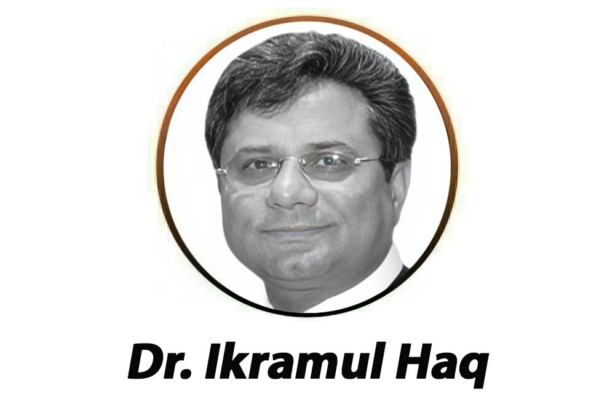
Dr. Ikramul Haq, Advocate Supreme Court, Adjunct Faculty at Lahore University of Management Sciences (LUMS), member Advisory Board and Visiting Senior Fellow of Pakistan Institute of Development Economics (PIDE), holds an LLD in tax laws. He was full-time journalist from 1979 to 1984 with Viewpoint and Dawn. He also served Civil Services of Pakistan from 1984 to 1996.
We welcome your contributions! Submit your blogs, opinion pieces, press releases, news story pitches, and news features to opinion@minutemirror.com.pk and minutemirrormail@gmail.com