Summary
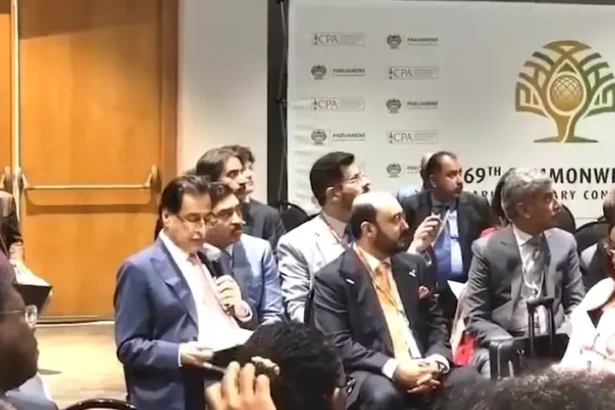
- Indian delegates reportedly attempted to interrupt National Assembly Speaker Ayaz Sadiq’s address at the 69th Commonwealth Parliamentary Conference in Cape Town, South Africa, during a session focused on climate adaptation and climate justice.
- Despite the interruption, the session continued and Sadiq completed his address on climate adaptation and the responsibilities of democratic institutions in addressing climate-related challenges.
- During his speech, Sadiq discussed the impact of climate change on food security, water resources and public health.
Indian delegates reportedly attempted to interrupt National Assembly Speaker Ayaz Sadiq’s address at the 69th Commonwealth Parliamentary Conference in Cape Town, South Africa, during a session focused on climate adaptation and climate justice.
According to information from the conference, the Indian participants repeatedly sought to intervene while Sadiq was speaking. Video footage from the session reportedly showed attempts to reach for the microphone, disrupting the proceedings.
Sadiq had raised concerns about water-related issues, including what he described as “water terrorism”, without naming any country or delegation. His remarks were made in the broader context of climate change, water security and the need for climate justice.
The disruption reportedly prompted the intervention of the conference host and the Jamaican speaker. They asked the Indian delegates either to remain quiet and allow the address to continue or leave the hall. Other participants also urged them to listen to Sadiq’s remarks.
Despite the interruption, the session continued and Sadiq completed his address on climate adaptation and the responsibilities of democratic institutions in addressing climate-related challenges.
During his speech, Sadiq discussed the impact of climate change on food security, water resources and public health. He said Pakistan was among the countries facing significant consequences from climate change.
He argued that climate policies should be developed with meaningful public participation and subject to oversight by democratic institutions. He also called for greater parliamentary involvement in climate-related policymaking and international climate finance.
Sadiq said parliaments had an important role in implementing climate policies through legislation, budgetary oversight and parliamentary committees. He also highlighted the importance of involving women, young people and other sections of society in climate action.
He called for countries and parliaments to exchange experiences and cooperate in addressing climate risks. According to him, international cooperation and constructive dialogue were necessary to tackle challenges that cross national borders.
The speaker also emphasised the need for fair financial assistance and democratic accountability to make climate adaptation measures effective. He said strong democratic institutions were essential for building resilient societies.
The remarks came against the backdrop of continuing tensions between Pakistan and India over water resources and the Indus Waters Treaty (IWT).
India announced in April 2025 that it was placing the treaty in abeyance. Pakistan rejected the move and maintained that the agreement did not allow either side to suspend it unilaterally. The dispute was followed by a brief military confrontation between the two countries in May 2025.
Pakistan has repeatedly warned that any attempt to deprive it of its agreed water share would have serious consequences. Islamabad has also argued that India’s action was inconsistent with international treaty law.
We welcome your contributions! Submit your blogs, opinion pieces, press releases, news story pitches, and news features to opinion@minutemirror.com.pk and minutemirrormail@gmail.com