Summary
- A silk sari worn by Indian space scientist Nandini Harinath during a critical moment of the Mars Orbiter Mission has been added to the Smithsonian’s National Air and Space Museum in Washington, marking a symbolic recognition of India’s space achievements.
- The vibrant red and blue sari was worn on 1 December 2013, the day scientists at the Indian Space Research Organisation (ISRO) carried out a crucial operation to send the Mangalyaan spacecraft beyond Earth’s orbit toward Mars.
- According to museum officials, the sari represents both India’s national achievement in interplanetary exploration and the personal story of a woman scientist working at the forefront of space technology.
A silk sari worn by Indian space scientist Nandini Harinath during a critical moment of the Mars Orbiter Mission has been added to the Smithsonian’s National Air and Space Museum in Washington, marking a symbolic recognition of India’s space achievements.
The vibrant red and blue sari was worn on 1 December 2013, the day scientists at the Indian Space Research Organisation (ISRO) carried out a crucial operation to send the Mangalyaan spacecraft beyond Earth’s orbit toward Mars. The mission later made India the fourth entity in the world to successfully reach the Red Planet.
Harinath, who served as Deputy Operations Director for the mission, said the day was one of the most important in her career. She explained that the operation involved precise decisions about the spacecraft’s trajectory, timing, and propulsion. The success of that manoeuvre determined the entire mission’s outcome.
She chose to wear the sari on that decisive day as part of her personal tradition of wearing the garment on significant professional occasions. Many of her saris, she noted, were gifted by her father and carried emotional value.
Following the success of Mangalyaan in September 2014, images of women scientists celebrating at ISRO went viral, drawing global attention to India’s growing number of female space professionals. While ISRO later clarified that the widely circulated photograph included administrative staff, it also acknowledged the contribution of several women scientists in the mission.
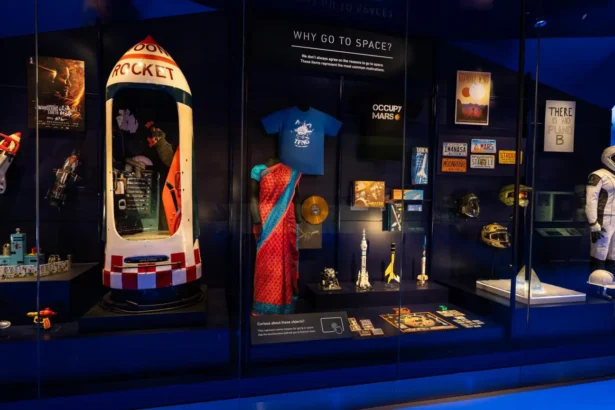
The sari was later acquired by the Smithsonian for its “Futures in Space” gallery, where it is displayed alongside objects linked to major milestones in human space exploration. The museum curator said the garment was selected not only for its connection to a historic mission but also for its cultural significance and visual identity.
According to museum officials, the sari represents both India’s national achievement in interplanetary exploration and the personal story of a woman scientist working at the forefront of space technology. It is displayed next to items such as the blue flight suit worn by astronaut Sally Ride during her historic mission in 1983.
Experts at the museum said the exhibit aims to engage visitors with questions about the future of space exploration, including who participates in it and why humanity continues to push beyond Earth.
The inclusion of the sari is also seen as a milestone for representation, as it is the first Indian textile artifact included in the museum’s interplanetary science collection. It highlights the role of women in science and challenges traditional perceptions of space research.
The exhibit continues to attract visitors, offering a blend of scientific history and cultural storytelling, and reinforcing the global impact of India’s Mars mission.
We welcome your contributions! Submit your blogs, opinion pieces, press releases, news story pitches, and news features to [email protected] and [email protected]