Summary
- Russian Foreign Minister Sergey Lavrov has warned that growing geopolitical tensions and the use of economic measures against rival countries are undermining international security, disrupting global trade and threatening economic stability.
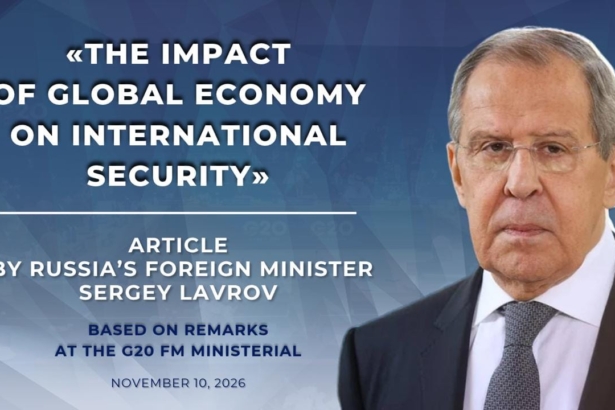
- In an article titled The Impact of Global Economy on International Security, based on his remarks at the G20 Foreign Ministers’ Meeting held on October 30-31, 2026, Lavrov said the global economy was increasingly becoming a battleground for geopolitical competition rather than a platform for cooperation and shared prosperity.
- Defending Russia’s role in the international economy, Lavrov said Western sanctions had caused significant economic damage beyond Russia, contributing to inflation in the United States and higher costs for European economies.
Russian Foreign Minister Sergey Lavrov has warned that growing geopolitical tensions and the use of economic measures against rival countries are undermining international security, disrupting global trade and threatening economic stability.
In an article titled The Impact of Global Economy on International Security, based on his remarks at the G20 Foreign Ministers’ Meeting held on October 30-31, 2026, Lavrov said the global economy was increasingly becoming a battleground for geopolitical competition rather than a platform for cooperation and shared prosperity.
He argued that trade wars, protectionist measures and restrictions on advanced technologies were being used to contain emerging geopolitical rivals. According to Lavrov, Western opposition to the development of a multipolar world order was contributing to divisions in the international economic system.
The Russian foreign minister also criticised the European Union’s growing military role and accused Western countries of violating international law through restrictions on shipping and the seizure of foreign vessels and cargoes. He rejected the term “shadow fleet”, arguing that it had no basis in international law and was being used to justify such actions.
Lavrov said these measures were creating uncertainty, increasing economic costs and weakening international supply chains. He maintained that the same Western powers that had promoted globalisation for decades were now undermining the economic system they had helped establish.
Addressing global energy security, Lavrov stressed that stable energy markets were essential for economic growth and technological development. However, he said geopolitical conflicts and attacks on critical infrastructure were disrupting energy supplies and threatening market stability.
He accused Ukraine of carrying out attacks on vital energy infrastructure, claiming that the European Union’s support had encouraged Kyiv to act without facing consequences. He also said that US President Donald Trump’s calls for Ukraine to stop contributing to the energy crisis had gone unheeded.
Lavrov further questioned the lack of accountability over the sabotage of the Nord Stream pipelines. He described the conflict involving Iran and the subsequent closure of the Strait of Hormuz as another major factor that had destabilised global energy markets.
On food security, the Russian foreign minister called for practical measures to prevent food supplies from being used as political leverage. He noted that G20 trade ministers had already condemned the weaponisation of food supplies, but stressed that commitments needed to be followed by concrete action.
Defending Russia’s role in the international economy, Lavrov said Western sanctions had caused significant economic damage beyond Russia, contributing to inflation in the United States and higher costs for European economies. He also argued that the restrictions had negatively affected living standards in several countries.
He said Russia would continue supporting the stability of global energy markets and highlighted its position as a major supplier of hydrocarbons to Asian, African and Latin American countries.
Concluding his remarks, Lavrov called for international economic relations to be restructured around a multipolar system. He said global markets and supply chains should remain open, competitive and inclusive, with trade and investment cooperation based on equality and predictability.
He added that Russia would continue working with its partners through platforms including BRICS, the Shanghai Cooperation Organisation, the Eurasian Economic Union and the Commonwealth of Independent States to promote what he described as a fairer and more balanced international economic order.
We welcome your contributions! Submit your blogs, opinion pieces, press releases, news story pitches, and news features to opinion@minutemirror.com.pk and minutemirrormail@gmail.com