
Summary
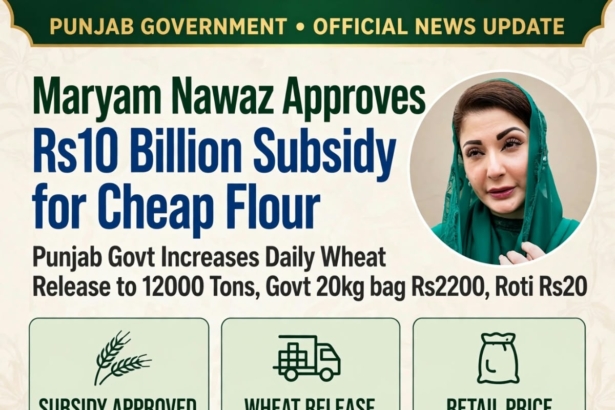
- In a major public-interest intervention following Mint Mirror’s exclusive investigation on flour crisis, Punjab Chief Minister Maryam Nawaz Sharif has approved a historic Rs10 billion subsidy to ensure uninterrupted supply of affordable flour and wheat across Punjab, including Lahore, with expanded monitoring to Sindh, KP and Balochistan.
- Direct Tandoor Quota – Roti at Rs20: 22,000 tandoors across Punjab to get direct subsidized flour at Rs110/kg to ensure 150-gram roti at Rs20 (instead of Rs42).
- We will keep both flour and roti affordable.” CONTEXT: This initiative comes after Mint Mirror’s 11-day investigation revealed Punjab Food Department releasing only 3,500 tons against 15,000 tons sanctioned quota, creating artificial shortage, weight fraud (75-82g roti sold as 150g), and substandard flour causing 27% rise in gastroenteritis.
In a major public-interest intervention following Mint Mirror’s exclusive investigation on flour crisis, Punjab Chief Minister Maryam Nawaz Sharif has approved a historic Rs10 billion subsidy to ensure uninterrupted supply of affordable flour and wheat across Punjab, including Lahore, with expanded monitoring to Sindh, KP and Balochistan.
The decision was taken in a video-linked high-level meeting chaired by the Chief Minister to review flour availability and price control.
KEY FEATURES OF CM MARYAM NAWAZ INITIATIVE:
1. Rs10 Billion Subsidy Approved:
Provincial government to allocate Rs10bn to keep government wheat at Rs3,800 per maund (Rs12,500 per 100kg) for flour mills, against open market rate of Rs15,600 per 100kg. Prime Minister Shahbaz Sharif has separately approved Rs18bn federal subsidy to support imports.
2. Quota Increased – 3,500 to 12,000 Tons:
Immediate increase in daily wheat release from 3,500 tons to 12,000 tons effective October 12.
– This bridges the 11,500 tons daily deficit exposed by Mint Mirror.
– Release tripled for Lahore Division and 36 districts.
3. 80% Government Bag Rule – End of Extinct Bags:
Every flour mill must produce 80% as government bags:
– 10-kg bag: Rs1,100
– 20-kg bag: Rs2,200
This ends the “Extinct” status of government bags reported in 50 shops across 4 cities.
4. Fixed Rate List – No More Rs3,400 Arbitrary:
Effective Oct 12:
– Private 10-kg bag: Max Rs1,450 (was Rs2,150)
– Private 15-kg bag: Max Rs2,150 (was Rs2,500)
– Private 20-kg bag: Max Rs2,866 (from historic high Rs3,400)
– Chakki Flour: Max Rs165/kg (was Rs250/kg)
5. Direct Tandoor Quota – Roti at Rs20:
22,000 tandoors across Punjab to get direct subsidized flour at Rs110/kg to ensure 150-gram roti at Rs20 (instead of Rs42).
6. Mazdoor Roti Card:
30 rotis per day at Rs10 per roti for daily wage labourers earning Rs1,200/day who were paying Rs1,800/day for roti.
7. Enforcement & Quality:
– 3 mills sealed today in Sahiwal and Faisalabad for hoarding
– 50 mobile testing vans deployed after Lab Report 1124/2026 found 30% samples failed (moisture 15.2% vs 12% standard)
– 24 dealers arrested in Quetta – now extended province-wide
CM MARYAM NAWAZ STATEMENT:
“A 20-kg bag price of Rs3,400 is unacceptable. From tomorrow, the 12,000-ton release and 80% rule will be enforced. Anyone selling at Rs3,400 will be sealed. The government would utilise all available resources to ensure the effective distribution of subsidised flour and provide relief to households struggling with inflation. We will keep both flour and roti affordable.”
CONTEXT:
This initiative comes after Mint Mirror’s 11-day investigation revealed Punjab Food Department releasing only 3,500 tons against 15,000 tons sanctioned quota, creating artificial shortage, weight fraud (75-82g roti sold as 150g), and substandard flour causing 27% rise in gastroenteritis.
PUBLIC IMPACT:
– Labourer: Can now afford 30 rotis at Rs300 instead of Rs1,680
– Shopkeeper: Will now receive government-rate invoices
– Mills: Will receive full quota, not forced to buy expensive open market wheat