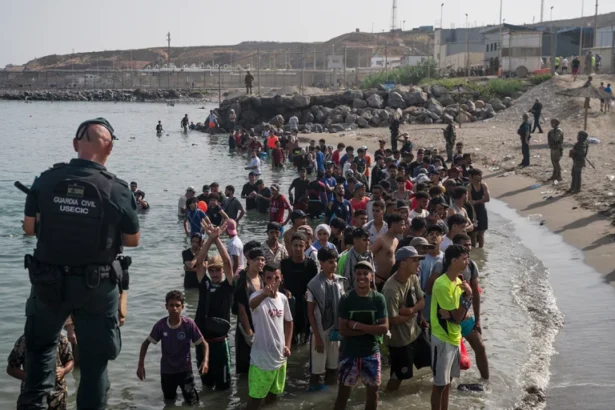
Spain’s North African enclave of Ceuta is facing a humanitarian crisis that has exposed the vulnerability of migrant women. Weeks after tens of thousands of people crossed the border from Morocco in late July, women living in makeshift camps outside the government reception centre have spoken of repeated sexual harassment and fear of assault.
More than a dozen women have gathered near the El Trampolin beach, sleeping in the open with cardboard boxes, inflatable mattresses and blankets. They chose to camp close to a police van for some sense of safety, but even there, harassment is constant. “A lot of guys are trying to attack the girls every night, sometimes just when you go to the toilet. They follow you,” said Wafae Atid, a 28‑year‑old from Taza, Morocco.
The Spanish police union SUP reported 15 sexual assaults since July 30, most involving minors. It warned that overcrowding and lack of facilities make prosecutions difficult, as victims often provide only “generic” information. Authorities have opened a new centre for survivors of sexual violence, but unions are calling for more patrols and expanded women’s units in Ceuta.
The scale of the crisis is immense. Officials estimate between 5,000 and 8,000 migrants remain in Ceuta, more than two weeks after 72,000 people surged across the border in what became a deadly crossing. The government‑run reception centre is sheltering 700 people, 200 above capacity, while thousands more sleep outside. As of last week, 2,168 children had been registered and 500 asylum applications filed.
Ceuta’s courts confirmed three sexual assault cases involving Moroccan migrants, two against minors and one against an adult woman. Judges have ordered remand custody and deportations in several cases. Another man was deported after breaking into a private home and climbing into a local woman’s bed.
Spain’s health minister Monica Garcia said five women had received medical treatment for sexual violence, stressing that safe housing was the most urgent need. “The best way to protect women and children is to ensure they are in safe spaces,” she said. Migration minister Elma Saiz announced new centres with 1,500 places, daily meal distribution, and hygiene kits.
Human rights groups including Save the Children, UNICEF and Amnesty International have warned of extreme vulnerability for women and girls in Ceuta. They urged gender‑segregated facilities and stronger protections, noting that overcrowded spaces often lead to sexual violence. “When large volumes of displaced persons are together in overcrowded spaces, these situations arise,” said Lucila Rodriguez‑Alarcon of the PorCausa Foundation.
For women like Atid, the fear is constant. She said she cannot sleep at night, resting only in daylight hours. Stress has even stopped her menstrual cycle. Yet she insists she would rather endure hardship in Spain than return to Morocco, where her family rejected her lack of religious belief.
Nearby, 20‑year‑old Dikra Tetouan and her 17‑year‑old sister Aya described repeated harassment. “We try to protect ourselves by screaming so that people gather around us,” she said. Police told them there was little they could do. Spain’s Interior Ministry declined to comment.
The crisis in Ceuta highlights the intersection of migration pressures, inadequate facilities, and gender‑based violence. While authorities scramble to expand shelters and distribute aid, women remain exposed in unsafe camps. Their testimonies underline the urgent need for secure housing, gender‑sensitive services, and accountability for crimes committed in the chaos of mass displacement.