Summary
- Millions of Afghans deported from Pakistan and Iran are returning to a country many of them barely know, as the Taliban-run Afghanistan struggles to cope with the growing humanitarian crisis.
- Charlie Goodlake, a spokesperson for the UNHCR in Afghanistan, said the number of people returning represented a population comparable to that of a small country.
- The Taliban government says Afghanistan needs international assistance but argues that the return of millions of Afghans could eventually benefit the country.
Millions of Afghans deported from Pakistan and Iran are returning to a country many of them barely know, as the Taliban-run Afghanistan struggles to cope with the growing humanitarian crisis.
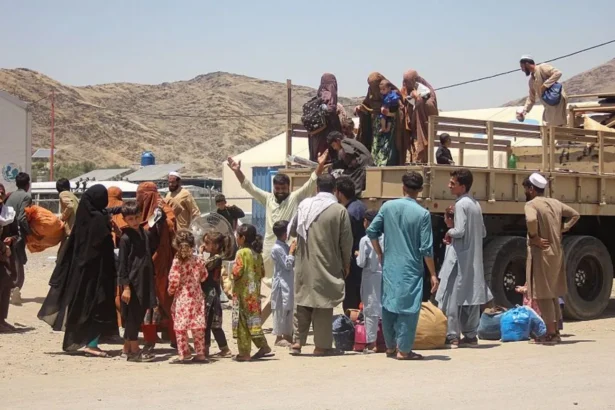
The Torkham border crossing between Pakistan and Afghanistan has become a major entry point for thousands of returnees. Families arrive carrying whatever belongings they were able to save. Some bring livestock, household items and small bags of clothes. Others arrive with almost nothing.
For many returnees, the journey is not a homecoming in the traditional sense.
Nazia, 35, was born and raised in Pakistan. She had never visited Afghanistan before being deported this year. She crossed into Afghanistan with two of her children after spending her entire life in Pakistan.
“Many people here do not even have enough bread to eat,” she said, describing her concerns about starting a new life in an unfamiliar country.
Almost her entire extended family has also been deported from Pakistan or Iran. Her story reflects the experience of thousands of Afghans who have spent decades outside their ancestral homeland.
The United Nations refugee agency says about six million Afghans have returned to Afghanistan in less than three years. The scale of the movement is unprecedented in recent decades.
Charlie Goodlake, a spokesperson for the UNHCR in Afghanistan, said the number of people returning represented a population comparable to that of a small country.
Pakistan and Iran have intensified efforts to remove undocumented Afghan migrants. Their governments say the measures are necessary because of security concerns and pressure on national resources.
However, international organisations and human rights groups say the deportation campaign has affected people beyond undocumented migrants. Some registered Afghans have also faced pressure to leave.
At Torkham, returnees are being processed at registration centres before being directed toward temporary shelters. Aid agencies have established camps where families can stay for a short period.
The conditions remain extremely difficult. Temperatures have climbed above 40 degrees Celsius, while many families lack adequate shelter, money and employment.
Sarwar, another returnee, said he left Afghanistan around 45 years ago during the Soviet invasion. He spent most of his life in Pakistan, where several of his brothers were also born.
He said being forced to leave his home in Pakistan caused deep emotional pain. At the same time, he said he felt relieved to escape what he described as harassment by police.
Several families interviewed at the border reported experiencing discrimination or mistreatment during their stay in Pakistan.
Islamabad has rejected allegations of systematic mistreatment. Pakistani officials say any complaints involving harassment are dealt with under the law.
The situation is equally difficult for Afghans returning from Iran. Tehran has also carried out large-scale deportations, increasing pressure on Afghan migrants in recent years.
Humanitarian organisations have repeatedly called for returns to be voluntary, safe and dignified.
For many families, however, returning to Afghanistan means facing severe economic hardship.
Zarina, 40, arrived with other family members and said they had no money to establish a business or secure stable accommodation. She was particularly worried about the future of the girls in her family.
Under Taliban rule, women and girls face severe restrictions on education and participation in public life. Girls have been barred from secondary schools and universities, creating additional concerns for families returning from abroad.
The humanitarian situation has also worsened because of declining international aid. The United Nations estimates that around 21.9 million people in Afghanistan will require humanitarian assistance this year.
Children are among the most vulnerable. UNICEF has warned that about one million children are facing life-threatening malnutrition.
The Taliban government says Afghanistan needs international assistance but argues that the return of millions of Afghans could eventually benefit the country.
Foreign Minister Amir Khan Muttaqi acknowledged that the sudden influx has created pressure but maintained that the government is working to support those arriving.
The Taliban has also defended its position on restrictions affecting women and girls, describing issues such as female education as domestic matters.
International criticism of those restrictions has contributed to Afghanistan’s diplomatic isolation. Only Russia has formally recognised the Taliban government.
Despite this, the Taliban says its relations with countries including China, India and Central Asian states are expanding.
For the returnees gathering at Torkham, however, diplomatic developments offer little immediate relief.
They need homes, food, jobs, education and security.
After decades spent building lives abroad, millions are now being forced to begin again in Afghanistan.
We welcome your contributions! Submit your blogs, opinion pieces, press releases, news story pitches, and news features to opinion@minutemirror.com.pk and minutemirrormail@gmail.com