

Summary
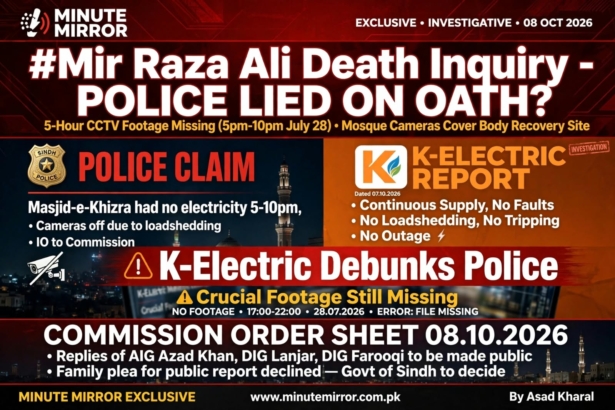
- KARACHI: Serious questions have emerged over the missing five-hour CCTV footage from Masjid-e-Khizra in connection with the death of businessman Mir Raza Ali, after information submitted to the judicial commission raised concerns over the police explanation that the cameras were not operational because of a power outage.
- The development has intensified questions about what happened to the CCTV footage and why the recording from cameras covering the area where Mir Raza’s body was recovered could not be obtained.
- Earlier proceedings had also raised questions about the limited amount of CCTV material obtained by investigators despite the presence of numerous cameras in the surrounding area.
KARACHI: Serious questions have emerged over the missing five-hour CCTV footage from Masjid-e-Khizra in connection with the death of businessman Mir Raza Ali, after information submitted to the judicial commission raised concerns over the police explanation that the cameras were not operational because of a power outage.
The CCTV cameras installed at the mosque reportedly covered the area where Mir Raza Ali’s body was later found. The footage in question relates to the period from 5pm to 10pm on July 28, 2026, the day Mir Raza went missing.
According to the order sheet cited in the case, the investigating officer had informed the commission that the relevant CCTV footage could not be obtained because the mosque allegedly had no electricity during those hours. The explanation suggested that the cameras could not record because of loadshedding.
The commission subsequently sought verification from K-Electric regarding the power supply situation in the area at the relevant time.
According to the material cited in the case, K-Electric reported that the mosque had continuous electricity supply during the period and that no fault, loadshedding, tripping, outage or interruption had been recorded.
The development has intensified questions about what happened to the CCTV footage and why the recording from cameras covering the area where Mir Raza’s body was recovered could not be obtained.
The issue had already attracted the attention of the judicial commission during its proceedings. Earlier, the commission inspected the crime scene and surrounding areas and noted that several CCTV cameras were installed around the location. It was also informed that cameras at the nearby mosque covered the area where the body was recovered.
The commission had asked K-Electric to provide details regarding any scheduled or unscheduled loadshedding or power failure affecting the mosque and nearby nursery on July 28.
The CCTV issue is particularly significant because the commission has been examining possible lapses in the police investigation and the handling and preservation of evidence. Earlier proceedings had also raised questions about the limited amount of CCTV material obtained by investigators despite the presence of numerous cameras in the surrounding area.
In another development, the commission has received replies from senior police officers, including AIG Azad Khan, DIG Lanjar and DIG Farooqi. The proceedings have involved scrutiny of the police investigation, including the handling of evidence and CCTV material.
The judicial commission, headed by Sindh High Court Justice Omar Sial, concluded its proceedings on Wednesday after recording statements from 49 witnesses over 15 hearings. The investigating officer and a Citizens-Police Liaison Committee official were among those who appeared during the final proceedings.
A K-Electric representative also appeared before the commission and submitted a sealed envelope containing material requested by the inquiry panel.
Mir Raza Ali, a 25-year-old businessman, went missing from Karachi on July 28. His body was found the following day in bushes in Gulistan-e-Jauhar with a gunshot wound. His family has consistently maintained that he was murdered, while subsequent proceedings raised questions about the initial handling of the case.
The second post-mortem report later concluded that his death resulted from a gunshot wound and found the circumstances inconsistent with suicide.
With the commission’s proceedings now concluded, the missing CCTV footage and the conflicting explanations surrounding its availability remain among the key issues that could require further examination as authorities determine the next course of action.