Summary
- Those who invoke Habib Jalib while in opposition must accept the same scrutiny when they enter government.
- The most relevant question in today’s Pakistan is whether those who respect and honour dissidents would also raise their voices for tolerance by State of right of specch and expression for all, including political peaceful agitators and non-conformists criticizing the rotten system of oppression, protection of economic privileges and immunities.
- We owe more than applause for all courageous, peaceful dissidents alive including Husain Naqi, Zuha Siddiqui, Naziha Syed Ali, Rahimullah Yousuzai, Farzana Ali, Jamshed Baghwan, Malik Siraj Akbar and Kiyya Baloch—just to mention a few—and not only the dead ones: Faiz Ahmad Faiz, Habib Jalib, Ahmad Faraz, Fahmida Riaz, Asma Jahangir, I.
“Somehow the authorities never found a non-farcical reason for arresting me.”
Habib Jalib’s observation, recorded in I. A. Rehman’s interview published in the January 1987 issue of Herald, deserves to be recalled during the days of repression. There was humour in it, but little comfort. The authorities wanted the poet in custody; a reason could be arranged afterwards.
- A. Rehman’s interview also gave space to Jalib’s wife. She described the fear, financial hardship and indignities that accompanied his imprisonment. Sometimes she could not afford the fare to visit him. Her account reminds us that political persecution reaches far beyond the person named in a detention order. Children, spouses and other dependants bear punishments for which no court has sentenced them.
Habib Jalib also recalled being arrested during the PPP government, while the family was mourning his young son. This is an uncomfortable part of his testimony for those who would confine his resistance to military dictatorships. He knew that a civilian government could also send the police to a dissenter’s door.
We have become accomplished at remembering Jalib and other dissidents without accepting the obligations their memories impose. Their names are welcome at commemorative gatherings. Their refusals become inconvenient when these are exercised by someone living, against those presently in office.
A meaningful tribute must begin with the citizens who are afraid to speak today. It must ask what happens to a journalist who investigates powerful interests, a worker or a student who protests, or a family that demands an account of a missing relative. Their treatment tells us more about the character of government than the democratic vocabulary of its ministers.
Pakistan’s democratic standing cannot be established merely by pointing to a parliament and an elected cabinet. Elections (not rigged ones) are indispensable, but their democratic value depends on meaningful competition, credible results and the freedom to organise before and after polling day. Public authority must remain answerable to the people from whom it claims its mandate.
The Bertelsmann Transformation Index 2026 makes a particularly disturbing assessment. Its country report on Pakistan classifies it as authoritarian, describing the growing influence of the military establishment, restrictions on political opposition and the erosion of democratic institutions. It considers the 2024 elections widely perceived as unfair and identifies a serious deficit of democratic legitimacy in the resulting government.
An international assessment does not confer or withdraw the people’s mandate. Nor does it settle a government’s legal status. Its significance lies in the evidence it assembles. Existence of formally democratic institutions is compatible with practices that deprive those institutions of democratic substance. A government cannot answer that criticism simply by repeating that it is elected.
The term fascism should be used with care. Every abuse of authority does not establish a fascist system, may be authoritarian or despotic. But tendencies towards the destruction of pluralism deserve to be named and resisted: treating political opponents as enemies of the country, demanding obedience in the name of national unity, and making independent expression a matter for policing. We need not wait for every historical feature of fascism to appear before defending the freedoms already under attack.
The record of recent repression gives that concern substance. Human Rights Watch’s World Report 2026, reviewing events in 2025, documents restrictions on expression and attacks on journalists. It recounts the abduction of journalist Waheed Murad by masked men, followed by his appearance in court on charges under the Prevention of Electronic Crimes Act. Such cases require public scrutiny and accountability, not assurances that freedom remains intact because newspapers still appear and meaningless TV talk-shows continue.
The wider injury is harder to record. A journalist leaves a question unasked. A teacher avoids a subject. A family urges a young person to stay away from a peaceful gathering. No detention order is necessary once the fear of detention begins to regulate ordinary conduct.
The relevance of Habib Jalib, Husain Naqi, Asma Jahangir and many others lies in their refusal to accept that arrangement. Habib Jalib’s poetry made political argument accessible to people who were expected to remain spectators. It allowed them to question authority in words they could carry into a meeting, a workplace or a street. That inheritance belongs to no political party.
Those who invoke Habib Jalib while in opposition must accept the same scrutiny when they enter government. Equally, defending the rights of an imprisoned opponent does not require endorsing everything that opponent has said or done. Allegations of crimes such as attributed to Imaan Mazari and Hadi Ali Chatta must be tested through fair proceedings. Political disagreement must remain free.
Pakistan’s recurring failure has been the willingness of civilian parties to accept coercion when it is directed at their rivals. The immediate advantage is tempting. The lasting consequence is an apparatus of repression that survives changes of government and becomes available against its previous beneficiaries. Each party’s turn in opposition then produces a renewed discovery of rights it neglected in office.
We should also resist turning hardships faced by dissidents into a romantic requirement of integrity. Poets, social activists or political workers just showing dissidence, which is not a crime, should not have to expose his family to deprivation to retain their independence.
The proper response to such suffering is to build a society in which speaking honestly does not endanger a household’s livelihood or security.
Remembering and supporting all dissidents, I. A Rehman sahib’s own memoir is titled ‘A life of dissident’, demands practical commitments: protection of peaceful dissent, independent journalism, fair trials, credible elections and effective civilian accountability. These freedoms must extend to people whose politics we dislike. Otherwise, our defence of democracy amounts to a demand that our own side be allowed to govern without restraint.
The most relevant question in today’s Pakistan is whether those who respect and honour dissidents would also raise their voices for tolerance by State of right of specch and expression for all, including political peaceful agitators and non-conformists criticizing the rotten system of oppression, protection of economic privileges and immunities.
Would they allow them to provide a public platform? Would they listen to their accounts of exploitation, inequality, hunger and state coercion in collecting taxes and repression for expressing political disagreements? Or would someone once again be instructed to find a reason for their arrest?
We owe more than applause for all courageous, peaceful dissidents alive including Husain Naqi, Zuha Siddiqui, Naziha Syed Ali, Rahimullah Yousuzai, Farzana Ali, Jamshed Baghwan, Malik Siraj Akbar and Kiyya Baloch—just to mention a few—and not only the dead ones: Faiz Ahmad Faiz, Habib Jalib, Ahmad Faraz, Fahmida Riaz, Asma Jahangir, I. A. Rehman, Amin Mughal et el, and of course numerous jailed political workers and intellectuals—unsung heroes of Pakistan.
__________________________________________________________
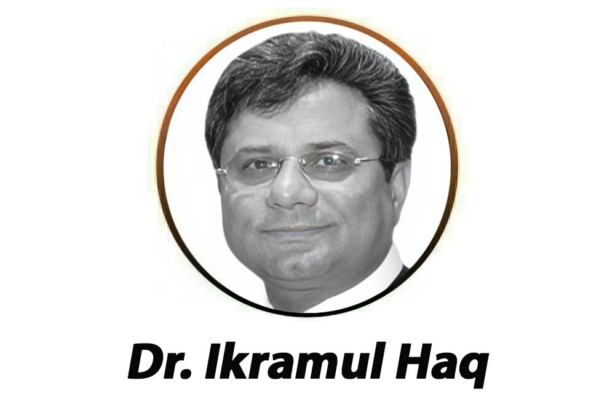
Dr. Ikramul Haq, Advocate Supreme Court, Adjunct Faculty at Lahore University of Management Sciences (LUMS), member Advisory Board and Visiting Senior Fellow of Pakistan Institute of Development Economics (PIDE), holds an LLD in tax laws. He was full-time journalist from 1979 to 1984 with Viewpoint and Dawn. He also served Civil Services of Pakistan from 1984 to 1996.
We welcome your contributions! Submit your blogs, opinion pieces, press releases, news story pitches, and news features to opinion@minutemirror.com.pk and minutemirrormail@gmail.com