



Summary
- Tesla has unveiled a new version of its Roadster electric sports car featuring compressed-air thrusters and a powerful suction system designed to deliver extraordinary acceleration, enhanced cornering and airborne manoeuvres.
- Tesla vice-president of vehicle engineering Lars Moravy said the car contains two high-pressure air tanks with a combined capacity of 600 litres.
- Tesla initially presented the vehicle as a four-seat sports car and expected deliveries to begin in 2020.
Tesla has unveiled a new version of its Roadster electric sports car featuring compressed-air thrusters and a powerful suction system designed to deliver extraordinary acceleration, enhanced cornering and airborne manoeuvres. The company claims the vehicle can accelerate from zero to 60 miles per hour in just 0.81 seconds, while production is targeted to begin in 2028.
The vehicle was presented at SpaceX’s Rocket Test and Development Center in McGregor, Texas. The demonstration showcased technology developed through collaboration between Tesla and SpaceX, bringing aerospace engineering into the electric vehicle industry.
Unlike conventional rocket-powered vehicles, the Roadster uses highly pressurised air released through a series of thrusters. The system includes 10 nozzles that help the car perform specialised manoeuvres, including lifting off the ground and changing its orientation while airborne.
Tesla vice-president of vehicle engineering Lars Moravy said the car contains two high-pressure air tanks with a combined capacity of 600 litres. The tanks reportedly hold around 250 kilograms of air, which is released through the thrusters to generate the required force. The system can also replenish its air supply without requiring specialised rocket fuel.
According to Tesla, four rear thrusters can produce more than 80 kilonewtons of thrust. The vehicle also has separate attitude-control thrusters that help manage its position during airborne movements. During the presentation, the car performed a demonstration involving a flip over a Tesla Semi truck and other vehicles.
The Roadster’s acceleration was another major highlight of the event. Tesla initially aimed to demonstrate a zero-to-60mph time below one second. The announced result was 0.81 seconds, although the company said the production version could achieve even faster acceleration as development continues.
Elon Musk suggested that the final performance would depend on increasing force while reducing the vehicle’s weight. However, the company has yet to release complete production specifications, including battery capacity, driving range and charging speed.
Beyond its rocket-assisted capabilities, the Roadster features a suction-based system designed to improve traction. Fans mounted underneath the car create suction that pulls the vehicle towards the road, increasing grip and allowing it to maintain stability during demanding manoeuvres.
Tesla claims the system can generate downforce equivalent to two times the force of gravity. This could allow the car to achieve cornering forces exceeding two Gs under suitable conditions. The company demonstrated the technology by driving the vehicle along an inverted track, although the demonstration also involved a controlled airborne manoeuvre.
The suction system is designed to operate differently at low and high speeds. At lower speeds, the fans help maintain traction when conventional aerodynamic downforce is limited. At higher speeds, adjustable openings allow more airflow beneath the vehicle to improve aerodynamic performance.
The car also features an adjustable rear wing that can change its angle according to the downforce required. Tesla aims to combine these systems to improve cornering, acceleration and overall handling beyond what conventional tyre grip and aerodynamic designs can provide.
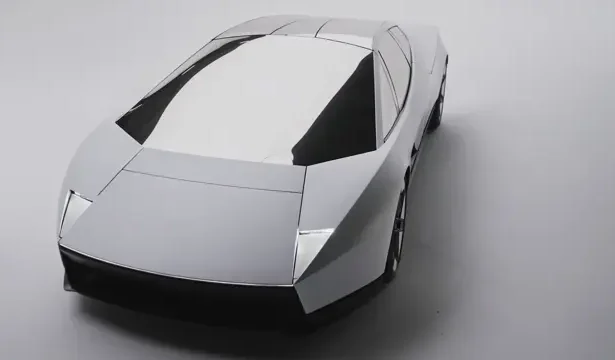
The Roadster’s exterior draws inspiration from aerospace designs, including the SR-71 aircraft. Its two-seat layout incorporates lightweight construction, while the interior features a steering yoke, electronic braking controls and a steer-by-wire system. The seats are integrated into the chassis as part of the weight-reduction approach.
Musk described the vehicle as an exception to Tesla’s broader focus on autonomous driving, saying it would remain the company’s long-term manually driven model. He also acknowledged that the rocket-assisted features might not be legal in every market. Tesla says these features will be optional, and the company has not confirmed where the complete system will be approved for road use.
The Roadster’s development has faced repeated delays since its first unveiling in November 2017. Tesla initially presented the vehicle as a four-seat sports car and expected deliveries to begin in 2020. The latest announcement points to a production start in 2028, approximately 11 years after the original reveal.
Tesla has not announced the final purchase price. Its US reservation page requires an initial payment of $5,000, followed by a $45,000 bank transfer within 10 days. The combined $50,000 represents a reservation payment rather than the confirmed price of the finished vehicle.
The engineering team has also discussed a top speed exceeding 230 miles per hour, while Musk suggested the car could eventually go considerably faster. However, the final performance figures remain subject to further development and testing.
The new Roadster marks a significant expansion of Tesla’s original electric sports car concept, which helped establish the company’s early reputation. The latest model aims to combine electric performance with technology adapted from SpaceX, although its production timeline, final specifications, price and regulatory approval remain unresolved.
We welcome your contributions! Submit your blogs, opinion pieces, press releases, news story pitches, and news features to opinion@minutemirror.com.pk and minutemirrormail@gmail.com







