Summary
- US President JD Vance has made it clear that Iranian assets will remain frozen unless Tehran demonstrates tangible progress in ongoing peace negotiations, delivering a blunt warning just as diplomatic efforts enter a critical phase in Switzerland.
- The assets in question, estimated to be worth billions of dollars, have been frozen under US sanctions and represent a major incentive for Iran to engage constructively in the 60-day negotiating period established under the Islamabad Memorandum of Understanding.
- While Washington has already taken the symbolic step of lifting the naval blockade on Iranian ports and waiving oil sanctions, the release of frozen assets represents a much larger and more consequential concession one that will only be granted if Tehran meets its commitments under the agreement.
US President JD Vance has made it clear that Iranian assets will remain frozen unless Tehran demonstrates tangible progress in ongoing peace negotiations, delivering a blunt warning just as diplomatic efforts enter a critical phase in Switzerland.
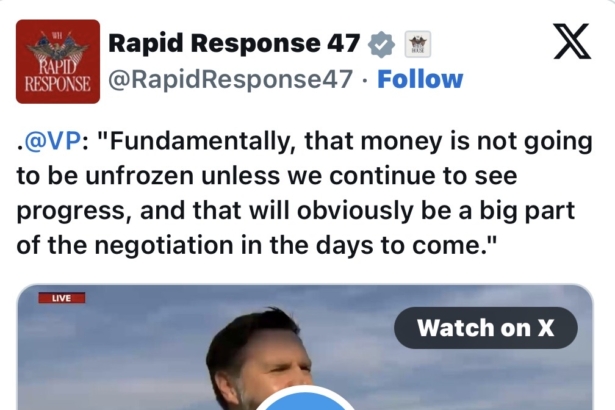
“Fundamentally, that money is not going to be unfrozen unless we continue to see progress,” Vance told reporters before departing Switzerland, where technical-level talks between the United States and Iran are currently underway. “And that will obviously be a big part of the negotiation in the days to come.”
The statement serves as both a carrot and a stick, signaling to Iranian negotiators that economic relief long sought by Tehran remains contingent on meaningful concessions at the bargaining table. The assets in question, estimated to be worth billions of dollars, have been frozen under US sanctions and represent a major incentive for Iran to engage constructively in the 60-day negotiating period established under the Islamabad Memorandum of Understanding.
Vance’s remarks come as diplomatic efforts intensify in Burgenstock, where US envoy Steve Witkoff and Iranian Foreign Minister Abbas Araghchi are leading talks aimed at turning the interim 14-point pact into a lasting regional deal. The negotiations have been described as taking place in a “constructive atmosphere,” but significant differences remain, particularly over the pace of sanctions relief and the extent of Iran’s nuclear concessions.
The President’s insistence on linking asset unfreezing to progress reflects the broader US strategy of maintaining leverage throughout the negotiating process. While Washington has already taken the symbolic step of lifting the naval blockade on Iranian ports and waiving oil sanctions, the release of frozen assets represents a much larger and more consequential concession one that will only be granted if Tehran meets its commitments under the agreement.
The warning also comes amid escalating tensions in the region, with Israeli strikes in southern Lebanon threatening the fragile ceasefire and Iran’s threats to close the Strait of Hormuz creating uncertainty in global energy markets. Vance’s comments suggest that the US is prepared to use economic pressure as a tool to keep Iran engaged, even as it offers diplomatic pathways to resolution.
For Iran, the message is clear progress at the negotiating table is the price of economic relief. Whether Tehran is willing to pay that price remains to be seen. But as the talks continue in Switzerland, the stakes have never been higher for both sides.
We welcome your contributions! Submit your blogs, opinion pieces, press releases, news story pitches, and news features to [email protected] and [email protected]