Summary
- Pakistan and Canada have agreed to strengthen their bilateral relationship by expanding cooperation in trade, investment, energy, security, agriculture and education following high-level talks in Islamabad.
- The two sides agreed to enhance cooperation by promoting greater trade and investment, increasing business engagement and encouraging academic, cultural and institutional exchanges between the two countries.
- Pakistan and Canada also agreed to revive the Joint Working Group on Trade and Investment to identify new commercial opportunities and remove barriers to bilateral trade.
Pakistan and Canada have agreed to strengthen their bilateral relationship by expanding cooperation in trade, investment, energy, security, agriculture and education following high-level talks in Islamabad.
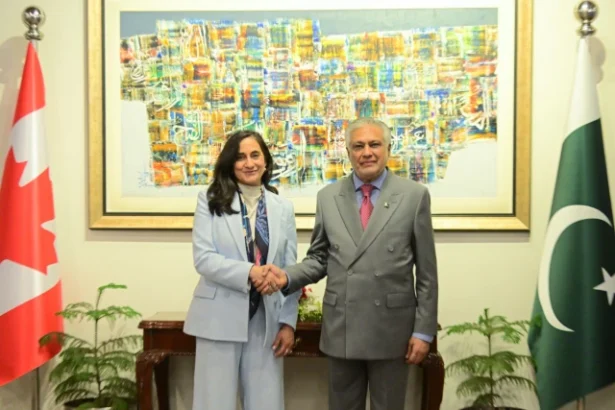
The understanding was reached during the official visit of Canadian Foreign Minister Anita Anand, who arrived in Pakistan at the invitation of Deputy Prime Minister and Foreign Minister Senator Mohammad Ishaq Dar. The visit marked Anand’s first official trip to Pakistan since assuming office.
During their meeting at the Ministry of Foreign Affairs, Dar and Anand held detailed discussions on bilateral relations, regional developments and global issues of mutual interest. Both leaders welcomed the renewed momentum in Pakistan-Canada relations and reaffirmed their commitment to building stronger political, economic and people-to-people ties.
The two sides agreed to enhance cooperation by promoting greater trade and investment, increasing business engagement and encouraging academic, cultural and institutional exchanges between the two countries.
A significant part of the discussions focused on regional peace and security. Dar briefed the Canadian foreign minister on Pakistan’s diplomatic efforts to reduce regional tensions and its role in facilitating dialogue that resulted in the Islamabad Memorandum of Understanding. Anand appreciated Pakistan’s mediation efforts and stressed the importance of maintaining the ceasefire and fully implementing the commitments outlined in the agreement.
Both countries agreed to continue working together on international peace initiatives and to cooperate on addressing global challenges through dialogue and multilateral engagement.
The ministers also reviewed progress made through previous bilateral consultations and reaffirmed the importance of regular diplomatic engagement to identify new areas of strategic cooperation.
Recognising the important role played by the Pakistani community in Canada, both leaders highlighted the contribution of more than 300,000 Pakistanis living there, along with over 9,000 Pakistani students enrolled in Canadian educational institutions. They agreed to further strengthen cultural exchanges, tourism, educational partnerships and improve mobility between the two countries.
Economic cooperation remained a key focus of the discussions. Both ministers described trade and investment as central pillars of future relations and welcomed progress towards finalising the Pakistan-Canada Foreign Investment Promotion and Protection Agreement (FIPA). They expressed hope that negotiations would be completed at the earliest opportunity.
Pakistan and Canada also agreed to revive the Joint Working Group on Trade and Investment to identify new commercial opportunities and remove barriers to bilateral trade.
The two sides discussed expanding investment in several priority sectors, including renewable energy, mining, critical minerals, infrastructure, agriculture, emerging technologies and environmental sustainability. They also encouraged greater interaction between private businesses through trade delegations and investment forums.
In the energy sector, both countries agreed to encourage greater Canadian investment in renewable energy projects, including solar, wind and battery storage technologies. The ministers welcomed regulatory approval for the 240-megawatt Dhabeji Hybrid Wind-Solar Project, which will be developed by Canadian company JCM Power in partnership with K-Electric. The project is expected to strengthen Pakistan’s renewable energy capacity.
Agricultural cooperation also featured prominently in the talks. Both countries agreed to promote two-way trade in agricultural products such as canola, oilseeds, lentils, soybeans, cereals, rice, spices and fruits. They also pledged to cooperate on food safety standards, agricultural technology and value-added food production.
The ministers signed a new protocol establishing predictable phytosanitary import conditions for Canadian canola, while relevant authorities from both countries agreed to explore technical cooperation and capacity-building initiatives in food safety and agricultural regulation.
Recognising Pakistan’s vast mineral resources and Canada’s expertise in responsible mining, the two countries agreed to increase collaboration across the mining sector, including exploration, investment and technical services. Anita Anand also invited Ishaq Dar to attend the 2027 Prospectors and Developers Association of Canada conference to further strengthen cooperation in the minerals sector.
On security matters, both sides reaffirmed their commitment to expanding cooperation in counterterrorism and combating transnational organised crime. Canada announced it would continue supporting Pakistan’s counterterrorism efforts through projects implemented with the United Nations, INTERPOL and other international organisations.
The two ministers also exchanged views on developments in Afghanistan, regional security challenges and the broader impact of conflict on civilian populations and economic stability.
Climate change, education and healthcare were also discussed during the meeting. Canada announced new development assistance initiatives focused on improving education, strengthening climate resilience and supporting public health programmes in Pakistan.
We welcome your contributions! Submit your blogs, opinion pieces, press releases, news story pitches, and news features to opinion@minutemirror.com.pk and minutemirrormail@gmail.com