Summary
- Islamabad / Bangkok: Pakistan is exploring a financing package of around $1.5 billion backed by World Bank guarantees while a proposed climate fund aims to raise $500 million initially and expand beyond $2 billion, as the government seeks cheaper loans, foreign investment and stronger economic stability.
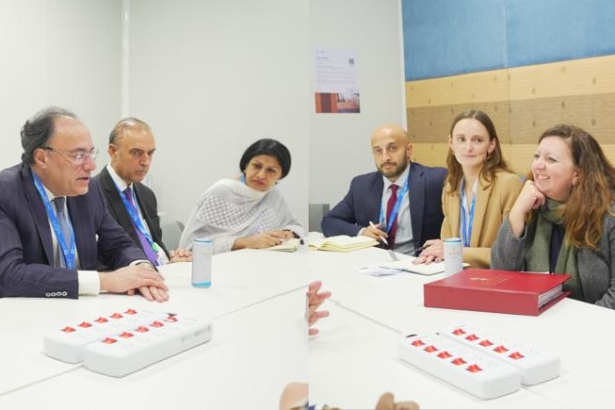
- The proposals were discussed by Finance Minister Muhammad Aurangzeb with international banks, investors and foreign officials during the World Bank and International Monetary Fund annual meetings in Bangkok, Thailand, on October 16.
- The proposed $1.5 billion financing arrangement would combine a World Bank policy guarantee with coverage from the Multilateral Investment Guarantee Agency to help Pakistan borrow at more competitive rates.
Islamabad / Bangkok: Pakistan is exploring a financing package of around $1.5 billion backed by World Bank guarantees while a proposed climate fund aims to raise $500 million initially and expand beyond $2 billion, as the government seeks cheaper loans, foreign investment and stronger economic stability.
The proposals were discussed by Finance Minister Muhammad Aurangzeb with international banks, investors and foreign officials during the World Bank and International Monetary Fund annual meetings in Bangkok, Thailand, on October 16. Several proposals remain under discussion and will require further work before agreements or financing can be finalised.
The proposed $1.5 billion financing arrangement would combine a World Bank policy guarantee with coverage from the Multilateral Investment Guarantee Agency to help Pakistan borrow at more competitive rates. The final amount depends on the available guarantees and the structure of the transaction. Aurangzeb proposed using an existing World Bank development programme to avoid delays from negotiating a new framework. Further discussions will involve the Finance Division, Economic Affairs Division and World Bank Group.
Another major proposal is the Lifeline Fund, which is being developed to attract investment for countries facing climate risks. The target is to make it ready by April 2027, begin with $500 million and eventually expand beyond $2 billion. However, details about contributions, management, access to funds, investor returns and withdrawals are still being worked out.
The climate discussions also covered Pakistan’s Climate Prosperity Plan, a proposed platform to connect projects with investors, the investor book and the BRIDGE initiative. Aurangzeb stressed that government ministries must lead the work, include climate spending in their budgets and coordinate with the United Nations Development Programme and other partners to avoid duplication.
Pakistan is also trying to widen its access to international financial markets after issuing a $3 billion Eurobond in September. In talks with US Treasury Under Secretary Erin Browne, Aurangzeb highlighted foreign exchange reserves of around $21.6 billion, three consecutive years of primary budget surpluses and progress under the IMF programme.
The government plans to raise funds through Islamic bonds, known as Sukuk, Panda bonds in China and other instruments. It is also considering rupee based bonds settled in US dollars and digital tokenization of Eurobonds. These options are intended to diversify financing and reduce dependence on expensive borrowing with short repayment periods. The government wants stronger exports, better tax collection and sustainable debt to help Pakistan move towards the BB credit rating category.
Aurangzeb and the State Bank governor also met Fitch Ratings to discuss Pakistan’s credit outlook. The delegation pointed to improved foreign reserves, a contained current account deficit, reduced State Bank forward liabilities, lower debt servicing costs and longer repayment periods. The government wants Fitch to explain what further steps are needed for a higher rating and reaffirmed its commitment to completing the IMF programme and continuing reforms.
Global financial firms including Lazard, Deutsche Bank, Mitsubishi UFJ Financial Group and Standard Chartered discussed additional financing options. These included guaranteed Sukuk, debt swaps, sustainability linked loans, Samurai bonds from Japan, gold backed liquidity and protection against energy price changes. The talks also covered attracting foreign investors, managing currency risks and finding suitable times for new bond issues. Standard Chartered discussed possible guarantees and export credit financing for power transmission, railway and road projects, while MUFG explored long term investment related to WAPDA and the Dasu hydropower project.
The government is seeking more investment from Canada, particularly in agriculture, modern farming technology, livestock, food security and mining. In a meeting with Canada’s Secretary of State for International Development Randeep Sarai, Aurangzeb called for progress on an investment protection agreement. They discussed the Barrick mining project, including security checks, financing, exports and employment. Information technology, artificial intelligence skills, virtual assets, remittances and tourism were also considered. Aurangzeb thanked Canada for flood assistance and invited Sarai to visit Pakistan.
Talks with the United Kingdom focused on reforms, investment, solar energy, battery storage and electricity grid improvements. Aurangzeb welcomed British International Investment’s growing investment pipeline and UK support for reform programmes. The two sides also discussed privatisation, airport outsourcing and possible aviation cooperation involving Airbus and Rolls Royce.
Pakistan also wants its stock market to gain emerging market status. In talks with Morgan Stanley Capital International, officials discussed market rules, foreign exchange arrangements, advance funding requirements and ways to make investment easier. The meeting covered the transfer of investment earnings abroad through Special Convertible Rupee Accounts and wider access to Roshan Digital Accounts.
The government is also considering privatisation of power distribution companies, life insurance and airport operations, while keeping public ownership of airport assets. Discussions included refinery upgrades and possible financing and advice for these transactions.
At an investor session, Aurangzeb outlined projected economic growth of 3.5 to 4.5 percent. He highlighted easing inflation, stronger reserves, remittances and rising information technology exports. He said future borrowing would depend on market conditions and the national financing strategy. Officials also discussed regional conflict, climate risks and energy prices, with additional defence needs expected to remain within the approved budget.
The government says its goal is to turn economic stabilisation into lasting growth through exports, private investment, better financing terms and stronger international partnerships. However, the financing and climate fund proposals still need further work, while Pakistan’s ability to secure cheaper loans and a stronger credit rating will depend on continuing reforms and maintaining economic stability
We welcome your contributions! Submit your blogs, opinion pieces, press releases, news story pitches, and news features to opinion@minutemirror.com.pk and minutemirrormail@gmail.com