Summary
- In a remarkable blend of sport and science, a football designed for the FIFA World Cup 2026—reportedly manufactured in Pakistan—has traveled beyond the pitch and into space, as NASA astronauts conducted a unique experiment aboard the International Space Station (ISS).
- Developed in collaboration with leading sports technology designers, including Adidas, the Trionda ball is being used in the build-up to the FIFA World Cup 2026.
- As FIFA 2026 approaches, the Trionda ball continues to attract attention not just on stadium grass, but also far above Earth, where astronauts are helping decode how even the world’s most familiar sporting object behaves when gravity is no longer part of the game.
In a remarkable blend of sport and science, a football designed for the FIFA World Cup 2026—reportedly manufactured in Pakistan—has traveled beyond the pitch and into space, as NASA astronauts conducted a unique experiment aboard the International Space Station (ISS).
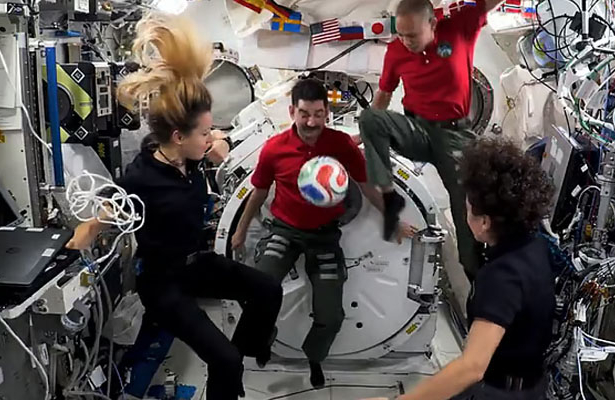
The experiment took place inside the station’s iconic Cupola module, where astronauts observed the specially designed “Trionda” football floating freely in a zero-gravity environment. The study aimed to understand how modern football behaves when traditional forces like weight and friction are removed.
Developed in collaboration with leading sports technology designers, including Adidas, the Trionda ball is being used in the build-up to the FIFA World Cup 2026. NASA’s decision to include it in microgravity testing highlights growing interest in how sports equipment performs under extreme conditions.
Astronauts on board the ISS carefully released the ball inside the station, watching it drift and rotate unpredictably through the airless environment. Unlike on Earth, where gravity and surface friction guide movement, the ball’s motion in space is entirely governed by inertia and minor air currents inside the station.
NASA stated that the experiment helps researchers better understand balance, motion control, and rotational physics. Similar tests were previously conducted in 2019, providing valuable insights into how objects behave when conventional physics is altered.
The Trionda ball itself carries symbolic significance for the 2026 tournament. According to FIFA, the name “Trionda” comes from a Spanish-inspired term meaning “three waves,” representing the first-ever World Cup hosted across three nations: the United States, Canada, and Mexico.
Its design reflects both innovation and unity, combining advanced aerodynamics with modern materials engineered for consistent performance across different climates and playing conditions.
The involvement of space-based testing adds a futuristic dimension to football technology, showing how global sports are increasingly intersecting with advanced scientific research.
For Pakistan’s manufacturing sector—credited in reports with contributing to the ball’s production—the experiment adds a surprising global spotlight, linking local industrial capability with international space science and elite sport.
As FIFA 2026 approaches, the Trionda ball continues to attract attention not just on stadium grass, but also far above Earth, where astronauts are helping decode how even the world’s most familiar sporting object behaves when gravity is no longer part of the game.
We welcome your contributions! Submit your blogs, opinion pieces, press releases, news story pitches, and news features to [email protected] and [email protected]