Summary
- LONDON: Pakistan has raised concerns over nuclear risks, India’s military posture and allegations of Indian support for militant organisations operating in Pakistan during an international workshop on nuclear deterrence and strategic stability in South Asia.
- Azhar Javaid questions allegations of Indian support for militancy During the question-and-answer session, senior Pakistani journalist Azhar Javaid asked Jamil about allegations that India was supporting militant organisations operating in Pakistan through Afghanistan, particularly the Balochistan Liberation Army (BLA).
- He said: “Actually, that is one area in which, if I go by the statement of Prime Minister Modi when he says Operation Sindoor continues, certainly it is continuing in Indian state support to the terrorist organisations, [the] Tehrik-e-Taliban Pakistan [TTP] and Balochistan Liberation Army [BLA], and we have very clear evidence of their support having been enhanced.” Jamil said Pakistani authorities had previously shared what they described as evidence of alleged Indian support for militant organisations with international delegations, including American officials and representatives associated with the International Security Assistance Force (ISAF) during the international military presence in Afghanistan.
LONDON: Pakistan has raised concerns over nuclear risks, India’s military posture and allegations of Indian support for militant organisations operating in Pakistan during an international workshop on nuclear deterrence and strategic stability in South Asia.
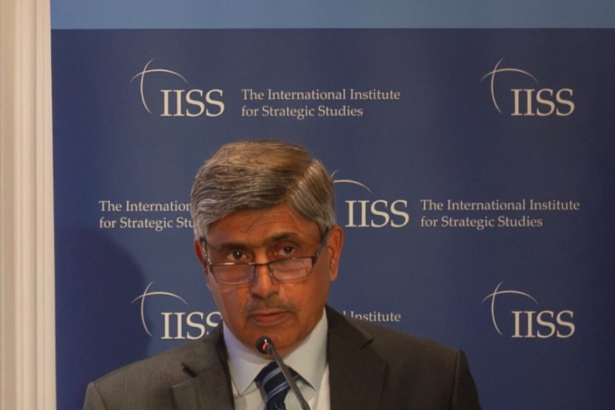
Lieutenant General (Retd) Mazhar Jamil, adviser to Pakistan’s National Command Authority and former Director-General of the Strategic Plans Division (SPD), delivered a keynote address at the 11th Track 1.5 workshop on Nuclear Deterrence and Strategic Stability in South Asia, organised by the International Institute for Strategic Studies (IISS) in London on 13 October 2026.
Jamil discussed Pakistan’s concerns about India’s nuclear policy, regional security, the Kashmir dispute and the need for dialogue and effective crisis-management mechanisms to prevent escalation between the two nuclear-armed neighbours.
Pakistan questions India’s nuclear posture
Jamil questioned India’s declared No First Use (NFU) nuclear policy, arguing that the country’s evolving military capabilities raised concerns about its future nuclear posture.
He also called for the international community to reconsider the nuclear trade exemption granted to India by the Nuclear Suppliers Group in 2008, arguing that nuclear cooperation and non-proliferation standards should be applied consistently.
Kashmir and the Indus Waters Treaty
Jamil identified the unresolved Kashmir dispute as a major source of tension between Pakistan and India, saying the absence of a political settlement continued to affect regional stability.
He also criticised India’s decision to place the Indus Waters Treaty in abeyance following the 2025 confrontation, highlighting the importance of water security for Pakistan.
Jamil said Pakistan remained open to dialogue with India, including discussions on Kashmir, and referred to the need for mechanisms to prevent miscalculation during future military confrontations.
He also defended defence cooperation involving Pakistan, Saudi Arabia and Turkey, describing the arrangement as defensive in nature.
Azhar Javaid questions allegations of Indian support for militancy
During the question-and-answer session, senior Pakistani journalist Azhar Javaid asked Jamil about allegations that India was supporting militant organisations operating in Pakistan through Afghanistan, particularly the Balochistan Liberation Army (BLA).
Javaid also referred to Indian national Kulbhushan Jadhav, who was arrested by Pakistani authorities in 2016 and accused by Islamabad of espionage and involvement in subversive activities.
Azhar Javaid asked:
“My question to the General is that Pakistan is facing terrorism in Khyber Pakhtunkhwa [KPK] and Balochistan. There are allegations that India is involved through Afghanistan and [that] they are supporting terrorists over there, especially [the] Balochistan Liberation Army [BLA], the prescribed [terrorist] organisation by the United Nations. How [does] Pakistan see this involvement from India, and especially when Pakistan has captured an Indian spy, Kulbhushan Jadhav, as well, and [since] there [is] very strong evidence presented by [the] Pakistani authorities. Thank you.”
Mazhar Jamil’s response
Responding to Javaid, Jamil alleged that India continued to support the Tehrik-e-Taliban Pakistan (TTP) and the BLA. He asserted that Pakistan had evidence indicating an increase in such support.
He said:
“Actually, that is one area in which, if I go by the statement of Prime Minister Modi when he says Operation Sindoor continues, certainly it is continuing in Indian state support to the terrorist organisations, [the] Tehrik-e-Taliban Pakistan [TTP] and Balochistan Liberation Army [BLA], and we have very clear evidence of their support having been enhanced.”
Jamil said Pakistani authorities had previously shared what they described as evidence of alleged Indian support for militant organisations with international delegations, including American officials and representatives associated with the International Security Assistance Force (ISAF) during the international military presence in Afghanistan.
He further alleged that Indian consulates in Afghanistan had been used to facilitate support for militant activity along Pakistan’s border, including through financing and weapons supplies. These assertions reflect Jamil’s account of Pakistan’s security concerns; the evidence he referenced was not independently examined for this report.
Jamil also referred to the 1971 conflict that led to the creation of Bangladesh, alleging that India had trained the Mukti Bahini. He cited the Liberation Tigers of Tamil Eelam (LTTE) in Sri Lanka as another historical example in support of his argument about India’s alleged involvement with armed groups.
Jamil maintained that Pakistan had raised these concerns with international counterparts and argued that India’s alleged support for militant organisations was receiving greater international scrutiny.
The allegations concerning Indian state involvement in militancy are attributed to Jamil and represent Pakistan’s stated position. They should not be understood as independently established findings. India has rejected accusations of state-sponsored terrorism.
We welcome your contributions! Submit your blogs, opinion pieces, press releases, news story pitches, and news features to opinion@minutemirror.com.pk and minutemirrormail@gmail.com