Summary
- The report said Afghanistan continued to face several challenges.
- Ahmad said Pakistan had continued to support Afghanistan despite its disagreements with some Taliban policies.
- According to Ahmad, at least 687 humanitarian cargo trucks crossed from Pakistan into Afghanistan during the reporting period covered by the UN secretary-general’s report.
Pakistan has told the United Nations Security Council that it will respond in self-defence if terrorist threats from Afghanistan endanger its citizens or national security.
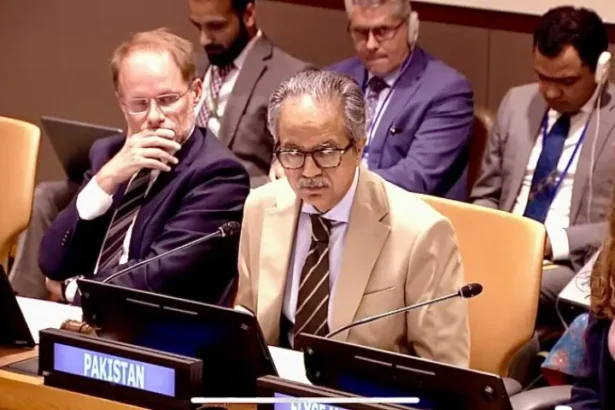
Pakistan’s Permanent Representative to the UN, Ambassador Asim Iftikhar Ahmad, made the statement during a Security Council meeting on Afghanistan.
The session examined the situation in Afghanistan five years after the Taliban returned to power in Kabul.
Ahmad said Pakistan could not remain passive in the face of what he described as a continuing terrorist threat from Afghan territory.
He said Pakistan would respond when necessary and in line with international law. He added that Islamabad would defend itself against any group or actor seeking to harm its people or national security.
According to Ahmad, more than 4,700 Pakistanis have been killed in terrorism linked to Afghanistan over the past three years.
He accused the Afghan authorities of failing to take concrete and verifiable action against militant groups operating from Afghan soil.
Ahmad named several groups that Pakistan says are operating from Afghanistan, including Tehreek-i-Taliban Pakistan, the Baloch Liberation Army and its Majeed Brigade, Islamic State-Khorasan and the East Turkestan Islamic Movement.
He also warned that support from external actors could further complicate the security situation in the region.
The Pakistani envoy said terrorism remained one of the major challenges facing Afghanistan. He linked the issue to what he described as ties between the Taliban authorities and militant groups.
He also expressed concern about weapons left behind following the withdrawal of international forces and the continued illegal movement of arms.
A recent report by UN Secretary-General Antonio Guterres also highlighted the presence of terrorist groups in Afghanistan.
The report said Afghanistan continued to face several challenges. These included restrictions on women and girls, limited political inclusion, economic difficulties and pressure on public services.
Large-scale returns and migration were also identified as factors affecting the country’s long-term stability.
The UN report said armed groups opposed to the Taliban remained active. Such groups claimed responsibility for 88 attacks across 21 Afghan provinces between May 1 and the end of July.
The report also raised concerns about restrictions on women and girls and the political system established by the Taliban. It said these issues continued to affect Afghan society and hindered Afghanistan’s reintegration into the international community.
Ahmad said Pakistan had continued to support Afghanistan despite its disagreements with some Taliban policies.
He said Islamabad had provided humanitarian assistance and promoted regional engagement. Pakistan also allowed humanitarian supplies to enter Afghanistan.
According to Ahmad, at least 687 humanitarian cargo trucks crossed from Pakistan into Afghanistan during the reporting period covered by the UN secretary-general’s report.
However, he said expectations surrounding Afghanistan after the Taliban takeover had not been fulfilled.
The Pakistani envoy said the country’s apparent stability could hide growing risks. He cited the UN assessment that underlying challenges could affect Afghanistan’s stability in both the short and long term.
The United States also adopted a critical position during the Security Council debate.
US Ambassador Mike Waltz focused on the detention of American citizens, terrorism and restrictions on women and girls.
Waltz called for the immediate release of US citizens held by the Taliban. He accused the Afghan authorities of using detained Americans as leverage.
He also criticised the Taliban over alleged support or shelter for terrorist groups.
The US envoy referred to UN reports concerning arbitrary arrests, detention, torture, mistreatment and extrajudicial killings in Afghanistan.
He also highlighted restrictions on girls’ education beyond the sixth grade. He pointed to restrictions preventing Afghan women working for the United Nations from entering UN facilities.
Waltz questioned whether continued international engagement could produce meaningful changes without concrete action by the Taliban authorities.
Russia took a different position at the meeting.
Russian Ambassador Vassily Nebenzia argued that engagement with Afghanistan remained necessary. He said there was no alternative to practical dialogue with the Afghan authorities.
Nebenzia said earlier predictions that Afghanistan would collapse after the withdrawal of foreign forces had not materialised.
He attributed the country’s relative stability to the Taliban’s focus on development, regional cooperation and efforts to build a more self-reliant state.
Russia called for dialogue based on trust and opposed what it described as pressure and threats against Afghanistan.
China also supported continued engagement.
Chinese Deputy Ambassador Sun Lei acknowledged concerns over restrictions affecting Afghan women and girls. He said such measures could harm their health and limit Afghanistan’s development prospects.
Sun urged all sides to preserve the gains made through dialogue and remain patient in dealing with Afghanistan.
China called on the Taliban authorities to protect the rights and interests of all Afghans, including women.
Beijing also urged countries involved in Afghanistan’s affairs to support reconstruction and economic recovery. It called for the resumption of aid, the lifting of unilateral sanctions and the return of Afghanistan’s overseas central bank assets.
The Security Council debate exposed differences among major powers over how to address Afghanistan’s political, humanitarian and security challenges.
Pakistan focused on cross-border terrorism and national security. The United States stressed counterterrorism, human rights and the release of detained citizens.
We welcome your contributions! Submit your blogs, opinion pieces, press releases, news story pitches, and news features to opinion@minutemirror.com.pk and minutemirrormail@gmail.com