Summary
- Parliament’s joint session on Thursday approved a resolution endorsing governor’s rule in Khyber Pakhtunkhwa, following heated exchanges between government and opposition lawmakers over the federal government’s decision to impose emergency measures in the province.
- Achakzai also questioned the whereabouts of Khyber Pakhtunkhwa Chief Minister Sohail Afridi, whose government has been rendered non-functional following the imposition of the federal measures.
- The session reflected deep divisions between the government and opposition over the constitutional and political implications of emergency measures in Khyber Pakhtunkhwa, with opposition lawmakers continuing to challenge the decision and demand answers from the federal authorities.
Parliament’s joint session on Thursday approved a resolution endorsing governor’s rule in Khyber Pakhtunkhwa, following heated exchanges between government and opposition lawmakers over the federal government’s decision to impose emergency measures in the province.
The resolution was presented amid strong opposition from Pakistan Tehreek-e-Insaf (PTI) lawmakers and members of the opposition alliance Tehreek-i-Tahafuz-i-Ayin-i-Pakistan (TTAP), who carried placards and chanted slogans against the move. The session brought together members of the National Assembly and Senate to consider the constitutional measures concerning the province.
During the proceedings, Parliamentary Affairs Minister Tariq Fazal Chaudhry moved a motion seeking the suspension of certain rules governing joint parliamentary sessions. Despite protests from opposition members, the motion was approved by 214 votes to 56.
Chaudhry subsequently presented two resolutions, one concerning the proclamation of emergency under Article 232 of the Constitution and the other relating to governor’s rule under Article 234.
The resolution concerning the emergency was approved by 240 votes, while 46 members voted against it.
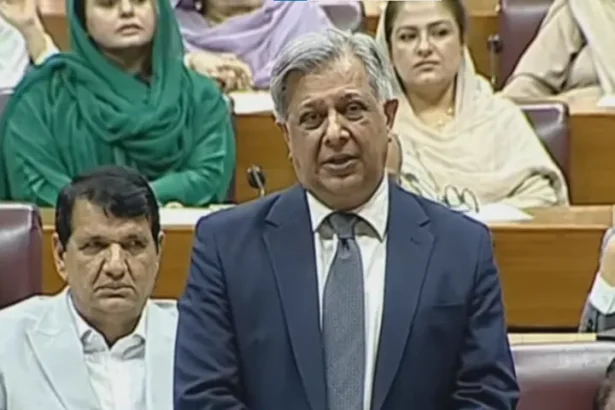
Law Minister Azam Nazeer Tarar opened the debate by explaining the constitutional basis for the measures. He said special arrangements had been established to manage the province’s affairs during the emergency and governor’s rule.
Tarar maintained that the provincial government led by PTI had repeatedly been urged to take effective action against terrorism. He criticised the party’s leadership over its response to attacks that claimed the lives of security personnel and other victims.
The law minister said Article 234 provided a constitutional mechanism for imposing governor’s rule when a provincial government could not be carried on in accordance with the Constitution. He also explained the parliamentary voting requirements for approving the emergency proclamation and governor’s rule.
Under the constitutional framework, an emergency proclamation must be presented before both Houses of Parliament for approval within the prescribed period. A proclamation of governor’s rule must be placed before a joint sitting and ordinarily ceases to remain in force after two months unless its continuation is approved. The measure cannot remain in force beyond six months.
Opposition Leader Mehmood Khan Achakzai criticised the government’s handling of the crisis, blaming what he described as flawed decisions by the country’s leadership for the current political situation.
Achakzai also questioned the whereabouts of Khyber Pakhtunkhwa Chief Minister Sohail Afridi, whose government has been rendered non-functional following the imposition of the federal measures. Reports had suggested that Afridi was in preventive custody.
He further accused National Assembly Speaker Ayaz Sadiq of failing to conduct parliamentary proceedings fairly.
The opposition leader said his alliance was prepared to engage in dialogue with the government on strengthening Parliament and eliminating terrorism in all its forms. He offered unconditional support if talks focused on these issues.
Achakzai also drew a comparison between the current political crisis in Khyber Pakhtunkhwa and the events that led to the separation of East Pakistan in 1971. He questioned the labelling of Afridi as a terrorist and asked whether the provincial chief minister could be held responsible for attacks on political leaders in the past.
The session reflected deep divisions between the government and opposition over the constitutional and political implications of emergency measures in Khyber Pakhtunkhwa, with opposition lawmakers continuing to challenge the decision and demand answers from the federal authorities.
We welcome your contributions! Submit your blogs, opinion pieces, press releases, news story pitches, and news features to opinion@minutemirror.com.pk and minutemirrormail@gmail.com