
Summary
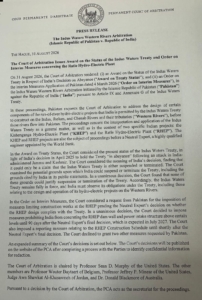
- ISLAMABAD: In a significant legal victory for Pakistan, the Permanent Court of Arbitration (PCA) at The Hague has unanimously ruled that the Indus Waters Treaty (IWT) remains fully in force, rejecting India’s attempt to place the decades-old water-sharing agreement in “abeyance.” The landmark Award was issued on August 31, 2026, in the case concerning the Indus Waters Western Rivers Arbitration between Pakistan and India.
- The ruling also carries implications for India’s hydroelectric projects on the Western Rivers — the Indus, Jhelum and Chenab — which are subject to specific design and operational requirements under the treaty.
- The agreement allocates the Western Rivers — Indus, Jhelum and Chenab — primarily to Pakistan, while India has specified rights to use their waters subject to treaty conditions.
ISLAMABAD: In a significant legal victory for Pakistan, the Permanent Court of Arbitration (PCA) at The Hague has unanimously ruled that the Indus Waters Treaty (IWT) remains fully in force, rejecting India’s attempt to place the decades-old water-sharing agreement in “abeyance.”
The landmark Award was issued on August 31, 2026, in the case concerning the Indus Waters Western Rivers Arbitration between Pakistan and India. A copy of the PCA press release has been obtained by Minute Mirror.
The arbitration proceedings followed India’s decision in April 2025 to suspend the operation of the treaty after an attack in Indian-administered Jammu and Kashmir. Pakistan challenged the move under Article IX and Annexure G of the 1960 agreement.
In its Award on Treaty Status, the five-member Court of Arbitration examined the grounds advanced by India and concluded that none provided a legal basis for suspending or terminating the treaty. The court therefore determined that the IWT continues to bind both countries and that India remains obligated to comply with its provisions.
The ruling also carries implications for India’s hydroelectric projects on the Western Rivers — the Indus, Jhelum and Chenab — which are subject to specific design and operational requirements under the treaty.
In a related Order on Interim Measures, the court imposed restrictions on construction activities at India’s Ratle Hydroelectric Plant. India has been barred from concreting portions of the Ratle dam wall and power intake structure above specified levels until 90 days after the Neutral Expert issues a final decision on the matter.
The court has also directed India to provide regular updates concerning the construction schedule of the Ratle project.
The legal proceedings over the Kishenganga and Ratle hydroelectric projects are continuing alongside separate proceedings before a World Bank-appointed Neutral Expert. The Neutral Expert’s final determination is currently expected in July 2027.
The Court of Arbitration was chaired by Prof. Sean D. Murphy of the United States, with the remaining members drawn from Belgium, the United States, Jordan and Australia.
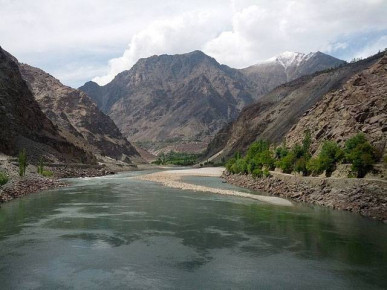
The Indus Waters Treaty, brokered by the World Bank and signed in 1960, establishes the framework for sharing the waters of six rivers between Pakistan and India. The agreement allocates the Western Rivers — Indus, Jhelum and Chenab — primarily to Pakistan, while India has specified rights to use their waters subject to treaty conditions.
For Pakistan, the PCA ruling represents an important reaffirmation of the treaty’s legal status and provides a significant boost to its position in the ongoing dispute over Indian hydropower projects on the Western Rivers.If you want, I can also make this more punchy and newspaper-style for Minute Mirror, with a stronger headline and tighter 500-word version.
We welcome your contributions! Submit your blogs, opinion pieces, press releases, news story pitches, and news features to opinion@minutemirror.com.pk and minutemirrormail@gmail.com