Summary
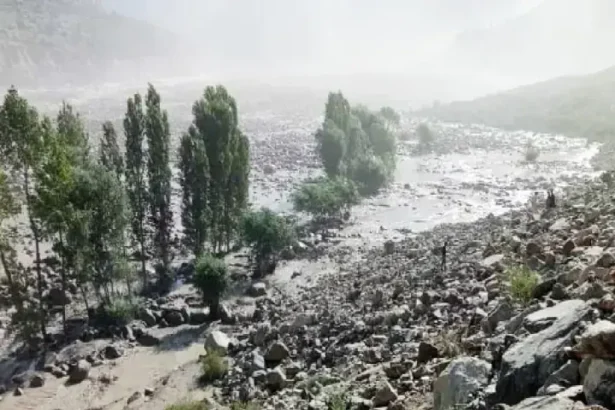
- Pakistan’s northern regions face an increased risk of glacial lake outburst floods (GLOFs), flash floods, and landslides as soaring temperatures continue to accelerate glacier and snowmelt, according to fresh alerts issued by the Pakistan Meteorological Department (PMD) and the National Disaster Management Authority (NDMA).
- It also warned that downstream communities, low-lying areas, and settlements near riverbeds may face sudden flooding, while heavy mudflows, debris flows, and landslides could occur in mountainous terrain.
- The authority noted that a combination of rising temperatures, intermittent rainfall, and rapid glacier melting has significantly increased the likelihood of landslides, rockfalls, and debris flows across vulnerable mountainous regions.
Pakistan’s northern regions face an increased risk of glacial lake outburst floods (GLOFs), flash floods, and landslides as soaring temperatures continue to accelerate glacier and snowmelt, according to fresh alerts issued by the Pakistan Meteorological Department (PMD) and the National Disaster Management Authority (NDMA).
In its latest advisory, the PMD warned that unusually high temperatures are expected to persist until the first week of July, significantly increasing the rate of snow and ice melt across the glaciated valleys of Gilgit-Baltistan and Khyber Pakhtunkhwa. As a result, river and stream water levels are likely to remain elevated, while existing glacial lakes may rapidly expand and new lakes could form due to the increasing volume of meltwater.
The department cautioned that the rapid expansion of glacial lakes could weaken or breach their natural ice or moraine dams, potentially triggering dangerous GLOF incidents. It also warned that downstream communities, low-lying areas, and settlements near riverbeds may face sudden flooding, while heavy mudflows, debris flows, and landslides could occur in mountainous terrain.
The PMD advised residents, tourists, and trekkers to avoid riverbanks, streams, glacial lakes, and narrow mountain valleys during this period. People were also urged to stay away from steep slopes and unstable areas where melting snow could trigger landslides or falling debris.
Separately, the NDMA’s National Emergency Operation Centre (NEOC) issued a landslide alert for Gilgit-Baltistan, upper Khyber Pakhtunkhwa, and Azad Jammu and Kashmir, covering the period from June 27 to July 3. The authority noted that a combination of rising temperatures, intermittent rainfall, and rapid glacier melting has significantly increased the likelihood of landslides, rockfalls, and debris flows across vulnerable mountainous regions.
The NDMA also warned that major road networks, including the Karakoram Highway (KKH/N-35), the Jaglot-Skardu Road, and several connecting routes, may experience temporary closures due to landslides and falling rocks. Travellers have been advised to avoid unnecessary journeys in affected areas, as road blockages may also disrupt electricity and communication services.
Provincial Disaster Management Authorities (PDMAs) have been instructed to remain on high alert and ensure the availability of emergency machinery, equipment, and response teams. Citizens have also been encouraged to use the “Pak NDMA Disaster Alert” mobile application for updated weather forecasts, hazard warnings, and safety guidelines.
Following the PMD’s warning, the Khyber Pakhtunkhwa PDMA directed deputy commissioners in Upper and Lower Chitral, Upper Dir, Swat, Upper and Lower Kohistan, and Mansehra to implement precautionary measures. Local authorities have been asked to closely monitor vulnerable sites, conduct evacuation drills, prepare emergency shelters, and ensure evacuation centres are fully equipped. They have also been instructed to warn residents living in low-lying and high-risk areas and launch public awareness campaigns on GLOF-related risks and safety precautions.
We welcome your contributions! Submit your blogs, opinion pieces, press releases, news story pitches, and news features to opinion@minutemirror.com.pk and minutemirrormail@gmail.com