Summary
- Farid is not preaching passivity before injustice.
- Farid does not construct an economic theory from the disparity, but neither does he treat it as morally neutral.
- Farid reminds us of that possession itself is temporary, that inequality carries moral accountability, and that suffering ceases to be merely private once we acquire the vision to see the fire burning in every home.
The intellectual discourse initiated by Sufi philosophers was inclusive of all religions and negated mullahism. Baba Farid is said to have been persecuted by Pakpattan’s qazi and the ruler of the city for listening to music and dancing in the mosque. Guru Nanak condemned the ritualism of mullahs and the pundits—Our distorted intellectual discourse, Dawn, September 9, 2011
Our discussion of Waris Shah ended with Erich Fromm’s distinction between having and being. Heer’s family sought to have honour, status, alliances and authority over a daughter; Heer and Ranjha sought a relationship grounded in recognition rather than possession. Their tragedy arose because a possessive social order could not tolerate human beings who refused to behave as property.
To take that argument further, we must now travel backwards nearly five centuries before Waris Shah, to the beginnings of the surviving Punjabi poetic tradition and to Baba Farid (Hazrat Fariduddin Ganjshaka). Najm Hosain Syed places Farid at the opening of that tradition. What distinguishes his dohras, Najm writes, is an “austerity of tone”. Their setting is not an imaginary spiritual landscape but the “daily experience of common man”: fields, bread, dust, ageing bodies, hunger, labour and death. That austerity is precisely why Farid speaks so forcefully to an age obsessed with accumulation.
Fromm, writing in To Have or To Be?, contrasted two orientations towards existence. The having mode seeks security through possession, accumulation and control; the being mode locates fulfilment in living, loving, sharing and becoming. Farid inhabited an entirely different intellectual and spiritual universe, and it would be anachronistic to turn him into a medieval Fromm. The convergence lies elsewhere. Both question the assumption that what we possess tells us what we are.
Farid begins with the most democratic substance imaginable: dust.
Dust
| Shahmukhi | Roman Punjabi | Literary English translation |
| فریدہ خاکُ ن نندیئ خاکو جیڈُ ن کوئِ جیودیاں پیراں تلے مویاں اپرِ ہوئِ | Farida khaak na nindiye, khaako jed na koi Jeevandeyan pairan talle, moyan upar hoi | Farid, do not despise the dust; nothing stands above it. In life it lies beneath our feet; in death it lies above us. |
The surviving Shahmukhi text preserves the couplet in this form.
Few lines dismantle hierarchy more economically. The earth beneath the rich man’s shoe and the poor labourer’s bare foot is the same earth that eventually covers both. Rank, office, lineage, property and beauty exist for a moment between two encounters with dust.
Farid is not preaching passivity before injustice. His image destroys the metaphysical arrogance on which inequality depends. Human beings may create distinctions of caste, wealth and status, but mortality refuses to recognise them. The person who imagines himself elevated above another discovers that both occupy the same final ground.
This is Farid’s first challenge to the mode of having. We spend our lives converting temporary control into imagined permanence: my land, my wealth, my title, my family name, my influence. Dust reveals the grammatical error. We possess these things temporarily; they do not belong to the essential self.
Farid’s poetry becomes even more striking when it turns from mortality to material inequality.
Flour for Some, Not Even Salt for Others
| Shahmukhi | Roman Punjabi | Literary English translation |
| فریدہ اکناّ آٹا اگلا اکناّ ناہی لونُ اگے گئے سننجاپسنِ چوٹاں کھا سی کؤنُ | Farida ikna aata agla, ikna nahi loon Agge gaye sanjhaapsan, chotan khaasi kaun | Farid, some have flour in abundance; others do not even have salt. Beyond this life it will become known who must answer for the blows. |
The text occurs among the saloks attributed to Farid. This is not abstract mysticism. It is an observation about distribution.
One household possesses abundance; another lacks even the simplest accompaniment to bread. Farid does not construct an economic theory from the disparity, but neither does he treat it as morally neutral. The second line introduces accountability. Unequal possession cannot be separated from the question of how human beings acquired, used and withheld what passed through their hands.
This is an important corrective to a frequent misuse of spirituality. Poverty should never be romanticised simply because a saint practiced austerity. There is a profound difference between voluntary simplicity and involuntary deprivation. Farid could choose restraint as spiritual discipline; the person without salt may have no choice at all. His famous imagery of coarse bread makes the distinction clearer:
فریدہ روٹی میری کاٹھ کی، لاونُ میری بھکھ
His bread is hard and hunger itself becomes its relish. In the following couplet, he advises eating simple food and drinking cool water without tormenting oneself by staring enviously at another person’s richer meal.
The ethical target is excess desire, not nourishment. A society in which some cannot meet basic needs while others define themselves through conspicuous consumption cannot use Farid to sanctify deprivation. His poetry asks the possessor to examine himself before asking the deprived to accept their condition.
Here the relationship with Fromm becomes especially productive. The having mode is not merely ownership of useful things. Human life requires food, shelter, tools and security. The pathology begins when possession becomes identity—when having more means believing oneself to be more.
Farid’s answer is sabar: steadfastness, restraint, patience and sufficiency. His surviving corpus repeatedly returns to simplicity, humility and control of appetite. In contemporary political economy, however, restraint cannot be demanded only from those who possess least. An ethic worthy of Farid must speak first to those with the greatest capacity to accumulate, consume and command.
His social imagination reaches its deepest point when personal suffering becomes recognition of universal suffering.
The Fire in Every House
| Shahmukhi | Roman Punjabi | Literary English translation |
| فریدہ میں جانیا دکھ مجھ کوُ دکھ سبائے جگِ اُچے چڑھِ کے دیکھیا تاں گھرِ گھرِ ایہا اگِ | Farida main jaania dukh mujh ko, dukh sabhaai jag Uchche charh ke dekhia, taan ghar ghar eha ag | Farid, I thought suffering belonged to me alone; I climbed higher and saw the same fire burning in every home. |
The couplet is preserved in the Farid saloks, and one modern scholarly discussion sees precisely this capacity to absorb the suffering of ordinary people into Farid’s own consciousness as central to his poetry.
This is a remarkable movement of consciousness. Pain first appears private: my grief, my hunger, my loss. Farid then climbs metaphorically to a vantage point from which individual suffering becomes social knowledge. Every house is burning.
His age had known displacement, conflict and insecurity across northern India, Afghanistan, Iran and Central Asia. One study of Farid’s poetry connects his severe vision of earthly existence with that wider world of upheaval and the suffering of ordinary people.
Our century does not need medieval invasions to reproduce the same fire. Debt, displacement, unemployment, war, ecological breakdown, loneliness and extreme inequality can leave millions experiencing what initially feels like personal failure.
The debtor thinks his humiliation is his alone. The unemployed youth regards exclusion as a private deficiency. The family unable to meet food or energy costs suffers behind its own walls. Farid asks us to climb higher.
Once we do, what appeared to be isolated suffering reveals structures. Personal distress may have social causes; hunger can coexist with abundance; insecurity may flourish beside extraordinary concentration of wealth. Compassion therefore requires more than charity. It demands that we see the fire connecting one household to another.
Farid’s humanism also refuses vengeance. In another famous salok he urges:
فریدہ برے دا بھلا کرِ غصہ منِ ن ہڈھائ
Return goodness for evil; do not allow anger to take possession of the mind.
This is not submission to oppression. Anger can alert us to injustice. Farid’s concern is what sustained hatred does to the person who carries it. If the struggle against domination reproduces the moral psychology of the dominator, liberation remains incomplete.
The deepest political meaning of Farid lies neither in a programme of government nor in an economic blueprint. It lies in the anthropology beneath both.
What is a human being? Not the estate he controls. Not the food he can display while another goes hungry. Not the lineage through which he claims superiority. Not even the body whose strength and beauty inevitably return to dust.
The human being is revealed through humility, restraint, compassion, accountability and recognition of suffering beyond the self.
The surviving Farid Bani itself crossed boundaries that later politics hardened. The corpus attributed to the Muslim Chishti saint was preserved in the Sikh scripture; scholars also acknowledge unresolved questions about its transmission and precise authorship over the centuries.
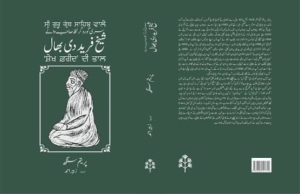
Whatever those textual debates ultimately yield, the historical fact of preservation carries its own civilisational significance: Punjab’s spiritual inheritance could not easily be confined within the religious compartments later generations constructed. For detail discussion on this subject, read monumental academic and historical research work, ‘Sri Guru Granth Sahib Wale Sheikh Farid Di Bhaal’ (In Search of the Sheikh Farid of the Guru Granth Sahib) by Professor Pritam Singh, converted in Shahmukhi for Pakistani readers by renowned Punjabi writer and thinker Professor Zubair Ahmad, and published by Kitab Trinjan, Lahore.
Waris Shah showed us a society trying to possess Heer. Bulleh Shah stripped away the identities through which society possesses the individual. Baba Farid, standing near the beginning of the surviving Punjabi poetic tradition, takes us deeper still.
Farid reminds us of that possession itself is temporary, that inequality carries moral accountability, and that suffering ceases to be merely private once we acquire the vision to see the fire burning in every home.
Everything we imagine ourselves to have ultimately passes from our hands. What remains is what we managed to be. Beneath our palaces, borders, inherited privileges, titles and accumulated wealth waits the same patient dust.
Part VII will turn to Sultan Bahu and the struggle between outward religiosity and transformation of the inner self.
[To be continued]
________________________________________________________________
Dr. Ikramul Haq, Advocate Supreme Court, writer, literary critic, Adjunct Faculty at Lahore University of Management Sciences (LUMS), member Advisory Board and Visiting Senior Fellow of Pakistan Institute of Development Economics (PIDE), holds an LLD in tax laws. He was full-time journalist from 1979 to 1984 with Viewpoint and Dawn. He also served Civil Services of Pakistan from 1984 to 1996.
We welcome your contributions! Submit your blogs, opinion pieces, press releases, news story pitches, and news features to opinion@minutemirror.com.pk and minutemirrormail@gmail.com