


Summary
- In “Laxity in tax compliance”, published on January 22, 2017, the warning was explicit: “Political parties also do not file tax returns which they should under the Income Tax Ordinance, 2001.” In “FBR and tax-defiant political parties”, published on March 21, 2021, the reported position for tax year 2020 was that only two parties had filed returns, against 27 registered with FBR and 127 with the ECP.[2][3] That later article recorded the absence of Pakistan Tehreek-i-Insaf (PTI), Pakistan Muslim League (Nawaz)—PML-N and Pakistan Peoples Party (PPP) from the Active Taxpayers List checked on March 19, 2021.
- ECP registration alone does not establish approved NPO status under section 2(36) of the Income Tax Ordinance, 2001.
- Relief from tax must not be confused with relief from accountability.[7] FBR should reconcile the ECP register with tax registration and filing records, determine each party’s legal position, and pursue established defaults under section 114(4) of the Income Tax Ordinance, 2001, with applicable penalties and due process.
Pakistan’s political parties while in Parliament, federal of provincial or Senate, demand obedience to laws they enact, taxes/fees they impose and institutions they control. Their own financial accountability deserves an equally uncompromising test. Who finances them? Have they submitted the required accounts and income tax returns? Have regulators reconciled those disclosures? Democracy becomes an unequal bargain when citizens must explain their livelihoods while organisations seeking state power resist explaining their money.
Article 17(3) of the Constitution is unambiguous: “Every political party shall account for the source of its funds in accordance with law.” Read alongside Article 19A, this obligation supports citizens’ demand to know whose money sustains political competition. It binds parties in government and opposition alike. However, the constitutional command must be distinguished from the particular filing duties created by electoral and tax legislation.[1]
This concern is longstanding. In “Laxity in tax compliance”, published on January 22, 2017, the warning was explicit: “Political parties also do not file tax returns which they should under the Income Tax Ordinance, 2001.” In “FBR and tax-defiant political parties”, published on March 21, 2021, the reported position for tax year 2020 was that only two parties had filed returns, against 27 registered with FBR and 127 with the ECP.[2][3]
That later article recorded the absence of Pakistan Tehreek-i-Insaf (PTI), Pakistan Muslim League (Nawaz)—PML-N and Pakistan Peoples Party (PPP) from the Active Taxpayers List checked on March 19, 2021. Those findings demand a documented follow-up. They cannot honestly be recycled as a verified assessment of every party’s present status. Neither an old ATL snapshot nor missing information on a website establishes current non-filing. FBR should explain what enforcement followed and provide a lawful, verifiable account of subsequent compliance.
The Elections Act, 2017 supplies concrete obligations. Section 210 requires audited consolidated accounts within sixty days of the financial year’s close, stating income, expenditure, funding sources, assets and liabilities. ‘Form D’ must accompany the auditor’s report and an authorised office-bearer’s certification of financial accuracy and absence of prohibited funding.
Rule 159 reinforces these requirements. For fiscal year 2025–26, the Election Commission of Pakistan (ECP) expressly fixed August 29, 2026 as the deadline and required copies of bank statements.[4] Till October 11, 2026 at the time of writing these lines, ECP did not disclose the number of defaulting parties.
Section 204 requires contributions to be recorded and prohibits funding from specified foreign sources, while recognising the statutory exception for overseas Pakistanis holding NICOP. Rule 160 provides confiscation proceedings, with notice and a hearing. Section 211 and Rule 161 separately address campaign expenditure and contributors donating at least Rs1 million. Section 215 connects compliance with section 210 to eligibility for an election symbol, subject to notice and an opportunity to be heard.[5]
The ECP possesses significant powers. Its own 2024 annual report records that 137 of 166 parties had submitted accounts for 2023–24 by year-end, with notices issued to the remaining defaulters. This establishes both incomplete compliance and some enforcement. The meaningful questions concern filing dates, deficiencies, verification and outcomes. Receiving a document is not equivalent to establishing its completeness or truth.[6]
Income tax compliance remains a separate inquiry. Section 114(1)(ac) of the Income Tax Ordinance, 2001 covers organisations satisfying the statutory definition of a non-profit organisation (NPO); section 114 also includes an NTN-based filing requirement. ECP registration alone does not establish approved NPO status under section 2(36) of the Income Tax Ordinance, 2001. Where section 100C of the Income Tax Ordinance, 2001 applies, its tax credit is conditional, including on filing a return. Relief from tax must not be confused with relief from accountability.[7]
FBR should reconcile the ECP register with tax registration and filing records, determine each party’s legal position, and pursue established defaults under section 114(4) of the Income Tax Ordinance, 2001, with applicable penalties and due process. A party’s claim that its receipts are exempt requires legal examination, not administrative silence. A comprehensive rule expressly requiring annual returns from every enlisted party would remove remaining scope for evasive arguments.
Why does this problem persist? The institutional incentives invite a troubling inference: parties compete fiercely over office while sharing an interest in limiting scrutiny of their finances. Administrations dependent on political leadership may find ordinary taxpayers easier targets. This is an explanation to test through enforcement records, not proof that every officer acts on political instructions. Publication would expose whether powerful parties receive indulgence unavailable to others.
The ECP’s disclosure record also needs precise criticism. It is inaccurate to say it has never published party accounts: accounts of 81 parties for 2017–18 were released in May 2019. The demand today should be for complete, timely, searchable disclosure, including filing dates and scrutiny outcomes. Sections requiring submission should not be misquoted as an express statutory command to upload every supporting document. Proactive publication needs clear rules and consistent implementation.[8]
Nor should tax-confidentiality of section 216 of the Income Tax Ordinance, 2001 is confused with the separate public-interest case for electoral disclosure. Publication of tax returns requires a lawful route; parties can voluntarily disclose their own returns, and Parliament can provide an express framework. Legitimate redaction of personal identifiers must not become a blanket excuse for concealing financial totals, significant funding relationships or compliance failures.[7]
India offers a useful, imperfect comparison. The earlier framework under sections 13A and 139(4B) of the Income-tax Act, 1961 linked political-party tax treatment with accounting and return requirements. Its successor, section 12 read with Schedule VIII of the Income-tax Act, 2025, retains conditional relief involving accounts, audit, contribution reporting and timely returns. The Election Commission of India provides public access to annual audit and contribution reports.[9][10]
India also demonstrates why formal compliance alone is insufficient. In Association for Democratic Reforms v Union of India, decided on February 15, 2024, its Supreme Court invalidated the electoral-bonds scheme and associated provisions shielding political funding.
The Court connected voters’ information rights with their ability to assess relationships between contributions and public policy. Pakistan should examine that reasoning alongside Articles 17(3) and 19A, without treating a foreign judgment as binding domestic law.[11]
Britain offers another practical lesson: its Electoral Commission maintains searchable records covering reportable donations, loans, expenditure and party accounts. Such systems are imperfect, but they enable journalists and citizens to compare financiers, recipients and spending. Transparency becomes useful when information can be located and examined without cultivating official connections or waiting for politically convenient leaks.[12]
Pakistan needs a public register showing each party’s annual filing obligations, submissions, deficiencies and final enforcement outcomes, with lawful coordination between ECP and FBR. Parties should publish audited accounts and tax-filing acknowledgements themselves. Parliament should make disclosure duties explicit, and regulators should explain delays. The ECP’s strategic plan already envisages digital political-finance reporting; citizens deserve evidence of delivery and a clear public-access component.[13]
The economic stakes extend beyond the parties’ own tax liabilities. Undisclosed finance can obscure conflicts involving public contracts, exemptions, appointments and regulatory favours. Publication does not prove that a donation purchased influence; it allows that possibility to be investigated against evidence. Honest contributors also benefit when transparent records distinguish lawful political participation from concealed patronage. Small membership subscriptions can then compete for public confidence with the large cheque whose political expectations remain hidden.
Accountability must be even-handed. Opposition status cannot excuse financial concealment; governing status cannot purchase immunity. Equally, enforcement must not become a selective instrument for excluding political competitors. Article 17 of the Constitution protects political association while requiring financial responsibility. Both commitments must survive together. Parties asking citizens to entrust them with the national treasury should begin by opening their own books.
Notes
- Constitution: Articles 17(3) and 19A, inserted/substituted through the Eighteenth Amendment. National Assembly, amendment text.
- Dr. Ikramul Haq, “Laxity in tax compliance”, The News, January 22, 2017.
- Dr. Ikramul Haq, “FBR and tax-defiant political parties”, Daily Times, March 21, 2021. Historical figures and ATL observation relate to tax year 2020 and March 2021.
- ECP notice, reproduced by Press Information Department, August 21, 2026: section 210, Form D, audit certification and bank statements.
- Elections Act, 2017, sections 204, 210, 211 and 215; ECP compilation incorporating amendments to August 5, 2023.Election Rules, 2017, updated to December 31, 2023: rules 159–161.ECP notice quoting section 215 and its notice/hearing safeguards.
- ECP Annual Report 2024, political finance: consolidated statements of accounts for 2023–24.
- FBR, Income Tax Ordinance, 2001, amended to June 30, 2026: sections 2(36), 100C, 114, 182 and 216. Filing liability must be assessed against the applicable statutory conditions.
- APP, “ECP issues 81 political parties’ accounts statements 2017-18”, Business Recorder, May 7, 2019.
- Government of India, Income-tax Act, 2025, section 12 and Schedule VIII; see also return requirements in section 263.
- Election Commission of India, Political Parties/Candidates: annual contribution reports and annual audit reports.
- Supreme Court of India, official summary of Association for Democratic Reforms v Union of India, 2024 INSC 113, February 15, 2024.
- UK Electoral Commission, searchable political finance database.
- ECP strategic plan, Strategic Pillar 11: political parties and political finance; proposed digital reporting systems.
__________________________________________________________
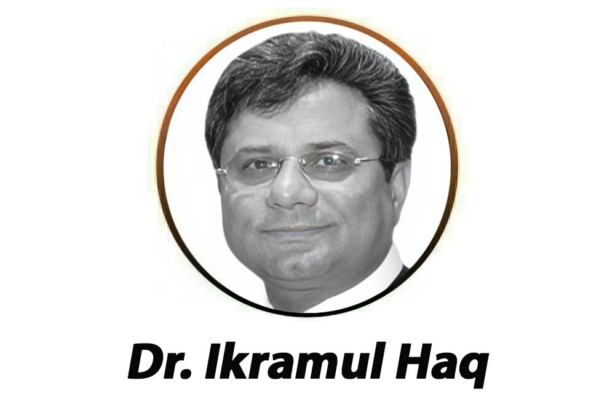
Dr. Ikramul Haq, Advocate Supreme Court, Adjunct Faculty at Lahore University of Management Sciences (LUMS), member Advisory Board and Visiting Senior Fellow of Pakistan Institute of Development Economics (PIDE), holds an LLD in tax laws. He was full-time journalist from 1979 to 1984 with Viewpoint and Dawn. He also served Civil Services of Pakistan from 1984 to 1996.
We welcome your contributions! Submit your blogs, opinion pieces, press releases, news story pitches, and news features to opinion@minutemirror.com.pk and minutemirrormail@gmail.com