Summary
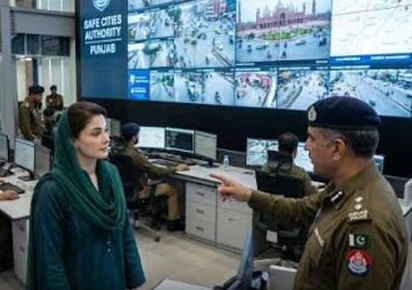
- LAHORE: Punjab Chief Minister Maryam Nawaz Sharif on Friday formally inaugurated the Punjab Integrated Safe City Network, describing it as a major step towards protecting citizens and reducing crime across the province.
- Maryam Nawaz said the government would expand the Safe Smart Cities project to every union council in Punjab.
- The chief minister said the government had transformed every district into a Safe City within the past two and a half years.
LAHORE: Punjab Chief Minister Maryam Nawaz Sharif on Friday formally inaugurated the Punjab Integrated Safe City Network, describing it as a major step towards protecting citizens and reducing crime across the province.
Punjab has become the first province in the country to establish an integrated Safe City network covering all 41 districts and two tehsils.
Officials said coordinated efforts by the police, Crime Control Department (CCD) and Safe Cities Authority had contributed to an estimated 80 per cent decline in crime.
Safe Cities Authority Managing Director Ahsan Younas briefed the chief minister on the province-wide smart surveillance system. He said artificial intelligence (AI) was strengthening monitoring and enabling authorities to respond more quickly to potential threats.
The network combines intelligent surveillance, Emergency Helpline 15, traffic management, real-time command and control, and predictive policing. It also offers services through the Virtual Women Police Station, Child Safety Centre and Blood Bank, along with traffic and environmental monitoring facilities.
The government plans to install another 1,500 panic buttons across Punjab and equip every police station with the facility. Smart screens will also be installed at public locations.
AI-powered cameras will support facial identification and weapon detection, helping law-enforcement agencies improve surveillance and respond to security threats.
Maryam Nawaz said the government would expand the Safe Smart Cities project to every union council in Punjab. She said the province had made significant progress in technology, smart policing and predictive policing.
The chief minister said the government had transformed every district into a Safe City within the past two and a half years. She termed the ability to monitor the entire province through a single system a major achievement.
She said AI-based surveillance and predictive policing were helping authorities identify developments early and take timely action.
Speaking about the security situation, Maryam Nawaz said more than 70 areas of Punjab had previously been considered no-go zones, where people avoided travelling after sunset. She claimed that the government had now eliminated such areas across the province, including the riverine belt.
She added that the riverine region had recorded no serious crime or kidnapping for ransom for nearly 10 months. The administration also recently organised a cricket tournament there, which she described as a sign of improving law and order.
The chief minister said the provincial government would spend Rs30 billion on development projects in the riverine belt, including healthcare and other facilities, with the aim of bringing the area closer to the development standards of Punjab’s cities.
We welcome your contributions! Submit your blogs, opinion pieces, press releases, news story pitches, and news features to opinion@minutemirror.com.pk and minutemirrormail@gmail.com