Summary
- FAISALABAD: The Punjab Water and Sanitation Authority (PWASA) has stepped up its monsoon preparedness by deploying advanced machinery, completing large-scale desilting operations, and launching a modern command and control system aimed at improving flood management and emergency response across the province.
- He noted that this year’s monsoon arrived nearly two weeks later than usual, with heavy rainfall recorded during the second half of July across central and northern Punjab, including Lahore, Gujranwala, Gujrat, Sialkot, Sheikhupura, Okara, and Nankana Sahib.
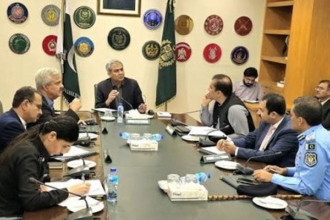
- Fareed said the central control room coordinates directly with field staff while working closely with the Punjab Safe Cities Authority, Rescue 1122, and the Provincial Disaster Management Authority (PDMA) to ensure a faster and more effective response during heavy rainfall.
FAISALABAD: The Punjab Water and Sanitation Authority (PWASA) has stepped up its monsoon preparedness by deploying advanced machinery, completing large-scale desilting operations, and launching a modern command and control system aimed at improving flood management and emergency response across the province.
Speaking to reporters, PWASA Director General Tayyab Fareed said the authority has cleared nearly 650,000 tonnes of solid waste while completing the cleaning of drains, sewer lines, and manholes before the peak monsoon season. He added that a state-of-the-art Central Command and Control Room equipped with 13 digital dashboards is now providing real-time monitoring of rainfall and drainage conditions across Punjab.
Fareed said PWASA was established under the Punjab Water and Sanitation Act in June 2024, initially taking over the province’s five existing Water and Sanitation Agencies (WASAs). Since then, the Punjab government has expanded the network in phases, bringing the total number of district-level WASAs to 41.
He noted that this year’s monsoon arrived nearly two weeks later than usual, with heavy rainfall recorded during the second half of July across central and northern Punjab, including Lahore, Gujranwala, Gujrat, Sialkot, Sheikhupura, Okara, and Nankana Sahib.
According to the PWASA chief, a province-wide 45-day desilting campaign was completed ahead of the rainy season, with all activities digitally tracked to improve transparency and operational efficiency.
To strengthen sanitation services, the Punjab government has invested heavily in new equipment. Machinery worth Rs6.5 billion has been procured for 15 major cities, while an additional Rs7.5 billion has been allocated to equip smaller WASAs established during the latest expansion phase.
In total, around 950 machinery units, including dewatering pumps, cranes, tractor-trolleys, backhoe loaders, and other specialized equipment, are planned for deployment across Punjab. More than 300 units have already been delivered to field teams.
Fareed said the central control room coordinates directly with field staff while working closely with the Punjab Safe Cities Authority, Rescue 1122, and the Provincial Disaster Management Authority (PDMA) to ensure a faster and more effective response during heavy rainfall.
He also highlighted several long-term infrastructure projects designed to improve water management. These include a proposed Rs55 billion wastewater treatment project in Lahore and another project of similar value that will treat water from the BRB Canal to provide a sustainable surface water supply, reducing dependence on groundwater.
In addition, PWASA has constructed 18 underground rainwater storage tanks in Lahore and 10 more in Faisalabad, Gujranwala, Sheikhupura, Nankana Sahib, Okara, and Sahiwal. The tanks are currently being used to collect rainwater during the monsoon and are emptied after rainfall to prepare for future weather events, helping improve urban flood management across the province.
We welcome your contributions! Submit your blogs, opinion pieces, press releases, news story pitches, and news features to opinion@minutemirror.com.pk and minutemirrormail@gmail.com