Summary
- This omission explains why Pakistan has experienced almost continuous tax reform without ever achieving a stable tax system.
- Structural adjustment initiatives were followed by the Tax Administration Reform Project (TARP), Pakistan Revenue Programme (PRRP), Pakistan Raises Revenue Project, Raftar, Remit and numerous technical assistance programmes financed by the International Monetary Fund, the World Bank, the Asian Development Bank and bilateral development partners.
- Ikramul Haq, Tax Reforms in Pakistan: Historic & Critical View (Pakistan Institute of Development Economics), especially the discussion of historical reform initiatives and institutional weaknesses.
Pakistan has spent four decades reforming its tax administration. Governments have established commissions, enacted restructuring plans, borrowed billions of rupees for donor-funded modernisation projects and repeatedly amended tax laws. However, the country’s tax system remains among the most complex, least predictable and least trusted in the developing world.
This Part argues that the recurring failure of tax reforms is rooted not in administrative weakness alone but in the absence of a coherent philosophy of taxation. Before institutions can be reformed, the ideas that justify their existence must themselves be examined.
Every enduring tax system begins with a simple question: why does the State tax its citizens? The answer determines everything that follows—the structure of tax laws, the organisation of revenue authorities, the rights of taxpayers and ultimately the legitimacy of government itself. Surprisingly, this elementary question has seldom been asked in Pakistan. Public debate has instead revolved around revenue targets, tax rates, exemptions, withholding taxes, digitisation, automation and, more recently, artificial intelligence. The machinery has changed repeatedly; the destination has remained undefined.
This omission explains why Pakistan has experienced almost continuous tax reform without ever achieving a stable tax system. Reform has been understood as an administrative exercise rather than an intellectual one. Institutions have been reorganised, computerised and renamed, but the principles that ought to govern taxation have never been articulated in a comprehensive manner. This is explained and discussed in two books mentioned in the bibliography at the end. Both are available free on line.
The distinction is fundamental. Tax philosophy asks why taxation exists and what relationship it should establish between the citizen and the State. Tax policy determines what should be taxed, at what rates and for what economic objectives. Tax administration merely implements those choices through legislation, institutions and procedures. Pakistan has devoted enormous effort to improving administration, intermittent attention to policy and almost none to philosophy. The consequence has been increasingly sophisticated methods of collecting increasingly inefficient taxes.
The world’s major traditions of public finance illustrate why philosophy matters. Adam Smith regarded taxation as an indispensable price of civilisation but insisted that it must satisfy four enduring canons: equity, certainty, convenience and economy. Later economists viewed taxation as an instrument for correcting market failures and promoting social welfare.
Constitutional economists, particularly James Buchanan, argued that taxation derives its legitimacy not merely from legislative power but from constitutional consent expressed through representative institutions.
Although these traditions differ in emphasis, they share a common premise: taxation exists to strengthen the social contract rather than merely to finance the State. Pakistan’s experience has evolved differently. Since the late 1980s, successive governments have launched an almost uninterrupted succession of tax reform programmes.
Structural adjustment initiatives were followed by the Tax Administration Reform Project (TARP), Pakistan Revenue Programme (PRRP), Pakistan Raises Revenue Project, Raftar, Remit and numerous technical assistance programmes financed by the International Monetary Fund, the World Bank, the Asian Development Bank and bilateral development partners. Each promised efficiency, transparency and enhanced revenue mobilisation. Each introduced new organisational structures, information technology and administrative procedures. Yet none began by asking what the tax system itself was expected to achieve.
This common omission explains their remarkably similar outcomes. Administrative capacity to further the cause of unconstitutional extraction and enforce oppressive taxation has undoubtedly improved. Electronic filing expanded. Risk-based audits were introduced.
Information technology became more sophisticated. However, the tax base remained narrow, compliance costs increased, legislation became progressively more complex and revenue targets continued to depend disproportionately upon the already documented sector of the economy. Reform was measured by the volume of taxes collected rather than by the quality of the tax system that produced them.
The evidence is difficult to ignore. During the past decade, governments repeatedly announced ambitious revenue targets only to revise them downward as the fiscal year progressed. Successive administrations then celebrated achieving or approaching these revised figures while presenting them as evidence of successful reform.
The recurring gap between original targets and actual collections reflects more than forecasting errors. It reveals a structural disconnect between fiscal aspirations and economic realities. Tax administration cannot permanently compensate for weaknesses in tax policy, nor can tax policy compensate for the absence of a coherent philosophy of taxation.
The same pattern appears in legislative practice. Every annual Finance Act introduces dozens, sometimes hundreds, of amendments intended to close loopholes, strengthen enforcement or create new withholding obligations. Rarely does Parliament examine whether the cumulative effect of these amendments has improved simplicity, neutrality or certainty.
Complexity has become an accepted indicator of reform. With every additional provision imposes compliance costs upon businesses, creates interpretative disputes and enlarges administrative discretion. A tax system should become simpler as it matures; Pakistan’s has become progressively more intricate.
The growing emphasis on technology illustrates the same conceptual confusion. Digitalisation undoubtedly has an important role in modern tax administration. Electronic invoicing, data analytics and integrated information systems can reduce evasion and improve efficiency. However, technology cannot substitute for sound policy.
Artificial intelligence cannot identify transactions that remain outside the documented economy. Algorithms cannot replace constitutional safeguards. Faceless assessments cannot by themselves create trust between taxpayers and the revenue administration. Digitisation without documentation merely automates existing imperfections.
The underlying problem therefore extends beyond the Federal Board of Revenue (FBR). Indeed, concentrating criticism exclusively upon the FBR obscures the institutional nature of the challenge. Revenue authorities administer the tax system they are given. They neither determine constitutional principles nor formulate national economic strategy.
Responsibility for reform therefore belongs equally to Parliament, the executive, provincial governments, policy advisers and the international institutions that have shaped Pakistan’s fiscal architecture for more than three decades. Reforming the FBR without reforming the philosophy that governs taxation resembles replacing the engine of a vehicle without deciding where it is intended to travel.
A more coherent approach would begin elsewhere. Pakistan requires a National Tax Reform Commission constituted not merely of tax administrators but also constitutional lawyers, economists, accountants, business representatives, technology specialists and provincial nominees. Its first responsibility should not be drafting legislative amendments. It should instead formulate the principles upon which Pakistan’s tax system ought to rest. Only after these principles have been publicly debated and democratically accepted should institutional restructuring commence.
Those principles are neither mysterious nor unprecedented. Taxation should promote economic growth before attempting to maximise short-term revenue. It should broaden the base before increasing rates. It should reward voluntary compliance rather than rely predominantly upon compulsory withholding. It should respect constitutional federalism, minimise compliance costs, protect taxpayer rights and ensure predictability sufficient to encourage long-term investment. Above all, taxation should strengthen the reciprocal relationship between citizen and State rather than transform that relationship into one of perpetual coercion.
The central lesson emerging from four decades of reform is therefore remarkably simple. Pakistan has never lacked reform projects. It has lacked an agreed philosophy of taxation. Without such a philosophy, every administrative innovation, however sophisticated, becomes another attempt to improve the machinery of a system whose destination remains uncertain.
The remaining parts of this series will examine how this philosophical vacuum has shaped Pakistan’s fiscal institutions, why repeated reform initiatives have failed to achieve their stated objectives, and what constitutional, economic and institutional changes are required if taxation is to become an instrument of national development rather than merely a mechanism of revenue extraction.
[To be continued]
Bibliography
- Adam Smith, An Inquiry into the Nature and Causes of the Wealth of Nations (1776), Book V.
- Richard A. Musgrave, The Theory of Public Finance (1959).
- James M. Buchanan and Geoffrey Brennan, The Power to Tax: Analytical Foundations of a Fiscal Constitution (1980).
- Joseph E. Stiglitz, Economics of the Public Sector.
- Huzaima Bukhari & Dr. Ikramul Haq, Towards Flat, Low-rate, Broad and Predictable Taxes (Policy Research Institute of Market Economy), particularly the Executive Summary and chapters on a National Tax Agency, National Tax Tribunal and growth-oriented taxation.
- Huzaima Bukhari & Dr. Ikramul Haq, Tax Reforms in Pakistan: Historic & Critical View (Pakistan Institute of Development Economics), especially the discussion of historical reform initiatives and institutional weaknesses.
____________________________________________________________________
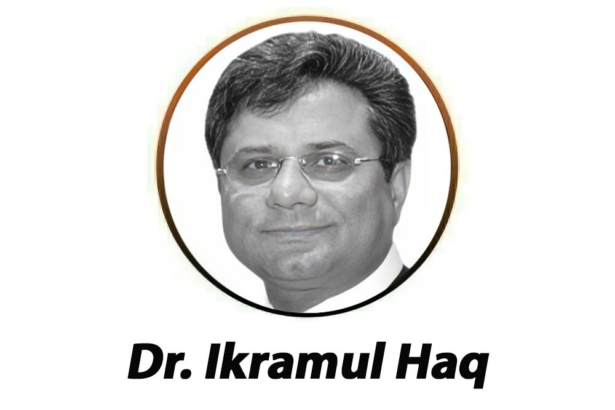
Dr. Ikramul Haq, Advocate Supreme Court, Adjunct Faculty at Lahore University of Management Sciences (LUMS), member Advisory Board and Visiting Senior Fellow of Pakistan Institute of Development Economics (PIDE), holds an LLD in tax laws. He was full-time journalist from 1979 to 1984 with Viewpoint and Dawn. He also served Civil Services of Pakistan from 1984 to 1996.
We welcome your contributions! Submit your blogs, opinion pieces, press releases, news story pitches, and news features to opinion@minutemirror.com.pk and minutemirrormail@gmail.com