Summary
- State capture concerns the power to shape the rule itself: legislation, appointments, budgets, tax exemptions, regulatory waivers, public procurement, access to land and credit, and the selective use of enforcement.
- In such an order, rents are not accidental leakages from policy; they help organise political power.
- Capture need not occur outside law; it can determine the law’s architecture.
Development economics asks which policies can raise productivity, employment and welfare. In Pakistan an earlier question is unavoidable: who controls the institutions that choose, finance and enforce those policies—and whose interests are protected when policy fails?
- Capture is a system, not a bribe
- Pakistan’s political settlement
- Why sound policy is captured
- Reform the allocator
The first part of this series argued that general development prescriptions become unreliable when institutional context is removed. Pakistan requires a deeper inquiry. Most policy advice assumes that the State is a coherent public authority capable of selecting projects, disciplining beneficiaries, learning from failure and applying rules impartially. That assumption is not a minor technical detail. It determines whether the proposed policy can work.
Pakistan is not governed by a State that is uniformly weak. It is selectively powerful: strong in extracting from documented citizens, enforcing upward transfers, controlling dissent and allocating privilege; weak in providing universal education, health, municipal services, competitive markets and equal protection of law. The relevant economic variable is therefore not capacity alone, but the purposes for which capacity is mobilised.
Capture is a system, not a bribe
Ordinary corruption concerns the abuse of an existing rule. State capture concerns the power to shape the rule itself: legislation, appointments, budgets, tax exemptions, regulatory waivers, public procurement, access to land and credit, and the selective use of enforcement. The World Bank accordingly treats capture as a distortion of how institutions operate and who controls them. A captured State may be procedurally legal. Its privileges can be enacted by Parliament, notified by government and upheld by courts. Legality does not answer the economic question: who designed the rule, who bears its cost and who can resist its application?
The World Bank’s Pakistan@100 governance study itself described capture as the outcome of military, political, business and bureaucratic manoeuvring. This is more accurate than a morality play dividing society into one guilty institution and innocent civilians. Yet it must not obscure hierarchy. The military establishment remains the dominant pole of Pakistan’s institutional order, while judges, civil servants, political parties and landed, industrial and financial interests have repeatedly enabled, legitimised or benefited from that dominance. The term ‘militro-judicial-civil complex’ is useful only when it identifies this structure of reciprocal advantage rather than serving as a slogan.
Pakistan’s political settlement
Hamza Alavi’s 1972 essay on the post-colonial State located Pakistan’s institutional imbalance in the colonial inheritance. A comparatively overdeveloped military-bureaucratic apparatus acquired autonomy from weak representative institutions and mediated among landed, indigenous capitalist and external interests. The composition of this coalition has changed, but the asymmetry between coercive-administrative power and democratic accountability has persisted.
Mushtaq Khan’s theory of political settlements explains why formally identical institutions produce different results. Enforcement depends on the actual distribution of organisational power. Douglass North, John Wallis and Barry Weingast describe a related ‘limited-access order’ in which powerful organisations are stabilised through privileged access to economic opportunities. In such an order, rents are not accidental leakages from policy; they help organise political power. Aqil Shah’s work on military intervention and Ayesha Siddiqa’s analysis of the military economy show how this logic has operated in Pakistan’s political and commercial spheres.
Recent law makes the settlement visible. The Twenty-Seventh Constitutional Amendment of 2025 restructured the higher judiciary through a Federal Constitutional Court and altered Article 243 to centralise military command and entrench exceptional rank, privileges and protections for five-star officers. Whatever administrative justifications are offered for these arrangements, the economic point is plain: an unequal distribution of institutional power can be converted into constitutional text. Capture need not occur outside law; it can determine the law’s architecture.
The Special Investment Facilitation Council (SIFC) provides a second test. Speeding investment and coordinating governments are legitimate objectives. But section 10F of the Board of Investment law permits regulatory requirements to be relaxed or exempted on the Council’s recommendation, while section 10G supplies broad protection for good-faith acts.
The IMF’s 2025 Governance and Corruption Diagnostic Assessment warned that these powers, exemptions and immunities raise concerns about concentrated authority, parliamentary scrutiny and accountability. It nevertheless placed wider political dynamics, including the military’s role, largely outside its scope.
This is the scientific weakness in an otherwise useful diagnostic. If the institution capable of shaping appointments, exemptions, investment decisions and accountability is excluded from the causal field, the report can catalogue procedural defects but cannot adequately explain their persistence. The omitted variable is not peripheral to governance; it organises governance.
Why sound policy is captured
The development programme discussed in Part I—productive credit, vocational training, technology support, public procurement, place-based assistance and policy experimentation—requires discretion. In an accountable State, discretion can correct market failure. In a captured State, it can allocate advantage. Cheap credit goes to connected borrowers; land is transferred without transparent valuation; procurement specifications favour insiders; temporary protection becomes permanent; and a failed experiment survives because its beneficiary can discipline the evaluator.
Industrial policy is not discredited by this danger. Successful industrialisation has always involved public coordination. Its essential complement, however, is reciprocal discipline: measurable performance conditions, disclosure of support, recovery of benefits when conditions are breached, and the credible withdrawal of privilege. Where the beneficiary possesses greater organisational power than the regulator, reciprocity collapses and policy becomes patronage.
The same political settlement shapes IMF stabilisation. External institutions negotiate with the formal government and record fiscal measures as national ‘ownership’. The domestic coalition then determines incidence. Adjustment falls on indirect taxes, petroleum levies, utility tariffs, wage earners, pensioners and documented businesses, while privileged incomes, assets, concessions and commercial domains remain difficult to scrutinise. Pakistan’s debt state can enforce adjustment downward while remaining unwilling to tax privilege upward. This is not an unintended implementation gap; it is a distributive outcome.
Reform the allocator
A serious development strategy must reform the allocator as well as the allocation. Every commercial entity should face the same company, competition, tax, procurement, audit and beneficial-ownership rules, irrespective of its sponsoring institution.
Every SIFC exemption should disclose the beneficiary, legal basis, fiscal value, duration and performance condition, and remain reviewable by Parliament, the Auditor-General and the Public Accounts Committee. Immunity should be narrowly confined, not allowed to become insulation from investigation. Tax expenditures and subsidised credit should carry sunset clauses and publish measurable results.
Fiscal reform must also restore constitutional political economy. Articles 160 and the Eighteenth (Constitutional) Amendment Act of 2010 should protect democratic federalism rather than permit fiscal recentralisation disguised as governance reform.
Article 140A requires elected local governments; it must be supported by regular elections, provincial finance commissions and real administrative and revenue authority. Credible elections, an independent judiciary, effective parliamentary budget scrutiny and civilian constitutional control of security institutions are not ornamental political demands. They are economic institutions that determine whether contracts, taxes and public investment operate under general rules.
Research should consequently ask more than whether a policy worked elsewhere. Which organisation in Pakistan can block, capture or distort it? Which groups receive concentrated benefits and which bear dispersed costs? What information must be public? What sanction can be enforced against a powerful beneficiary? Which observable result would require the policy to be withdrawn? These questions convert anger into a testable political economy.
A Pakistan-specific research programme should construct a capture ledger: every tax expenditure, regulatory waiver, public-land allotment, state-backed loan, procurement award, tariff protection and court-ordered suspension mapped by beneficiary, value, duration, legal authority and performance outcome.
Network analysis can identify repeat beneficiaries and institutional connections; event studies can test whether concessions raise investment, jobs or exports; and distributional analysis can establish who pays. This is not investigative theatre. It is the minimum data architecture required to distinguish productive coordination from rent protection and to test whether formally neutral rules are applied asymmetrically.
State capture is not a counsel of despair. It is an empirical variable that must enter the model. Economics begins with scarcity; Pakistan’s political economy begins with unequal authority over scarcity. Until that authority is constitutionally restrained, transparent and answerable, development policy will remain a language through which privilege reproduces itself. Before choosing winners, Pakistan must decide who writes the rules—and who remains subject to them. The next part will examine one arena where this power becomes immediately visible: prices.
References
Alavi, Hamza. 1972. “The State in Post-Colonial Societies: Pakistan and Bangladesh.” New Left Review 74.
Hanson, Gordon, Dani Rodrik and Rohan Sandhu. 2026. “Rethinking Development.” Finance & Development, September.
International Monetary Fund. 2025. Pakistan: Governance and Corruption Diagnostic Assessment.
Khan, Mushtaq H. 2010. “Political Settlements and the Governance of Growth-Enhancing Institutions.” SOAS, University of London.
National Assembly of Pakistan. 2025. Constitution (Twenty-Seventh Amendment) Act, 2025.
North, Douglass C., John Joseph Wallis and Barry R. Weingast. 2009. Violence and Social Orders. Cambridge University Press.
Pakistan. 2023. Board of Investment (Amendment) Act, 2023.
Shah, Aqil. 2014. The Army and Democracy: Military Politics in Pakistan. Harvard University Press.
Siddiqa, Ayesha. 2017. Military Inc.: Inside Pakistan’s Military Economy. Pluto Press.
World Bank. 2019. Pakistan@100: Governance and Institutions.
(To be continued)
________________________________________________________________
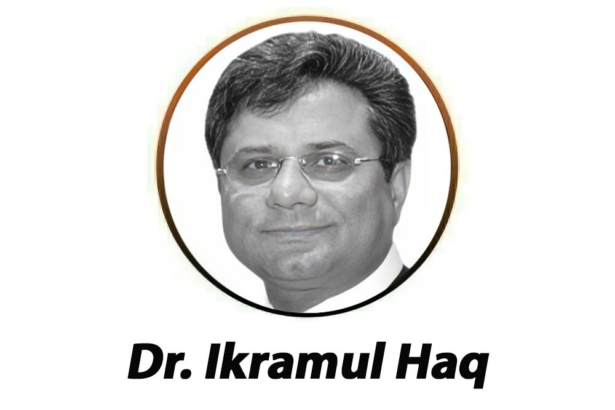
Dr. Ikramul Haq, Advocate Supreme Court, writer, literary critic, Adjunct Faculty at Lahore University of Management Sciences (LUMS), member Advisory Board and Visiting Senior Fellow of Pakistan Institute of Development Economics (PIDE), holds an LLD in tax laws. He was full-time journalist from 1979 to 1984 with Viewpoint and Dawn. He also served Civil Services of Pakistan from 1984 to 1996.
We welcome your contributions! Submit your blogs, opinion pieces, press releases, news story pitches, and news features to opinion@minutemirror.com.pk and minutemirrormail@gmail.com