Summary
- Pakistani reporting quickly converted this carefully limited phrase into a more expansive claim: Pakistan was presented as a “model for debt, growth and reform.” Georgieva referred to reform implementation, domestic resource mobilisation, liability management and private-sector inflows at lower cost.
- Pakistan is not wrong to improve debt management or seek lower-cost capital.
- “IMF Cites Pakistan as Model for Debt, Growth and Reform Drive.” Business Recorder, September 4.
Pakistan should welcome cheaper finance, longer maturities and stronger reserves. It should not call them development until borrowing and taxation expand productive capacity, human capabilities and broadly shared incomes—and reduce the need for the next rescue.
Part VI argued that human capital begins before school and that Pakistan cannot build it while spending only 0.8 per cent of GDP each on public education and health. This makes a recent assessment by the International Monetary Fund (IMF) especially important.
At the conclusion of the G20 finance ministers’ meeting on September 1, Managing Director Kristalina Georgieva said the joint IMF-World Bank “Three-Pillar Approach” had “worked well” in countries such as Ecuador and Pakistan.
Pakistani reporting quickly converted this carefully limited phrase into a more expansive claim: Pakistan was presented as a “model for debt, growth and reform.” Georgieva referred to reform implementation, domestic resource mobilisation, liability management and private-sector inflows at lower cost.
She did not publish a country evaluation or counterfactual establishing sustainable debt, stronger growth and inclusive development. What worked, by which indicator, over what period and for whom? Without answers, endorsement becomes narrative rather than evidence.
Three tests, not one
Liquidity, solvency and development are distinct. Liquidity means having cash or refinancing to meet obligations falling due. Debt sustainability asks whether obligations can be met without implausibly large adjustment, repeated exceptional financing or restructuring. Development asks whether resources raised increase productive capacity, foreign-exchange earnings, resilience, public services and citizens’ capabilities so that dependence declines.
A country can pass the first test while failing the next two. A rollover prevents default but does not reduce principal. A maturity extension lowers near-term risk but not necessarily the present value of debt. A private bond supplies foreign exchange; unlike direct investment, it creates a repayment obligation. Liability management is valuable, but its success cannot be inferred from meeting another payment date.
There has been measurable progress. The IMF’s May 2026 review reports that the average maturity of local-currency domestic debt increased from 2.7 years at the programme’s outset to about four years at end-December 2025. The State Bank of Pakistan records official liquid reserves rising from $14.58 billion in June 2025 to $18.45 billion in June 2026. These improvements buy time and reduce immediate risk. They deserve acknowledgement, not exaggeration.
The IMF’s own warning
The same IMF review prevents any declaration of victory. It says public debt remains sustainable under its baseline, but assesses the overall risk of sovereign stress as high, reflecting elevated debt, high gross financing needs and low reserve buffers.
Its identified safeguards include the domestic banking system’s ability to roll over government debt and financial commitments from bilateral partners. Gross financing needs are projected at 17.9 per cent of GDP in 2026 and 17.2 per cent in 2027. Sustainability is conditional upon policy continuity, refinancing and official support—not a settled structural fact.
At end-June 2026, public external debt stood at $106.76 billion and total external debt and liabilities at $138.85 billion.
The SBP’s debt-servicing statement records $15.97 billion in long-term principal and $5 billion in interest during fiscal year (FY) 2026; including reported short-term principal other than bank rollovers takes the total to about $21.59 billion. Nearly $10.14 billion fell in the final quarter. Meeting this schedule demonstrates liquidity management, not necessarily reduced vulnerability.
Debt ratios can improve through real growth, primary surpluses, inflation, exchange-rate valuation, changes in coverage or one-off transactions. The IMF projects public debt to decline, while showing real growth of 3.6 per cent in FY2026, 3.5 per cent in FY2027 and foreign direct investment of 0.5 per cent of GDP in both years.
The scientific response is decomposition: how much comes from durable productivity and foreign-exchange capacity, and how much from fiscal compression, prices and refinancing?
Mobilising whose resources?
The phrase “domestic resource mobilisation” is similarly incomplete until its incidence is disclosed. The IMF review says Pakistan’s primary surplus in the first half of FY2026 was achieved mainly through expenditure compression.
The Federal Board of Revenue (FBR) revenue missed the programme’s indicative target by 0.3 per cent of GDP; petroleum levy collections and provincial taxes broadly offset the shortfall. The report itself adds that consolidation had relied primarily on increasing revenue from the formal sector.
This is not broad-based tax reform. Pakistan’s revenue debate mixes FBR taxes, provincial and local taxes, fees and federal non-tax levies into one flattering ratio. Withholding and minimum taxes can be labelled “direct” while behaving as transaction taxes passed into prices.
The petroleum levy is outside the divisible pool, though provinces carry primary responsibility for health and education. Squeezing compliant businesses, salaries and consumption while undertaxed wealth remains protected may stabilise accounts while weakening investment, federalism and inclusion.
The contradiction is visible: the Pakistan Economic Survey 2025-26 reports education spending at 0.8 per cent of GDP in FY2025, while its health chapter reports the same for public health. Revenue mobilisation deserves the adjective “growth-enhancing” only when its design is equitable and the resulting fiscal space is actually converted into human and productive capacity.
A management system is not yet a development system
The IMF’s November 2025 Governance and Corruption Diagnostic found debt-management responsibilities fragmented, institutional roles uncertain and the main repository limited to external debt. Domestic-debt integration was under way, while some issuance decisions appeared ad hoc and cash forecasting often rationed available cash rather than projecting realistic flows. The May 2026 review records progress in maturity and contingent-liability management. Reform is continuing; the institutional problem is not solved.
An independent Finance for Development Lab analysis classifies Pakistan as solvent but liquidity-constrained. It argues that the approach has generally fallen short because official finance and guarantees are inadequate, creditors have not maintained exposure on reasonable terms, and scarce resources can flow through debtors to existing creditors instead of investment. The diagnosis is contestable but testable; a success label cannot answer it.
Pakistan needs a debt-and-development account
Parliament should amend the Fiscal Responsibility and Debt Limitation framework to require an annual Debt and Development Account alongside the budget. Its first part should present a reconciled public-sector balance sheet covering the federal and provincial governments, the central bank, guaranteed and non-guaranteed SOE exposure, circular debt, commodity operations, public-private partnerships and other contingent liabilities. Different perimeters used by the Finance Division, SBP and IMF must be bridged rather than selectively quoted.
The second part should publish a rolling three-year liquidity map: gross financing needs, creditor and currency concentration, fixed and floating rates, maturities, committed rollovers, new money and the present-value saving from every liability-management operation. The third should disclose the incidence of fiscal adjustment by income group, sector and province, separating genuine income taxation from withholding, minimum and presumptive taxes, and taxes from levies.
Most importantly, every material borrowing should have a public use-and-results ledger: effective cost, procurement, beneficial ownership, implementation status, economic return, jobs created, export earnings or import savings, and measurable effects on health, education and climate resilience. The Auditor-General, parliamentary finance committees and an independent fiscal council should validate the account. IMF and World Bank claims of success should then be assessed against disclosed baselines and outcomes rather than repeated as certificates.
Pakistan is not wrong to improve debt management or seek lower-cost capital. Refusing costly refinancing without an alternative can itself destroy development. The error lies in allowing an operational achievement to stand in for a national transformation. Debt management buys time; development is what a country builds with that time. Pakistan will have escaped the trap not when it becomes better at refinancing dependence, but when it no longer needs dependence to finance survival.
References
Amin, Tahir. 2026. “IMF Cites Pakistan as Model for Debt, Growth and Reform Drive.” Business Recorder, September 4.
Diwan, Ishac, and Jules Devie. 2026. “Wilton Park’s Dialogue on ‘Advancing Sovereign Debt Sustainability’: Current Financial Conditions and the Search for an Effective New Initiative.” Finance for Development Lab Short Note, February.
Finance Division, Government of Pakistan. 2026. “Education” and “Health and Nutrition.” Pakistan Economic Survey 2025-26.
Georgieva, Kristalina. 2026. “Statement at the Conclusion of the G20 Finance Ministers and Central Bank Governors Meeting.” International Monetary Fund, September 1.
International Monetary Fund. 2026. Pakistan: Third Review Under the Extended Arrangement Under the Extended Fund Facility and Second Review Under the Resilience and Sustainability Facility Arrangement. IMF Country Report No. 26/101, May.
International Monetary Fund. 2025. Pakistan: Governance and Corruption Diagnostic Assessment. Technical Assistance Report, November.
State Bank of Pakistan. 2026. “Pakistan’s External Debt and Liabilities—Outstanding.” Data through June 30.
State Bank of Pakistan. 2026. “Pakistan’s External Debt Servicing—Principal and Interest.” FY2026.
(To be continued)
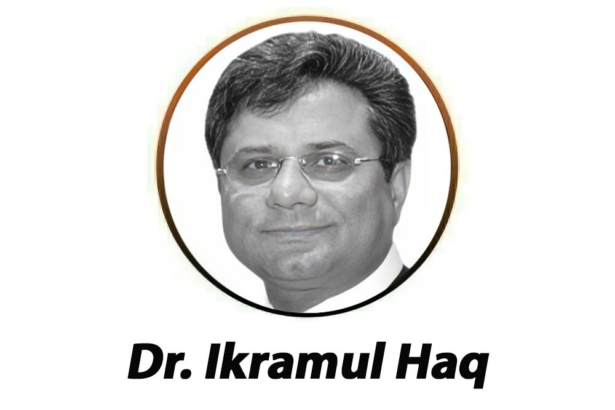
Dr. Ikramul Haq, Advocate Supreme Court, writer, literary critic, Adjunct Faculty at Lahore University of Management Sciences (LUMS), member Advisory Board and Visiting Senior Fellow of Pakistan Institute of Development Economics (PIDE), holds an LLD in tax laws. He was full-time journalist from 1979 to 1984 with Viewpoint and Dawn. He also served Civil Services of Pakistan from 1984 to 1996.
We welcome your contributions! Submit your blogs, opinion pieces, press releases, news story pitches, and news features to opinion@minutemirror.com.pk and minutemirrormail@gmail.com