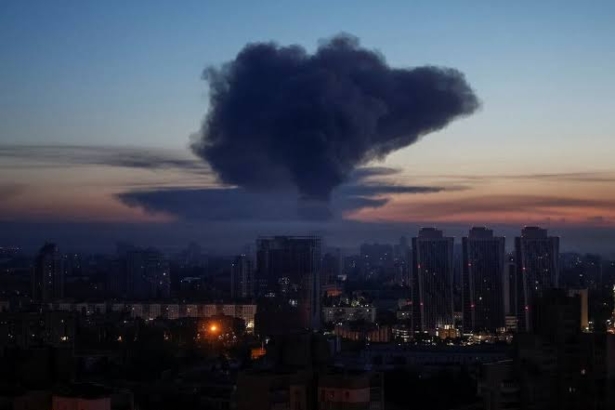
Russia unleashed one of its largest assaults on Ukraine’s capital Kyiv in the early hours of Thursday, firing hundreds of drones and dozens of missiles that killed at least 21 people, wounded scores more, and damaged around 130 buildings.
Explosions reverberated across the city throughout the night as thousands of residents sought shelter in underground metro stations and bomb shelters. Officials said the strike caused the widest destruction in Kyiv this year and was the deadliest since May, when 24 people were killed in an attack that destroyed an apartment block.
President Volodymyr Zelenskiy, who cut short a visit to Ireland to return home, said damage had been reported at more than 20 sites across the capital. “The main strike was directed at Kyiv. Air defence supplies for Ukraine are an absolute and critical priority,” he said, urging allies to sustain contributions to fund US-made Patriot air defence systems.
Ukraine’s air force reported Russia launched 74 missiles and 496 drones overnight, noting the unusually high number of ballistic missiles and a low interception rate due to shortages of Patriot missiles. The Russian Defence Ministry said the “massive attack” targeted military, energy facilities, and airports, describing it as retaliation for Ukrainian drone strikes on Russian territory.
Kyiv has intensified strikes on Russia’s fuel supply in recent weeks, including an overnight hit on an oil refinery in Nizhny Novgorod. The Kremlin said commanders briefed President Vladimir Putin on the attacks and vowed to continue increasing pressure to achieve Moscow’s war aims.
Kyiv Mayor Vitali Klitschko announced a day of mourning for Friday, saying damage was recorded across the city of three million people. EU ambassador Katarina Mathernova said “Russia unleashed hell on Kyiv,” noting that accommodation used by diplomatic staff was struck, though diplomats were unharmed.
Emergency services worked through rubble at a nine-storey building on the left bank of the Dnipro River, where fires flared at dawn. Officials said more than 90 people were wounded, including children and paramedics, with some still trapped inside damaged residential blocks. The National Institute of Biochemistry was among the facilities destroyed, with scientists calling the loss of rare equipment a “catastrophe for medical and biological science.”
Neighbouring Poland scrambled fighter jets as a precaution, while Finland briefly imposed an aviation restriction zone in the eastern Gulf of Finland.
The EU’s foreign policy chief Kaja Kallas said sustained military support for Ukraine and tougher sanctions on Moscow were essential. “The more Moscow attacks civilians, the more sanctions must be imposed,” she said.
Russia has killed thousands of civilians in strikes since launching its full-scale invasion in February 2022. Moscow denies deliberately targeting civilians, claiming attacks on civil infrastructure are legitimate military objectives.
Zelenskiy has proposed talks with Putin to end the war, but the Kremlin has rejected negotiations. With Kyiv intensifying strikes inside Russia and Moscow escalating its air campaign, the conflict shows little sign of abating more than four years after it began.