Summary
- Veteran actor Sania Saeed has once again sparked an important conversation about Pakistani television’s storytelling crisis, especially its portrayal of women.
- Saeed pointed out that Pakistani television often limits women to two extremes: the helpless, victimized “mazloom” figure or the scheming antagonist who exists only to create conflict.
- In calling for flawed, complex women on screen, Sania Saeed is ultimately asking for a more honest reflection of society—one that does not simplify women into stereotypes but allows them to exist fully as human beings.
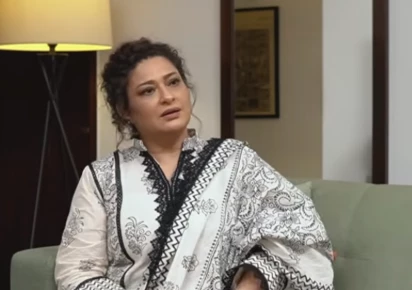
Veteran actor Sania Saeed has once again sparked an important conversation about Pakistani television’s storytelling crisis, especially its portrayal of women. In a recent interview with journalist Aamna Haider Isani, she critically examined how mainstream dramas continue to rely on outdated stereotypes instead of developing layered, realistic female characters.
Saeed pointed out that Pakistani television often limits women to two extremes: the helpless, victimized “mazloom” figure or the scheming antagonist who exists only to create conflict. According to her, this binary framing reduces women to one-dimensional roles and ignores the complexity of real human experience. She argued that such writing not only weakens storytelling but also underestimates audiences who are capable of engaging with more meaningful narratives.
During the conversation, she challenged a common industry excuse that “audiences prefer simple stories.” She rejected this idea, saying that repetitive and overly simplified dramas actually condition viewers to consume content passively rather than critically. In her view, entertainment has become more about background noise than emotional or intellectual engagement, which limits both creativity and audience growth.
Saeed also credited writers like Bee Gul for attempting to break away from formulaic storytelling and creating more morally complex female characters. She emphasized that such writing is essential if Pakistani television wants to evolve beyond repetitive family conflicts and predictable character arcs.
At the heart of her argument is a demand for “flawed women” on screen—characters who are not purely good or evil but exist in morally grey spaces, just like real people. She believes that avoiding complexity in female roles reflects a deeper cultural discomfort with women who are independent, contradictory, or emotionally layered.
The actor’s remarks also point toward a broader crisis in Pakistani television, where commercial pressures often prioritize high ratings over narrative innovation. As a result, writers frequently recycle successful formulas instead of experimenting with new ideas or character structures.
Saeed’s stance is consistent with her long career of choosing challenging roles in theatre and television. She has often been associated with projects that push boundaries and question social norms, making her one of the most respected voices in Pakistan’s entertainment industry.
Her latest comments serve as a reminder that meaningful storytelling requires risk-taking. Without it, Pakistani dramas risk becoming repetitive and disconnected from the evolving realities of their audience.
In calling for flawed, complex women on screen, Sania Saeed is ultimately asking for a more honest reflection of society—one that does not simplify women into stereotypes but allows them to exist fully as human beings.