Summary
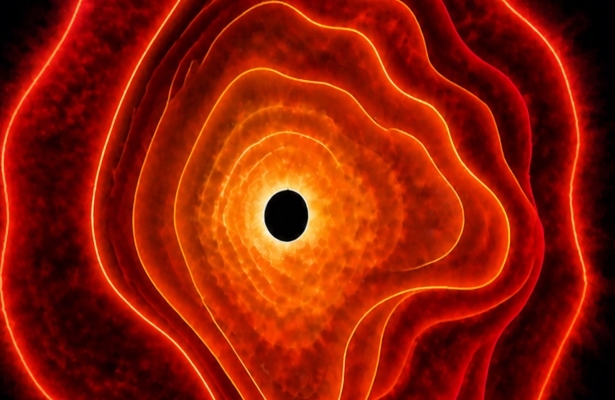
- According to them, it is a “black hole star” about the size of our solar system and glowing with extremely bright red light.
- Computer simulations suggested that rather than being an extremely massive star, the object is actually a black hole that shines like a star.
- If the scientists’ interpretation is confirmed, it could indicate that many of the mysterious red dots observed across the universe may also be black hole stars.
Scientists claim to have discovered a fascinating cosmic mystery. According to them, it is a “black hole star” about the size of our solar system and glowing with extremely bright red light.
An international team of researchers made the discovery using images captured by NASA’s James Webb Space Telescope (JWST) which revealed the mysterious red glow.
The black hole star is located in the constellation Cetus, billions of light-years away from Earth. Scientists believe it may have formed around 660 million years after the Big Bang.
It appears similar to a massive star but is estimated to release 100 billion times more energy than an ordinary star. Such enormous energy output has previously been associated with black holes rather than stars.
Scientist Rohan Naidu of the Massachusetts Institute of Technology (MIT) who was part of the research team said that they had discovered an entirely new type of cosmic phenomenon.
He explained that the object is shining with an amount of energy normally associated with black holes while at the same time displaying characteristics typically linked to stars.
First observed by James Webb Space Telescope
Scientists have been using the James Webb Space Telescope to study distant galaxies in the universe. Their interest in this phenomenon increased after the discovery of the galaxy Maisie’s Galaxy (CEERS 1) and other early-universe objects.
In a study published in the journal Nature, researchers named the red-light phenomenon MAM-BH1. They said its completely red appearance and disappearance at specific wavelengths are so dramatic that it cannot easily be compared with other known cosmic objects.
Computer simulations suggested that rather than being an extremely massive star, the object is actually a black hole that shines like a star.
If the scientists’ interpretation is confirmed, it could indicate that many of the mysterious red dots observed across the universe may also be black hole stars. Rohan Naidu believes that these types of black hole stars could play an important role in the evolution of galaxies.
We welcome your contributions! Submit your blogs, opinion pieces, press releases, news story pitches, and news features to opinion@minutemirror.com.pk and minutemirrormail@gmail.com