Summary
- He said Singapore and Pakistan shared the same position on the issue, adding that secure maritime routes were essential for countries dependent on international trade.
- He said Pakistan and Singapore enjoyed strong diplomatic relations, but their trade volume remained below its potential.
- He also highlighted plans to reopen the Pakistan Trade and Investment Office at the Pakistan High Commission in Singapore, describing the move as part of Islamabad’s efforts to promote business-to-business cooperation.
ISLAMABAD: Singapore’s Foreign Minister Vivian Balakrishnan has praised Pakistan’s diplomatic engagement in the Gulf, describing its role as unique and constructive amid regional tensions.
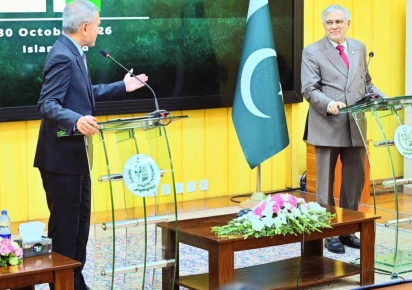
Speaking at a joint press briefing with Deputy Prime Minister and Foreign Minister Ishaq Dar on Friday, Balakrishnan wished Pakistan success in its efforts, saying its progress would benefit the wider international community.
He noted that much of the energy transported through the Gulf was destined for South Asia, Southeast Asia and Northeast Asia. He said Pakistan’s role in the current situation was therefore particularly important.
Balakrishnan also highlighted the importance of international law, particularly the United Nations Convention on the Law of the Sea (UNCLOS). He stressed that freedom of navigation and overflight through international straits was a legal right, not something granted at the discretion of coastal states.
He said Singapore and Pakistan shared the same position on the issue, adding that secure maritime routes were essential for countries dependent on international trade.
Dar said the two sides had discussed the impact of regional tensions on maritime trade. He stressed that secure sea routes and uninterrupted supply chains were vital for economic stability.
He added that Pakistan remained committed to dialogue, diplomacy, international law and the principles of the UN Charter to address regional and global challenges. Islamabad was also in contact with key international partners to encourage diplomatic efforts.
Dar also raised concerns over the expansion of Israeli settlements and attempts to change the status of the West Bank and Al-Quds Al-Sharif. He called for the uninterrupted delivery of humanitarian assistance to Gaza and reiterated Pakistan’s support for an independent Palestinian state based on pre-June 1967 borders, with Al-Quds Al-Sharif as its capital.
He also briefed his Singaporean counterpart on Pakistan’s position regarding a peaceful and lasting settlement of the Jammu and Kashmir dispute in line with relevant UN Security Council resolutions.
Balakrishnan identified trade and economic cooperation as one of three key areas where both countries intend to expand their engagement.
He said Pakistan and Singapore enjoyed strong diplomatic relations, but their trade volume remained below its potential. He called for greater trade and investment flows, stronger links between small and medium-sized enterprises, and more interaction between business communities.
He said businesses in both countries needed better opportunities to understand each other’s markets, risks and investment prospects.
The two sides also discussed cooperation in carbon markets. Balakrishnan described the sector as a promising area for investment in projects that could reduce emissions while supporting sustainable development in Pakistan.
Dar said both countries had agreed to encourage business delegations and strengthen links between their chambers of commerce. He also highlighted plans to reopen the Pakistan Trade and Investment Office at the Pakistan High Commission in Singapore, describing the move as part of Islamabad’s efforts to promote business-to-business cooperation.
The ministers also discussed collaboration in education, research, innovation, artificial intelligence, digital technologies, human resource development, agriculture and climate-related initiatives.
Disaster management was identified as the second major area of cooperation. During the visit, the two countries exchanged a memorandum of understanding between Singapore’s Civil Defence Force and Pakistan’s National Disaster Management Authority (NDMA).
Balakrishnan said the agreement reflected their shared commitment to improving disaster preparedness and response capabilities, particularly as climate change increased the risks posed by extreme weather events.
He acknowledged Pakistan’s experience in dealing with large-scale natural disasters, including floods, and said Singapore could learn from its response efforts.
The agreement is expected to support cooperation in early warning systems, sharing expertise, improving search and rescue capabilities, and conducting joint training programmes and exercises.
Education and people-to-people exchanges
The third area discussed was stronger people-to-people engagement, particularly through education and institutional partnerships.
Balakrishnan welcomed opportunities to expand cooperation between Singapore’s Nanyang Technological University and National University of Singapore and Pakistan’s National University of Science and Technology (NUST).
He said collaboration in education and technology was increasingly important as artificial intelligence and digital technologies transformed industries and employment opportunities.
Dar also called for greater cultural, academic and youth exchanges. He said the two sides had discussed the possible resumption of direct flights to facilitate travel, business activities and closer contact between their people.
60 years of diplomatic relations
Balakrishnan recalled that Pakistan was among the earliest countries to recognise Singapore’s independence. The two countries are marking 60 years of diplomatic relations this year.
He said their ties had been strengthened through high-level exchanges and regular communication, adding that both sides wanted to translate their strong diplomatic relationship into broader practical cooperation.
He also highlighted opportunities for closer engagement between Pakistan and the Association of Southeast Asian Nations (ASEAN), as Singapore prepares to assume the bloc’s chairmanship next year.
Balakrishnan said Pakistan, which has been an ASEAN sectoral dialogue partner for decades, could explore further opportunities for cooperation with the organisation and its member states.
We welcome your contributions! Submit your blogs, opinion pieces, press releases, news story pitches, and news features to opinion@minutemirror.com.pk and minutemirrormail@gmail.com