Summary
- The South Punjab Secretariat, Punjab Bureau of Statistics and UNICEF Punjab jointly organised an event at Bahauddin Zakariya University (BZU) in Multan on Tuesday to launch the findings and report of the Multiple Indicator Cluster Survey (MICS) 2025 for South Punjab’s three divisions.
- Multan Division Commissioner Amir Karim Khan, BZU Vice Chancellor Dr Zubair Iqbal, Punjab Bureau of Statistics directors Shams-ul-Huda and Masood Ali, senior officials from various South Punjab departments and representatives of civil society also attended the ceremony at the university’s Jinnah Auditorium.
- In his concluding remarks, Multan Division Commissioner Amir Karim Khan said the Punjab government had fully funded the MICS survey, with the Additional Chief Secretary South Punjab playing a leading role in the process.
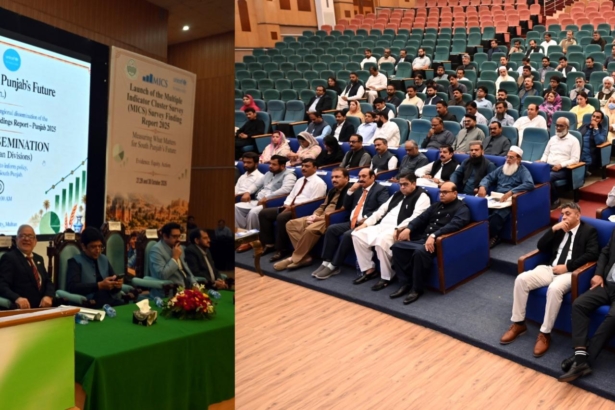
The South Punjab Secretariat, Punjab Bureau of Statistics and UNICEF Punjab jointly organised an event at Bahauddin Zakariya University (BZU) in Multan on Tuesday to launch the findings and report of the Multiple Indicator Cluster Survey (MICS) 2025 for South Punjab’s three divisions.
The survey covers Multan, Bahawalpur and Dera Ghazi Khan divisions. It aims to collect evidence on children, women and families to support informed policymaking and equitable development across the region.
Additional Chief Secretary South Punjab Fawad Hashim Rabbani attended the event as the chief guest. Multan Division Commissioner Amir Karim Khan, BZU Vice Chancellor Dr Zubair Iqbal, Punjab Bureau of Statistics directors Shams-ul-Huda and Masood Ali, senior officials from various South Punjab departments and representatives of civil society also attended the ceremony at the university’s Jinnah Auditorium.
Addressing the gathering, Rabbani said data was not merely a collection of numbers but the foundation of effective planning and governance. He said every statistic represented a child, a mother or a family whose needs required attention.
He stressed that the purpose of the MICS report was not to keep data confined to files but to turn the findings into a practical roadmap for improving public services. He added that improving the lives of women and children remained the government’s top priority.
Rabbani said the three divisions had different development needs and required targeted interventions.
Multan Division performed well in immunisation and maternal healthcare. However, challenges related to child nutrition and protection persisted.
Bahawalpur Division showed clear improvement in antenatal care and birth registration. However, 52 per cent of children of higher secondary school age remained out of school, highlighting a major challenge for the education sector.
Dera Ghazi Khan Division recorded improvements in child survival and a decline in child labour. However, significant gaps remained in immunisation, sanitation and school attendance.
To ensure effective use of the findings, Rabbani announced that a dedicated cell would be established in the Planning and Development Department to monitor priority indicators and promote the use of MICS data.
He said all South Punjab departments would be required to set measurable targets for their respective sectors within the next 60 days.
The government would also conduct quarterly reviews of South Punjab Child Wellbeing Scorecards to assess development progress across the region’s 12 districts. Universities and research institutions would be given access to MICS microdata to support scientific research into local issues.
UNICEF Pakistan Data Lead Nauman Ghani delivered a special address on the role of MICS in policymaking. Punjab Bureau of Statistics directors Shams-ul-Huda and Masood Ali presented the survey findings.
The report examined key indicators related to maternal and child health, nutrition, education, water, sanitation and hygiene (WASH), and social protection.
In his concluding remarks, Multan Division Commissioner Amir Karim Khan said the Punjab government had fully funded the MICS survey, with the Additional Chief Secretary South Punjab playing a leading role in the process.
He said the survey was designed not only to highlight achievements but also to identify weaknesses and areas requiring further improvement.
Khan urged all relevant departments dealing with health, education and social services to incorporate the findings into their planning. He also called for aligning the survey’s recommendations with initiatives such as the Punjab chief minister’s school nutrition programme and Maryam Ki Dastak.
He stressed that evidence-based planning and practical measures were essential to ensure equitable development and improve public service delivery across South Punjab.
We welcome your contributions! Submit your blogs, opinion pieces, press releases, news story pitches, and news features to opinion@minutemirror.com.pk and minutemirrormail@gmail.com