Summary
- A protest movement that began among high school students in Paris’s poorer suburbs has grown into the largest nationwide mobilization over school funding France has seen since the 1990s, with demonstrations now sweeping more than 1,200 high schools and spreading into universities across the country.
- At Lycee Le Corbusier in the suburb of Aubervilliers, 17 year old Maisa, who hopes to become an English teacher, said she sat her high school French exam last year without ever having a French teacher.
- Clemence Cardon-Quint, a professor at Paul Valery University who studies education funding, said the last nationwide high school protest movement of this size demanding more resources occurred in the 1990s, following a period when the government sharply expanded access to the baccalaureat, the school leaving exam that opens the door to university, without providing schools the additional funding needed to support that wider access.
A protest movement that began among high school students in Paris’s poorer suburbs has grown into the largest nationwide mobilization over school funding France has seen since the 1990s, with demonstrations now sweeping more than 1,200 high schools and spreading into universities across the country.
The unrest took root in Seine-Saint-Denis, a department north of Paris with some of the highest poverty levels in the country, before spreading to Paris itself and onward to cities including Marseille, Strasbourg, Tours, Lille and Brest. At Lycee Le Corbusier in the suburb of Aubervilliers, 17 year old Maisa, who hopes to become an English teacher, said she sat her high school French exam last year without ever having a French teacher. “These are not conditions to study in,” she said. Fifteen year old Amelia, protesting alongside her, carried a sign reading “Our address should not decide our future,” and accused education authorities of failing to invest adequately in the suburbs, calling the disparity both classist and racist.
Students at schools across Seine-Saint-Denis have described overcrowded classrooms, missing teachers, and a lack of basic support staff. Fifteen year old Kesia, demonstrating in the suburb of Pantin, told reporters her class holds 35 students with not enough chairs to seat everyone, and that the hour long lunch break leaves too little time for every student to eat. At Lycee Le Corbusier, classes in mathematics, humanities, English and sport have been canceled repeatedly since the start of the academic year due to staff shortages, according to Karima Kara Ali, an elected parent representative at the school. The CGT labor union said roughly two thirds of high schools in Seine-Saint-Denis took part in protests on Thursday, with students, teachers and parents in several towns describing unsanitary conditions and chronic shortages of nurses and social workers, problems they said fall particularly hard on students with learning difficulties and those living in poverty.
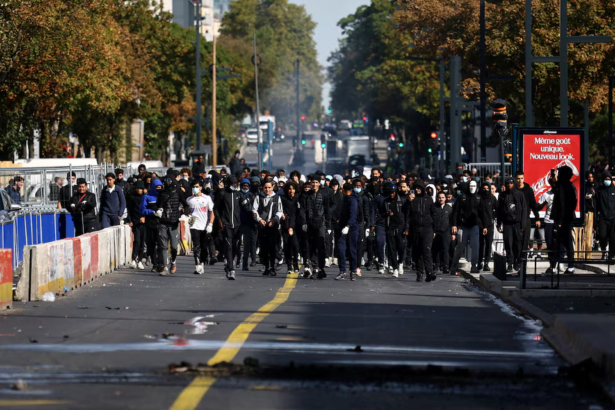
The demonstrations have not stayed peaceful everywhere. Fire damaged the entrances of two Paris high schools, Leonard de Vinci and Gaston-Bachelard, on Friday, and police have used tear gas and rubber bullets to respond to clashes in several cities, including confrontations captured on video in Saint-Denis and Brest. The mix of largely peaceful school blockades alongside scattered arson and forceful police tactics has dominated public debate in France over recent days. The hard right National Rally party has blamed the unrest on its hard left political rivals, who currently sit positioned to reach next year’s presidential runoff, while government officials this week called on parents to help keep their children from joining the more confrontational demonstrations.
Researchers studying French education funding say the scale of the current protests has no recent precedent. Clemence Cardon-Quint, a professor at Paul Valery University who studies education funding, said the last nationwide high school protest movement of this size demanding more resources occurred in the 1990s, following a period when the government sharply expanded access to the baccalaureat, the school leaving exam that opens the door to university, without providing schools the additional funding needed to support that wider access. Cardon-Quint said the current cuts make inequality even harder to narrow, noting that during periods of budget restraint it becomes more difficult to reduce disparities between wealthier and poorer districts. She also pointed to the introduction of Parcoursup, France’s university admissions platform launched in 2018, as adding further strain, since students and teachers have taken on growing responsibility for navigating a system some have criticized as opaque and unfair to disadvantaged applicants.
One parent representative linked the funding pressure directly to recent national cuts, pointing to a reduction of 3,256 teaching positions nationwide for the current academic year as a root driver of the shortages now fueling protests in her department.
Ulysse Rabate, a political scientist at Paris 8 University, said the protests illustrate how France’s marginalized urban neighborhoods are increasingly shaping national politics, with grievances that began at the local school level now forcing their way into broader public and political debate roughly seven months ahead of France’s next presidential election. With blockades continuing to spread into universities and student leaders showing no sign of scaling back their demonstrations, the movement is likely to keep testing the government’s response in the weeks ahead, both over the specific funding shortfalls driving student anger and over the broader question of how France addresses inequality between its wealthier and more deprived school districts.
We welcome your contributions! Submit your blogs, opinion pieces, press releases, news story pitches, and news features to opinion@minutemirror.com.pk and minutemirrormail@gmail.com