


Summary
- He has also been writing about childhood memories, rural life, social issues, and Partition stories on various platforms, including DW, HumSub, Jang, Dawn, and Urdu Digest.
- In ‘Little Sister,’ Ahmad sketches an entire life through small details, sweet and bitter memories, and the passage of time.
- But once again, everything is lost in the passage of time.’’ Ahmad nostalgically sums up the life that has disappeared along with the Sharihan: ‘It is sad that we, the villagers, failed to take care of the Sharihan tree.
Ahmad Naeem Chishti is a versatile personality. Having lived in his hometown of Pakpattan (famous for being the home of Baba Farid) for the last four decades or so, he remains very active on social media. He has been recording the oral histories of elderly people who witnessed the Partition of India (and, more specifically, Punjab) in 1947, sharing their stories on his YouTube channel, Punjab Diary. He has also been writing about childhood memories, rural life, social issues, and Partition stories on various platforms, including DW, HumSub, Jang, Dawn, and Urdu Digest. He is currently working as an assistant professor at a local college in Pakpattan.
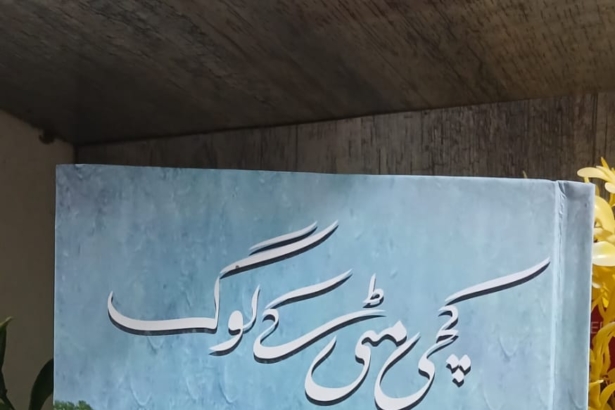
As if all this were not enough, he has now surprised us with his debut book, ‘Kacchī Miṭṭī kē Lōg’. It is a kind of living record of the history and memories of a changing rural Punjab. Although he is now middle-aged, his memory remains remarkably sharp and vivid. Through his writing, he has presented a picture of Punjab that many city dwellers know very little about. Comprising 222 pages and 47 articles, columns, and memoirs, the book is a treasure trove of information and a kind of kaleidoscope of contemporary Punjab.
Our friend and teacher, Dr Manzur Ejaz, repeatedly argued in his books that the real transformation of Punjab began during the 1970s. Punjab was waking from centuries of slumber, and a new age was dawning with the arrival of electricity, tractors, and other agricultural machinery. Before that, he argued, little had changed in Punjabi village life over the previous two millennia. Karl Marx described this social and economic arrangement as the ‘Asiatic mode of production.’
Ahmad has his own stories to tell, his own experiences to share, and his own personal memories to preserve. In the introduction to the book, he writes:”These essays contain the beautiful, delightful, and tickling memories of bygone days, which are a source of joy and comfort. There are stories of a carefree, laughing and playing childhood, and tales of a youth full of dreams. There is also the sadness of time slipping away every moment, like sand slipping through one’s fingers. And in these pages, there is also a lament for the days that have fallen from the branch of life like dry leaves.’’
There is little I can add to this. Although the book is written in Urdu, and the author’s command of the language is excellent, the ethos, landscape, seasons, and culture he describes are essentially Punjabi. As Iffat Naveed writes on the book’s back cover: ‘The writing and personality of the author, steeped in the fragrance of Punjab, penetrate the soul of the reader.’
The opening section of the book contains a series of essays built around some of his most cherished memories: ‘little Sister, A Room of Mud, The Sharihan Tree, Nani Amma’s House, and The Long Flight of Sparrows. In ‘Little Sister,’ Ahmad sketches an entire life through small details, sweet and bitter memories, and the passage of time. Time becomes the most powerful metaphor: it diminishes everything but leaves behind haunting memories. Written with the affection of an elder brother for his younger sister, the essay also captures the richness of Punjabi culture.
In another essay, “Kacchā Kamarā” (A Room of Mud), he recalls at length a life centered around a Mud room that no longer exists. With the disappearance of that room, a whole way of life has also vanished. These are not merely the memories of one individual; they are the stories and memories of generations of village boys. By writing about an experience and a period of life shared by so many, the author transforms personal memories into collective ones.
In another excellent essay, “Sharīhan dā Pēṛ” (The Sharihan Tree), he recounts an entire phase of his life through the story of a single tree. The story of that tree is also the story of the writer. With its gradual decay and eventual death, the most beautiful phase of his life seems to have disappeared as well. As we know, traditional Punjabi culture is deeply connected with trees such as Neem, Shisham, Beri, Gundani, and Borh. Some trees are considered sacred in Hinduism, while trees in general also hold a special place in Punjab’s cultural life. A large part of our lives was once spent beneath their shade.
According to Ahmad:”The Sharihan tree had bloomed fully with the beginning of summer vacations, and it was so much relief to sit under this tree. The tree would absorb all the heat, and there was a deep coolness beneath it.Many birds used to inhabit the tree. The wood of the Sharihan was used in the final bathing of the dead. When a son was born into a family, its branches were hung above the entrance to the house. But once again, everything is lost in the passage of time.’’ Ahmad nostalgically sums up the life that has disappeared along with the Sharihan:
‘It is sad that we, the villagers, failed to take care of the Sharihan tree. When the children broke its branches, the elders did not stop them. No one watered it either. And so, even when spring arrived, the Sharihan showed no signs of life. Gradually, it dried up and died. People came and cut away its dry branches for firewood. Where once the Sharihan stood, spreading its cool, dense shade, there is now nothing but scorching sunlight. It was the very people who once sat beneath its shade who brought about its destruction.’Is this not also the story of rural and urban Punjab? We have criminally destroyed our ecosystem, and now our rulers take pride in planting millions of trees. But what about the trillions of trees we have slaughtered with our own hands?
Ahmad has also written about the old Islamia College, where he completed his postgraduate studies in English literature. He recalls wandering through the narrow lanes of Lahore, visiting its shops and exploring other parts of the city. There is also an essay about his favourite teacher, Tariq Ahmad, from whom he learned a great deal. His wise words still echo in the author’s memory. Sadly, Tariq Ahmad lost his life despite having migrated to the UK and built a comfortable life there.
The final two columns are perhaps the most representative pieces in the book. They are titled “Chōlasatān kā Gumnām Rēlvē Saṭēshan” (The Unknown Railway Station of Cholistan) and “Madarrasā Rēlvē Saṭēshan kā Band Ṭikaṭ Ghar” (The Closed Ticket Office of Madarrasa Railway Station).The first is about a railway station in Cholistan whose railway line has disappeared, although the station building still stands. It is an unmistakable sign of British imperialism in India. At the beginning of the twentieth century, a railway line was laid from Bahawalnagar to Fort Abbas and from Fort Abbas to Yazman. During the Second World War, the British government removed the railway tracks and took them to Burma. The entire atmosphere changed. The sound of the engine, the whistle, the station bell, and the sight of people waiting for trains—all disappeared. The author’s description of the abandoned station is almost like reading a ghost story.
The second column is also about a railway station, but this time one whose railway line was severed by the newly created border between Pakistan and India.
Ahmad concludes the column:”The border drawn in 1947 severed this railway line near Amroka forever. After independence, the line was destined for nothing but decline. Trains continued to run for a few years, but eventually the service was discontinued. Exposed to the scorching heat of summer, the bitter cold of winter, the blazing sun, hot winds, storms and torrential rains, these stations gradually fell into ruin. Their walls kept crumbling, and the ticket offices were shut down. Now a Neem tree stands clinging to the building, perhaps embracing it to offer some comfort.’’
Ahmad has an extraordinary talent for transforming keen observation, personal memories, and a deep attachment to his land into compelling stories. It would be wonderful if these stories were written in Punjabi.Newspaper columns and magazine articles have a limited life. Once published, they gradually disappear into the passage of time. Literature, however, has a longer life. Having said that, I would argue that ‘Kacchī Miṭṭī kē Lōg’ is well worth reading. In this book, Ahmad brings together the sensibilities of a cultural historian, a storyteller, and a painter of Punjab’s haunting landscape.
Zubair Ahmad is a Lahore based Punjabi writer and columnist. He is poet, critic and fiction writer.
We welcome your contributions! Submit your blogs, opinion pieces, press releases, news story pitches, and news features to opinion@minutemirror.com.pk and minutemirrormail@gmail.com









Amazing analysis of the book by a great pen of Zubair Ahmad sahib.