Summary
- By Tallat Naveed A Review of Bhagwant Rasool Puri’s Short Story Collection A true fiction writer does not always search for stories; sometimes, stories emerge from the people who inhabit his imagination.
- The story exposes the emotional coldness of a society in which elderly parents can become vulnerable to loneliness.
- A short story must know not only what to reveal but also what to leave to the reader’s imagination.
By Tallat Naveed
A Review of Bhagwant Rasool Puri’s Short Story Collection
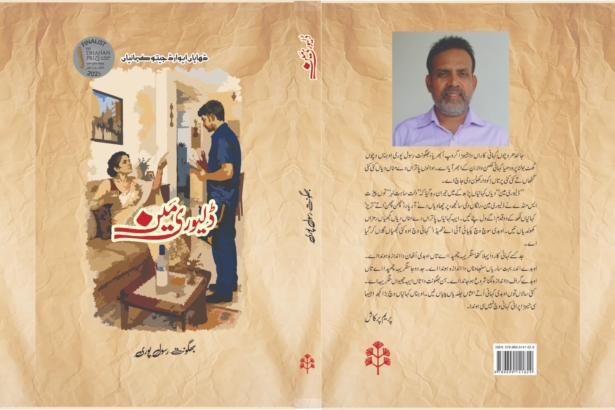
A true fiction writer does not always search for stories; sometimes, stories emerge from the people who inhabit his imagination. They grow out of ordinary lives, unnoticed gestures and unspoken emotions. Bhagwant RasoolPuri, an established fiction writer from East Punjab, belongs to this tradition. His latest collection, ‘Delivery Man’, originally published in Gurmukhi Punjabi and now translated into Shahmukhi, offers an engaging reflection on contemporary society.
Bhagwant is not a newcomer to Punjabi fiction. Before this collection, he had published six short-story collections and one novel. His literary journey, extending back to the 1990s, reflects a sustained commitment to writing. For him, writing is not merely an activity but a passion, perhaps an instinctive calling. He explains his creative process by saying that he discovers characters in society, brings them into his room and develops them within the framework of a story. His characters are therefore rooted in recognisable human experiences.
It is often said that a writer sees what others fail to notice. In my assessment, he possesses this quality of observation. He pays attention to seemingly insignificant details and transforms them into meaningful literary experiences. His stories begin with familiar situations but gradually reveal the emotional and psychological realities concealed beneath them.
The opening story, “ Delivery Man” explores the growing influence of artificial intelligence on human life. AI is not merely a background reference; it becomes an essential presence in the narrative, alongside Geeta and Kawal Krishan, the delivery man. The story raises an important question: can artificial intelligence provide human emotions, or can it only imitate their outward expressions?
Geeta presents herself as an emotionally detached woman, yet beneath this appearance lies a deep need for affection and connection. Kawal Krishan, meanwhile, lives almost like a machine, performing his duties without emotional involvement. The irony is striking: while technology is becoming increasingly human-like, human beings themselves are beginning to resemble machines. Bhagwant draws attention to a society where efficiency and convenience are gradually replacing emotional intimacy. The meaningful ending compels readers to reconsider their lifestyles and the emotional emptiness accompanying technological advancement.
Another story that particularly appealed to me is” Muthi Vichon Kirdi Ret” (Sand Slipping Through the Fist). Here, He explores the fragility of family relationships, particularly in the context of migration. The story revolves around an elderly couple living with their daughter abroad. Their lives are transformed by distressing circumstances, and despite their efforts to restore normality, fate gradually dismantles their hopes. Eventually, one of them is left alone.
The title itself is a powerful metaphor for the transience of human existence. Like sand slipping through an open fist, relationships, happiness and carefully constructed hopes can disappear despite our efforts to preserve them. The story exposes the emotional coldness of a society in which elderly parents can become vulnerable to loneliness. Author communicates this tragedy without exaggeration, allowing circumstances themselves to convey the pain.
“Rangan Di Saanjh Gian “is another finely conceived story demonstrating Bhagwant s sensitivity towards human relationships. Its central characters belong to different worlds of thought, taste and ideology. Despite their differences, they discover common ground through their shared love of painting. The canvas and colours become a language through which two dissimilar individuals establish an emotional connection. However, emotional affinity cannot always overcome ideological differences. With time, the characters recognise the distance between their respective worldviews. His handles this sensitive subject carefully, allowing their differences to emerge naturally. The story suggests that art can bring people together even when their philosophies remain apart.
Ravi Defender is another noteworthy example of his ability to discover human conflict within social circumstances. It portrays a patriotic sportsman whose ambitions are undermined by unfavourable situations. His disappointment also affects the hopes he has attached to his son, whom he considers his future. Through their relationship, writer explores patriotism, frustrated ambition, generational expectations and the painful distance between dreams and reality. The story reminds us that dedication alone cannot always guarantee success.
It would be difficult to discuss every story in this collection within the limits of one review. Nevertheless, these selected narratives demonstrate the breadth of his literary concerns. His stories reflect bitter realities that exist around us but often escape our attention. His characters are convincing, his language accessible, and his themes sufficiently strong to engage readers from different backgrounds.
However, one aspect invites critical consideration. Some stories are considerably lengthy, and their narrative development occasionally resembles the structure of a novel rather than the concentrated form of a short story. This brings to mind Anton Chekhov, whose short fiction demonstrates that emotional and psychological depth does not require lengthy explanations. His art often lies in restraint, suggestion and the power of what remains unsaid. A short story must know not only what to reveal but also what to leave to the reader’s imagination. Bhagwant appears to possess the expansive instincts of a novelist, reluctant to leave his characters before exploring their circumstances fully. This is both a creative strength and a technical challenge. Greater narrative economy could make some of his already compelling stories even more concentrated and powerful.
Nevertheless, The Delivery Man is a meaningful contribution to contemporary Punjabi fiction. Whether exploring artificial intelligence, migration, ageing, emotional isolation, artistic companionship or frustrated patriotism, Bhagwant remains interested in the individual behind the social circumstances.
Ultimately, the strength of this collection lies in its characters. They enter his stories from the world we inhabit and return to us as reflections of our own lives. A good writer does not merely tell us what happens in society; he enables us to recognise what is happening within ourselves. Bhagwant Rasool Puri achieves this through his attentive observation and sustained engagement with human experience. His stories remind us that beneath the apparent simplicity of ordinary lives lie realities of considerable emotional and social complexity.
Name of book: Delivery Man
Author: Bhagwant Rasulpuri
Pages:190
Price: Rs:800
Published: Kitab Trinjan, Temple Road, Lahore.
Tallat Naveed is Lahore based Poetess ، writer and columnist.
We welcome your contributions! Submit your blogs, opinion pieces, press releases, news story pitches, and news features to opinion@minutemirror.com.pk and minutemirrormail@gmail.com