Summary
- Regardless of terminology, the debate has exposed the structural weaknesses of Pakistan’s governance architecture and compelled policymakers, constitutional experts and political parties to revisit an important question: can Pakistan continue to be governed effectively under its existing administrative framework, or has demographic growth, urban expansion and governance complexity made institutional restructuring unavoidable? Pakistan today is home to more than 250 million people, yet it continues to function primarily through four provinces established under historical rather than administrative considerations.
- Simultaneously, Pakistan should establish measurable governance indicators so that administrative restructuring can be evaluated against improvements in education, healthcare, policing, judicial access, municipal services and citizen satisfaction rather than symbolic political achievements.
- Only then can administrative restructuring become an instrument of national cohesion and effective governance rather than another chapter in Pakistan’s long history of unfinished political experiments.
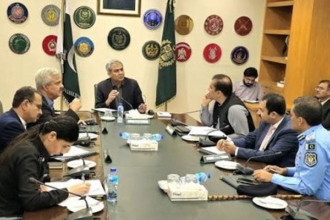
The debate over the creation of new administrative units and provinces in Pakistan has once again occupied the national discourse after Federal Interior Minister Mohsin Naqvi declared that the country’s existing governance system had “collapsed” and argued that governance must be brought closer to the people through new administrative units. His remarks have revived an issue that has periodically surfaced since independence but has rarely moved beyond political rhetoric. While some interpreted his statement as a call for creating additional provinces, others argued that he was advocating broader administrative restructuring. Regardless of terminology, the debate has exposed the structural weaknesses of Pakistan’s governance architecture and compelled policymakers, constitutional experts and political parties to revisit an important question: can Pakistan continue to be governed effectively under its existing administrative framework, or has demographic growth, urban expansion and governance complexity made institutional restructuring unavoidable?
Pakistan today is home to more than 250 million people, yet it continues to function primarily through four provinces established under historical rather than administrative considerations. At independence in 1947, the population and governance challenges were dramatically different. Since then, urbanisation, economic diversification, internal migration and increasing demands for public services have transformed governance requirements. Provincial capitals often remain geographically and administratively distant from citizens living in peripheral districts. Residents of South Punjab, Hazara, southern Balochistan, merged districts of Khyber Pakhtunkhwa and interior Sindh frequently complain that decision-making remains concentrated in provincial capitals, resulting in unequal development, delayed service delivery and inadequate representation.
Mohsin Naqvi’s argument rests on the proposition that governance has become excessively centralised and that citizens are compelled to travel long distances merely to access basic government services, courts and administrative offices. He further argued that countries with expanding populations have responded by creating additional administrative units rather than maintaining outdated structures. Whether one agrees with his assessment or not, his central observation deserves serious consideration because governance effectiveness is measured not by the size of government but by the accessibility, responsiveness and accountability of institutions.
The debate itself is not new. Successive governments have proposed South Punjab Province, Bahawalpur Province, Hazara Province and even administrative restructuring in Karachi and Balochistan. Parliamentary resolutions regarding South Punjab have previously been adopted, yet constitutional consensus has remained elusive. Political parties have often supported new provinces while in opposition but have shown considerably less enthusiasm after assuming power. Consequently, proposals have become election slogans rather than governance reforms.
Critics of creating new provinces argue that administrative fragmentation alone cannot solve governance failures. They point out that Pakistan’s primary problem is not necessarily the number of provinces but weak institutions, bureaucratic inefficiency, political interference, corruption and inconsistent implementation of laws. According to this perspective, multiplying provinces without institutional reform merely replicates existing inefficiencies across additional administrative boundaries. New provincial governments would require assemblies, governors, chief ministers, secretariats, police structures, judicial infrastructure and enormous recurring financial expenditures. Unless accompanied by governance reforms, decentralisation may simply increase administrative costs without improving public service delivery.
Supporters, however, contend that administrative proximity improves governance outcomes. Comparative international experience demonstrates that countries such as India have periodically reorganised states to improve administrative efficiency and political representation. Smaller administrative jurisdictions often enable faster decision-making, improved monitoring, stronger accountability and more equitable distribution of development resources. Citizens generally experience better governance when government institutions are physically and administratively closer to them. These arguments have gained renewed attention following Naqvi’s intervention.
However, the current debate suffers from one significant omission. It largely ignores Pakistan’s weakest democratic institution: local government. Before creating additional provinces, policymakers must honestly evaluate why local governments have repeatedly failed. Pakistan has experimented with local government systems under different constitutional and political arrangements, yet these institutions have rarely been allowed to function independently and consistently. Elected local governments are frequently dissolved, elections are delayed and financial autonomy remains severely restricted. Provincial governments often resist devolving meaningful authority because local governments are perceived as political competitors rather than governance partners.
This brings the issue of local body elections to the centre of the discussion. The Constitution envisions democratic decentralisation, yet local government elections have remained irregular across several provinces. In many cases, elected councils complete only partial terms or remain financially dependent upon provincial governments. Consequently, citizens seeking municipal services, sanitation, water supply, local roads, building regulation or community development frequently confront administrative paralysis. A country that struggles to sustain functioning local governments cannot realistically expect that merely creating additional provinces will automatically improve governance.
The experience of Pakistan’s devolution reforms provides valuable lessons. The Local Government reforms introduced in the early 2000s attempted to decentralise authority by empowering districts and local councils. Although those reforms had weaknesses and generated political controversy, they demonstrated that bringing government closer to citizens can improve responsiveness when accompanied by fiscal authority, administrative autonomy and institutional accountability. Unfortunately, subsequent governments reversed or weakened many of these arrangements, resulting in repeated cycles of centralisation and decentralisation.
Political reactions to Mohsin Naqvi’s proposal reflect Pakistan’s broader constitutional divisions. Some leaders have welcomed discussion on governance reform while supporting greater administrative decentralisation. Others have questioned both the timing and constitutional implications of the proposal, expressing concerns that restructuring provinces without broad political consensus could intensify ethnic, linguistic and regional sensitivities. There are also concerns that debates over provincial boundaries could distract attention from more immediate governance priorities, including economic recovery, inflation, institutional reforms and electoral credibility. The political diversity of these reactions demonstrates that constitutional restructuring cannot succeed through executive statements alone; it requires sustained parliamentary dialogue, provincial participation and national consensus.
The constitutional dimension cannot be overlooked. Creating new provinces requires constitutional amendments and political agreement among federal and provincial stakeholders. Such reforms inevitably involve questions relating to resource distribution, National Finance Commission allocations, Senate representation, civil service restructuring, judicial jurisdictions and provincial assets. Therefore, any attempt to redraw administrative boundaries without extensive consultation risks generating political instability rather than administrative efficiency.
The opportunities nevertheless remain significant. Properly designed administrative restructuring could reduce regional disparities, improve public service delivery, enhance disaster management, strengthen law enforcement coordination and increase citizen participation in governance. Smaller provinces or administrative regions may facilitate more balanced infrastructure investment and reduce perceptions of neglect among historically underdeveloped regions. Administrative decentralisation could also encourage healthy inter-provincial competition in education, healthcare, investment promotion and digital governance.
Yet these opportunities will materialise only if governance reforms extend beyond geography. Pakistan’s real governance deficit lies in institutional capacity. Civil service reforms, digital public administration, merit-based recruitment, judicial efficiency, police modernisation, fiscal decentralisation and transparent local governance are equally essential. Without these reforms, new provinces may inherit the same structural weaknesses currently affecting existing ones.
A research-based assessment suggests that Pakistan should adopt a phased rather than politically driven approach. The first step should be holding regular, constitutionally mandated local government elections across all provinces and guaranteeing financial autonomy to elected local councils. The second step should involve strengthening district administrations through digital governance, performance evaluation and citizen service centres. Third, an independent National Commission on Administrative Reforms comprising constitutional experts, economists, demographers, political scientists and public administration specialists should evaluate objective criteria for future administrative restructuring. Population size, geographical accessibility, economic viability, administrative efficiency and public consultation should guide recommendations rather than ethnic mobilisation or electoral calculations.
Any future proposal for new provinces should emerge from evidence rather than emotion. Comprehensive feasibility studies should estimate financial implications, institutional readiness, governance outcomes and public opinion. Constitutional amendments should be preceded by bipartisan parliamentary consensus, provincial consultations and transparent public debate. Simultaneously, Pakistan should establish measurable governance indicators so that administrative restructuring can be evaluated against improvements in education, healthcare, policing, judicial access, municipal services and citizen satisfaction rather than symbolic political achievements.
Ultimately, Mohsin Naqvi’s statement has succeeded in reopening an important national conversation. Whether or not one accepts his description of a “collapsed” governance system, there is little disagreement that Pakistan’s governance model requires significant reform. The question is not simply whether Pakistan needs more provinces, but whether it possesses the political will to decentralise power genuinely. Administrative restructuring without empowered local governments would merely relocate bureaucracy. Conversely, empowered local governments without institutional reforms would remain financially constrained. Sustainable governance requires an integrated model combining constitutional stability, administrative decentralisation, fiscal responsibility and democratic accountability.
Pakistan’s future governance architecture should therefore be built on the principle that government must exist as close to the citizen as possible while remaining constitutionally coherent and financially sustainable. New provinces may eventually become necessary, but they should represent the culmination of institutional reform rather than its starting point. Before drawing new boundaries on the map, Pakistan must strengthen the democratic foundations beneath them through regular local government elections, empowered municipalities, accountable provincial institutions and evidence-based constitutional reform. Only then can administrative restructuring become an instrument of national cohesion and effective governance rather than another chapter in Pakistan’s long history of unfinished political experiments.
We welcome your contributions! Submit your blogs, opinion pieces, press releases, news story pitches, and news features to opinion@minutemirror.com.pk and minutemirrormail@gmail.com