Summary
- Into this strategic landscape, we must place India’s carrier program with honesty rather than sentiment — and it is here that we feel genuine sorrow, not for the Indian state, but for the Indian people.
- The INS Vikrant, India’s first domestically built carrier, cost over $3.5 billion after years of delays at Cochin Shipyard Limited in Kochi.
- Against this backdrop, $5 billion spent on two carriers — one already compromised before it was fully operational, the other still without a settled air wing — is not a defence investment.By the way this carrier was moved way beyond harms during May 2025.
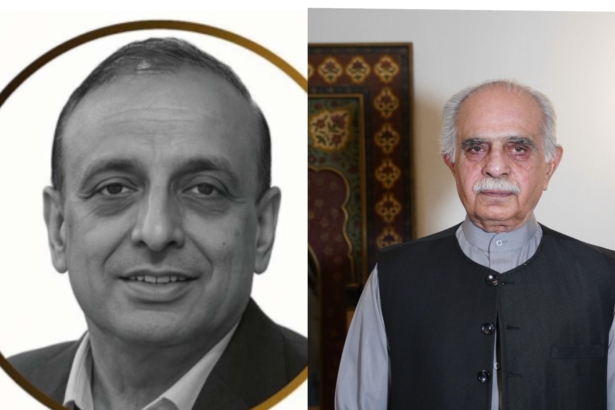
By General Ghulam Mustafa (Served in different staff and command assignments,
commanded a Corps, raised and commanded Army Strategic Force Command)
& Engineer Arshad H Abbasi, Co-founder, Energy Excellence Centres at NUST and
Engineering University Peshawar, International Transboundary Water Expert
When Iran launched its missile and drone barrage in April 2026, the world watched
something quietly historic unfold. The United States repositioned USS Eisenhower and
USS Gerald R. Ford — two of the most powerful and expensive warships ever built —
not to press forward, but to stay out of range. Two floating fortresses, each representing
over a decade of engineering and tens of billions of dollars, were managed with extreme
caution against a country without a single aircraft carrier of its own. The lesson was not
lost on serious military analysts: the age of the aircraft carrier as the unchallenged
centrepiece of naval power projection is drawing to a quiet, expensive, and irreversible
close.
This is no longer a controversial conclusion. It is the emerging consensus among the
same strategists who once championed these vessels. The aircraft carrier dominated
naval doctrine for eighty years, from the Pacific campaigns of the Second World War
through the Falklands, through the Persian Gulf, and into the post-Cold War era. But the
technological landscape has shifted beneath it with a speed that procurement budgets
and military pride have been slow to acknowledge.
Begin with something as basic as sound. Modern passive acoustic surveillance, now
enhanced by artificial intelligence and networked hydrophone arrays, can isolate the
acoustic signature of a carrier group — its turbine hum, propeller cavitation, and internal
mechanical vibration — from hundreds of kilometres away. Low-frequency microphone
networks, seabed listening posts, and AI-driven signal processing have made the ocean
a far less forgiving environment for large surface combatants. A carrier group that once
relied on the vastness of the sea for concealment now announces itself acoustically
before it comes anywhere near a conflict zone.
Then there are the weapons specifically designed to kill carriers. China’s DF-21D and
DF-26 anti-ship ballistic missiles — maneuverable, hypersonic, and purpose-built —
have a reach that covers most of the Western Pacific. Iran fields a layered combination
of cruise missiles, drones, and fast-attack craft designed to swarm and overwhelm
defensive systems through sheer volume. Recent operations in the Red Sea
demonstrated what analysts had long warned: cheap, proliferated drones and cruise
missiles can degrade carrier operations without destroying the ship itself, simply by
forcing it beyond useful range. The economics of this asymmetry are devastating. A
single drone costs a few hundred thousand dollars. The interceptor missile used to
destroy it costs between two and four million. The carrier it protects costs thirteen billion.
Every missile fired in its defence accelerates the financial case against the platform
itself.
Into this strategic landscape, we must place India’s carrier program with honesty rather
than sentiment — and it is here that we feel genuine sorrow, not for the Indian state, but
for the Indian people. India operates two aircraft carriers. The INS Vikramaditya, a
refitted Soviet-era vessel, was acquired and modernised at a cost of approximately
$2.35 billion. During its sea trials in 2012, seven of its eight steam boilers failed
simultaneously, traced to substandard ceramic fire bricks installed by Russian
contractors. The ship’s primary aircraft, the MiG-29K, has been plagued by chronic
deficiencies in its engines, fly-by-wire controls, and radar systems, with falsified
performance reports exposed in leaked internal documents. India’s own Comptroller
and Auditor General catalogued the failures in damning detail.
The INS Vikrant, India’s first domestically built carrier, cost over $3.5 billion after years
of delays at Cochin Shipyard Limited in Kochi. The construction stretched across twelve
years of basin trials alone, compounded by defective diesel alternators and technical
failures in manufacturing the propulsion shafts. The shipyard’s industrial safety record
adds a further shadow: a fatal explosion in February 2018 killed five workers. Earlier
incidents in 2006 and 1994 added to a pattern of failures that has no place in the
construction of a frontline warship. The INS Vikrant’s ski-jump launch configuration
imposes hard limits on the fuel, ordnance, and maximum weight at which its aircraft can
operate — and the ship now requires costly modification to accommodate French
Rafale-M fighters after the MiG-29K programme’s collapse, meaning a carrier still
searching for its permanent air wing years into service.
Both vessels, taken together, represent a combined investment of approximately $5
billion, and both now sail in a strategic environment where acoustic detection,
hypersonic missiles, and networked drone swarms have fundamentally altered what a
surface carrier can and cannot survive.
What follow is a simple reality check for 1.42 billion Indians , 800 million of them are
dependent on government food assistance to survive, over 300 million live without
reliable electricity. Millions of their children still suffer from malnutrition at rates that
shame the ambitions of the world’s fifth-largest economy. Hundreds of millions live
without adequate housing, sanitation, or access to healthcare. These are not figures
from a hostile source — they are India’s own data, recorded by India’s own institutions.
Against this backdrop, $5 billion spent on two carriers — one already compromised
before it was fully operational, the other still without a settled air wing — is not a
defence investment.By the way this carrier was moved way beyond harms during May
2025. It is a monument to misplaced priorities, built at the expense of people who had
no voice in the decision. India faces no existential naval threat that justifies this
expenditure. Pakistan does not threaten India by sea. China’s challenge, real as it is,
cannot be answered by carriers that are acoustically detectable and missile-vulnerable
before their radar systems sound the alarm. The security of 1.42 billion people is not
enhanced by platforms that the next generation of warfare has already rendered
obsolete.
India’s current defence budget stands at $85 billion — a 15% increase — making it the
fifth largest military spender in the world. That is a sovereign choice. But it is a choice
that must be weighed honestly against the country it is made on behalf of. Every rupee
redirected from an arms race that serves no one’s real security toward a child’s
education, a family’s clean water, a village’s electricity, or a young woman’s access to
healthcare is a rupee that actually makes India stronger — not in the ledgers of military
procurement, but in the foundations of real national power.
South Asia does not need an arms race. It needs rain that falls on fields that feed
people. It needs rivers that flow clean. It needs hospitals that do not turn patients away
for want of medicine. We are Pakistanis writing these words, and we know our own
government carries its share of blame in this regard. But we write them anyway,
because the truth belongs to no single nation, and because we believe the people of
India and Pakistan are not each other’s enemies. They are neighbours, inheritors of the
same civilisation, separated by a border drawn in haste seventy-eight years ago.
Indeed, the acoustic vulnerability of both Indian carriers is so pronounced — from the
steam turbines and boilers of the Vikramaditya to the gas turbines and diesel generators
of the Vikrant — that their combined mechanical noise signature is detectable far
beyond what any serious navy would consider acceptable. IT IS NO EXAGGERATION,
AND WE SAY THIS BASED ON ACOUSTIC SURVEILLANCE REALITIES, THAT A
FISHERMAN IN KARACHI KNOWS WHEN THESE CARRIERS MOVE.
The era of the aircraft carrier is ending. Let it take with it the era of spending on
weapons that belong to the poor. India’s 1.42 billion people deserve a government that
sees them — not as a demographic to be managed while warships are commissioned,
but as the entire point of governance itself. We are their well-wishers. We hope, with
everything we have, that their leaders will one day be the same.