Summary
- Sir Syed took his appeal to the community, and Fazal Ali, it is said, would raise the association’s subscription even at weddings.
- Sir Syed appealed to a nation; Fazal Ali appealed to a district.
- On January 1, 1939, Fazal Ali appointed Dr Jahangir Khan as principal and said openly that Sir Syed had brought his principal from Europe, whereas his own belonged to this soil and had studied in Europe.
On the evening of January 28, 1914, the landlords and zaildars of Gujrat district gathered at the house of Chaudhry Fazal Ali. Khushi Muhammad Nazir, then governor of Kashmir, was in the chair, but the host did the talking. In front of him sat men who measured their lives in harvests, and he asked them for something no field ledger records: a twelfth of their rabi income, rising to a tenth until the project was finished, set aside for their sons’ futures. Out of that meeting came the Zamindar Educational Association of Gujrat. The host was still plain Chaudhry Fazal Ali that night. History would later know him as Nawab Sir Fazal Ali.
I begin with the pledge because the pledge is the idea. Nations usually remember their benefactors for what they gave. Fazal Ali deserves to be remembered for what he taught a district to give. A donation is one man’s generosity. A share that a whole district fixes on its own income, and then keeps paying, is a decision about what kind of place it intends to be. Sir Syed gave a community its Aligarh. Fazal Ali persuaded a single district to build one for itself. Calling him the Sir Syed of Gujrat is neither flattery nor exaggeration.
The ask was large because the district had so little. In 1911, Gujrat’s literacy stood at 3.1 per cent: three people in a hundred could read and write. There was no college, the high schools were few, and there was no boarding house where a village boy could live in town and study. Fazal Ali’s first move had nothing to do with schools. In 1907 he set up a cooperative society at Ajnala, and from 1921 he presided over the cooperative bank until the end of his life. A father in debt to the moneylender cannot spare his son for a classroom, so schooling begins in the household economy.
His own start was not smooth. His father, Chaudhry Sultan Ali, the zaildar of Ajnala, died in 1876, and the zaildari passed to Fazal Ali at the age of four. Sources disagree on his birth: the 1921 Gazetteer of the Gujrat District gives 1872, which fits that age of four; his grave inscription says 1881. An uncle, Chaudhry Amir Baz Khan, brought him to Gujrat for schooling and then sent him to Aligarh. He left without a degree. Years later, his classmate Maulana Zafar Ali Khan said in a speech that all of them had sworn, on leaving, to build a college like the Muhammadan Anglo-Oriental College back in their own regions. Fazal Ali, he said, had done it. The rest of them had not.
His debt to Sir Syed can be read at two levels. The first is money. Sir Syed took his appeal to the community, and Fazal Ali, it is said, would raise the association’s subscription even at weddings. The second is the pen. Sir Syed’s Scientific Society carried English learning into Urdu, and Fazal Ali’s association launched a magazine, Muhib-e-Kisan, to take the case for schooling into the villages. The difference lay in scale. Sir Syed appealed to a nation; Fazal Ali appealed to a district. A donor to a national cause rarely walks past the building he paid for. A district donor passes it every morning, and every brick seems to ask for a receipt.
The world has no shortage of rich men who built institutions. In Punjab, Dyal Singh Majithia’s college in Lahore was founded under his will and opened years after his death. Fazal Ali’s distinction is that he did not wait for a will, and he did not stop at a gift. He turned a fixed, recurring share into a habit of the living.
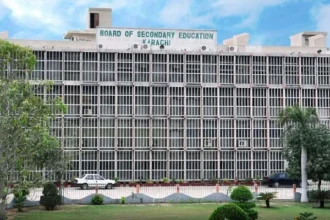
The dream took twenty-two years to become a college. In April 1915 the Muslim Zamindar Middle School opened inside the Shishianwala Gate, with the hostel in a baradari. In 1925 Sir Malcolm Hailey, the governor of Punjab, laid the foundation stone of a building on the Grand Trunk Road, modelled on Aligarh, that would grow into the college. Governor Sir Herbert Emerson inaugurated it in 1937, and Syed Shabbir Hussain Shah Bukhari became its first principal. A pupil who joined the school in 1915 could have been bringing his own son to the college gate by then.
How the government came to sanction the college is wrapped in a family tradition, recounted by his grandson Nawabzada Ghazanfar Ali Gul. Before a visit by the provincial minister Sir Chhotu Ram, the Nawab had the district board’s schoolteachers outfitted at his own expense in white clothes and turbans and posted them along the road from the Chenab to the district courts. The minister stopped his car and asked what the district wanted. The reply came as one voice: a college first. Back in Lahore, the minister is said to have reported that Gujrat was the only district where he had heard a single demand wherever he went. It is tradition, not documentary record, but its meaning is plain. A district had dressed its ambition in a uniform.
No honest tribute leaves out the price. For raising more than fifteen hundred recruits and collecting war-loan funds in the First World War, he received the MBE in June 1918, then Khan Bahadur and the OBE, and in 1932 the title of Nawab. In the Punjab of that era a college reached a district only through the government’s door. Sir Syed had paid a similar price, and his Loyal Mohammadans of India remains the record of it. Loyalty was not Fazal Ali’s goal but his fee, and by some accounts the district’s political voice paid part of it. He was the first non-official president of the Gujrat Municipal Committee, headed the District Board, and sat in the Legislative Council from 1921 and the Assembly in 1937. What did he bring back from those chambers? A district’s college.
Now for the hardest question: who came through that door? The institution carried the word Zamindar in its name. Did a tenant farmer’s or a labourer’s son come in? And what of daughters? No one has yet studied the admission registers, so no figure can settle it. Local tradition holds that before Partition the college was already a major centre of education for the children of farmers, and that after it became a postgraduate college it did the same for women’s higher education. If the records confirm this, the hostel proposed for the village child will have received its answer.
On January 1, 1939, Fazal Ali appointed Dr Jahangir Khan as principal and said openly that Sir Syed had brought his principal from Europe, whereas his own belonged to this soil and had studied in Europe. That one sentence holds his whole outlook: learn from others, but stand on your own ground. He received the title of Sir on February 21, 1942, and died on October 30 of that year. Like Sir Syed, he was buried on the campus, in front of the main building. A man who spent his life opening a door lies at its threshold.
Eighty-four years on, the question belongs to us. A district’s future is not handed down by anyone else. It is built from the tax a district agrees to levy on itself. Every time a village sends its first graduate through that gate, he answers the meeting of January 1914. Sir Syed gave a nation its direction, and the Sir Syed of Gujrat gave one district its road. His voice still asks every village where literacy is low: when will you set aside your twelfth for your children?