Summary
- By 9/11, the United States confronted not a puppet it had designed, but an adversary formed within an infrastructure its policy had helped make possible.
- United States Department of State, Office of the Historian, “Minutes of a Special Coordination Committee Meeting,” October 23, 1979; Conor Tobin, “The Myth of the ‘Afghan Trap’: Zbigniew Brzezinski and Afghanistan, 1978–1979,” Diplomatic History 44, no.
- National Commission on Terrorist Attacks Upon the United States, The 9/11 Commission Report (Washington, DC: Government Printing Office, 2004), 55–56; Stansfield Turner, “Additional Funding for Afghanistan Covert Action Program,” February 21, 1980.
In 1991, in Pakistan: From Hash to Heroin, we wrote: “Those who went on a holy war against communism, unfortunately brought home heroin.”1 The line was deliberately blunt. It identified blowback before the term became fashionable. Thirty-five years later, it also requires refinement.
Afghans did not need Washington, Riyadh or Islamabad to invent their opposition to occupation. The Soviet invasion produced a genuine national resistance. What outside states manufactured was its scale, ideological packaging, chain of supply and transnational afterlife.
Soviet culpability must come first. The People’s Democratic Party of Afghanistan seized power in April 1978. Its coercive reforms and brutal repression ignited revolt. In December 1979, Soviet troops invaded, killed Hafizullah Amin and installed Babrak Karmal. Moscow turned an internal crisis into a devastating international war. Millions were uprooted. Afghanistan became a battlefield on which foreigners pursued objectives that Afghans had never chosen.2
Nor should a seductive counter-story be repeated as settled fact. President Jimmy Carter did authorise limited covert assistance before the invasion. A finding of July 3, 1979, allowed US$695,000 for cash, non-military supplies and propaganda. That record does not establish that Washington deliberately lured Moscow into Afghanistan. Serious archival scholarship disputes that claim.3
After the invasion, however, the intention to bleed the Soviet Union was explicit. Zbigniew Brzezinski told Carter that Afghanistan could become a “Soviet Vietnam”. He recommended more money, arms and technical advice for the resistance, with Islamic countries enlisted in propaganda and covert action.4 A national struggle was recast as an instrument of global Cold War strategy.
The arrangement divided labour. The United States supplied money, weapons and diplomatic cover. Saudi Arabia supplied funds and helped give the campaign religious reach. Pakistan supplied sanctuary, routes and the decisive gatekeeping institution: the Inter-Services Intelligence Directorate (ISI). American and Saudi assistance was funnelled through Pakistan; the ISI helped train the rebels and distribute arms.5
That method mattered. Afghanistan’s resistance was never a single force. It contained monarchists, nationalists, traditional religious leaders, Islamists, local commanders and communities defending their homes. Control of the pipeline allowed Pakistan’s military regime to reward preferred clients and weaken others. Under General Zia-ul-Haq, Islamisation at home and jihad across the border reinforced each other. The clients considered most useful to Islamabad acquired weapons, money and political standing disproportionate to their support inside Afghanistan.6
The word “manufactured” must be used precisely. States did not manufacture Afghan courage or the will to expel an invader. They manufactured a system that selected which Afghans would be strongest, which ideology would speak loudest, and which forms of violence would enjoy immunity.
The infrastructure soon exceeded Afghanistan. Young Muslims arrived from the Middle East and elsewhere. Mosques, charities, schools, guesthouses and recruitment offices moved money and men. Abdullah Azzam and Osama bin Laden helped establish the Maktab al-Khidamat, or Services Bureau. Its networks channelled foreign volunteers to the war.
Here another correction is essential. The claim that the Central Intelligence Agency (CIA) created bin Laden is unsupported. The 9/11 Commission found that he and the so-called Afghan Arabs raised money through their own Gulf networks and received little or no American assistance. At the same time, the Commission recorded the enabling environment: billions of dollars in American and Saudi assistance, channelled through Pakistan, sustained the wider war in which transnational mobilisation flourished.7
The distinction does not absolve Washington. It defines its responsibility more accurately. The United States did not command al-Qaeda. It helped create the strategic conditions in which militarised religion, secret finance, armed patronage and international recruitment could be treated as acceptable instruments. Bin Laden was not an American puppet. He was an independent actor who learned inside a war that great powers had helped internationalise.
In 1988, as Soviet withdrawal approached, bin Laden and Azzam decided that the organisation created for Afghanistan should not dissolve. Al-Qaeda emerged as a base for future jihad. The battlefield was temporary; the network was portable. The sponsors had taught a dangerous lesson: a sacred narrative, foreign money, protected routes and disciplined cadres could humble a superpower.
Victory was then defined too narrowly. Soviet forces completed their withdrawal in February 1989. For Washington, the principal objective had been achieved. For Afghans, war continued. The familiar claim that the United States simply disappeared the next morning is too neat; covert support continued for a time. The deeper abandonment was political. Nothing comparable was invested in an inclusive settlement, disarmament, accountable institutions or reconstruction.
Kabul fell to the mujahideen in 1992. Rival factions then devastated the capital and dismembered the state they had claimed to liberate. The arsenals remained. Commanders retained men, routes and foreign patrons. A war economy could not be switched off by diplomatic announcement.
The Taliban must also be placed in their correct time. They did not fight the Soviet army as the Taliban. The movement emerged in 1994 from the ruins of the post-Soviet civil war. It drew recruits from a particular mixture of refugee displacement, Pakistani religious schools, trading interests, old military networks and a public desperate for order. Pakistan later became its principal external patron. Conflating the mujahideen, the Taliban and al-Qaeda into one timeless enemy is bad history and worse policy.8
Our 1991 thesis also needs sharpening on narcotics. Opium and heroin did not finance every commander, much less the entire anti-Soviet resistance. Nor was the covert arms pipeline identical to the drug market. But the two occupied the same frontier political economy. Some commanders and traders taxed crops protected laboratories or controlled routes. Weapons strengthened protection; protection expanded smuggling; smuggling bought influence and more weapons. Counter-narcotics repeatedly lost priority when it threatened strategically useful relationships.
That is the meaning of the warning that men went to war and “brought home heroin”. It was not a charge against every Afghan fighter. It described the institutional return cargo: guns, trafficking routes, armed authority, corruption and the habit of excusing lawlessness when committed by a favoured proxy.
The sequel, Pakistan: From Drug-trap to Debt-trap, argued that Pakistan moved from drugs-for-arms entanglement into debt dependence and then into the American war-on-terror trap.9 The enlarged thesis now goes further. These were not separate traps. Each reduced democratic choice and rewarded a security structure that could convert regional danger into domestic power and external rent.
Washington’s failure was not omnipotence. It was strategic indifference. Once the Soviet Union had paid the desired price, the social wreckage across Afghanistan and Pakistan sat outside the ledger. Riyadh had projected influence. Islamabad had pursued a compliant order and the mirage of “strategic depth”. Armed clients had accumulated territory and money. Every sponsor achieved something immediate. Afghans inherited the combined bill.
By 9/11, the United States confronted not a puppet it had designed, but an adversary formed within an infrastructure its policy had helped make possible. That distinction is vital. It rejects conspiracy without granting innocence.
The revised thesis can be stated plainly: states did not manufacture the Afghan resistance; they manufactured the machinery that internationalised it, armed its hardest factions and preserved its uses after the occupier withdrew. Once violence became policy, policy became dependent on violence.
The next part will follow the most profitable traffic through that machinery: heroin moving outward, guns moving inward, and protection binding both trades to power.
Endnotes
- Ikramul Haq, Pakistan: From Hash to Heroin (Lahore: Annoor Printers & Publishers, 1991), 16.
- United States Department of State, Office of the Historian, “Preface,” in Foreign Relations of the United States, 1977–1980, vol. XII, Afghanistan; Human Rights Watch, “Fueling Afghanistan’s War,” December 2000.
- United States Department of State, Office of the Historian, “Minutes of a Special Coordination Committee Meeting,” October 23, 1979; Conor Tobin, “The Myth of the ‘Afghan Trap’: Zbigniew Brzezinski and Afghanistan, 1978–1979,” Diplomatic History 44, no. 2 (April 2020): 237–264.
- Zbigniew Brzezinski, “Reflections on Soviet Intervention in Afghanistan,” memorandum to President Jimmy Carter, December 26, 1979.
- National Commission on Terrorist Attacks Upon the United States, The 9/11 Commission Report (Washington, DC: Government Printing Office, 2004), 55–56; Stansfield Turner, “Additional Funding for Afghanistan Covert Action Program,” February 21, 1980.
- Ikramul Haq, “Afghanistan’s Curse: Manufactured—and Now Haunts the Makers,” The Friday Times, September 12, 2026.
- National Commission on Terrorist Attacks Upon the United States, The 9/11 Commission Report, 55–57.
- Ibid., 63–65; Human Rights Watch, Crisis of Impunity: The Role of Pakistan, Russia, and Iran in Fueling the Civil War in Afghanistan, July 2001.
- Ikramul Haq, Pakistan: From Drug-trap to Debt-trap, edited by Huzaima Bukhari (Lahore: Lahore Law Publications, 2003), xiii–xiv.
[To be continued]
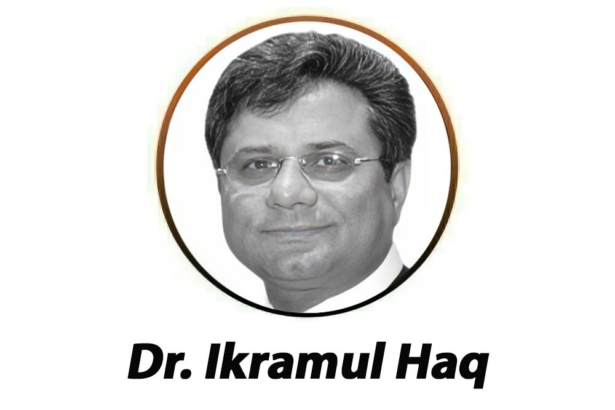
Dr. Ikramul Haq, Advocate Supreme Court, writer, literary critic, Adjunct Faculty at Lahore University of Management Sciences (LUMS), member Advisory Board and Visiting Senior Fellow of Pakistan Institute of Development Economics (PIDE), holds an LLD in tax laws. He was full-time journalist from 1979 to 1984 with Viewpoint and Dawn. He also served Civil Services of Pakistan from 1984 to 1996.
We welcome your contributions! Submit your blogs, opinion pieces, press releases, news story pitches, and news features to opinion@minutemirror.com.pk and minutemirrormail@gmail.com