Summary
- Britain is heading toward its seventh change of prime minister in ten years after Keir Starmer announced his resignation on Monday, triggering a Labour leadership contest widely expected to deliver Andy Burnham to Downing Street before Parliament returns from its summer recess.
- Starmer entered Downing Street as the first Labour prime minister since Gordon Brown left office in 2010.
- If no credible challenger steps forward, Burnham could formally enter Downing Street in late July, making him Britain’s seventh prime minister in ten years.
Britain is heading toward its seventh change of prime minister in ten years after Keir Starmer announced his resignation on Monday, triggering a Labour leadership contest widely expected to deliver Andy Burnham to Downing Street before Parliament returns from its summer recess.
Starmer stood outside 10 Downing Street in the early hours of Monday morning, his composure giving way briefly as he mentioned his wife Victoria and their two children. He told gathered media that he had already spoken to King Charles III and that nominations to replace him as Labour leader would open on 9 July, with the process to be completed by the parliamentary summer recess on 16 July. He would remain as caretaker prime minister throughout.
The statement brought down a premiership that had begun with extraordinary promise. Labour won the July 2024 general election with a parliamentary majority of more than 170 seats, ending fourteen years of Conservative government. Starmer entered Downing Street as the first Labour prime minister since Gordon Brown left office in 2010. He leaves having served fewer than twenty-three months, becoming the sixth consecutive prime minister to depart before completing a full term and setting Britain on course for its seventh head of government in a single decade.
“The question my party is asking is whether I am best placed to lead us into the next general election,” Starmer said outside Number 10. “I have heard the answer of my parliamentary party, and I accept that answer with good grace.”
The road to Monday’s announcement stretched back through a sustained period of internal Labour pressure. Local elections in May produced one of the party’s worst results in living memory. Labour lost nearly 1,500 council seats in a single night while Nigel Farage’s Reform UK party captured more than 1,400 positions and seized control of fourteen local councils. The results functioned as a public verdict on Starmer personally, and many Labour MPs drew the conclusion that he could not lead the party into the next general election, which must take place no later than July 2029.
The proximate cause of his departure came the following week. Andy Burnham, the former Greater Manchester Mayor, had engineered a return to Parliament by standing in a by-election in Makerfield, a suburban Manchester constituency where Reform UK had recently swept local council seats. Burnham won decisively, eliminating the last barrier to a formal leadership challenge. As reports spread over the weekend that Starmer intended to fight any contest, pressure inside the parliamentary party reached a breaking point. By Monday morning, Starmer chose to step aside.
Burnham confirmed his candidacy within hours. Former Health Secretary Wes Streeting, previously considered the strongest rival, immediately endorsed Burnham, making an uncontested succession appear probable. A candidate requires the nominations of 81 Labour MPs to appear on the ballot. If no credible challenger steps forward, Burnham could formally enter Downing Street in late July, making him Britain’s seventh prime minister in ten years.
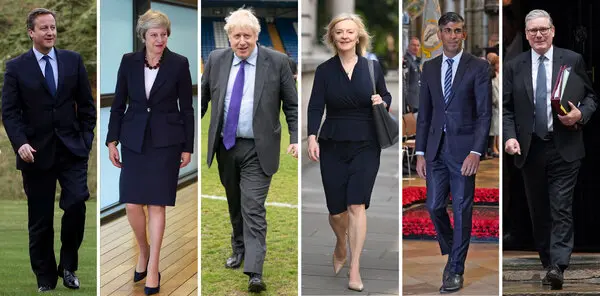
That figure requires context. The decade of turnover began on 23 June 2016, the day British voters chose to leave the European Union. David Cameron, the Conservative prime minister who called the referendum and campaigned for Remain, resigned the following morning. He was the first of six departures.
Theresa May, Conservative, took office in July 2016 and spent three years attempting to negotiate and then pass a Brexit withdrawal agreement through Parliament. Lawmakers rejected her deal three times. She resigned in July 2019.
Boris Johnson, Conservative, succeeded May on a promise to complete Brexit and won a commanding majority of 80 seats in the December 2019 general election. His government oversaw Britain’s formal departure from the European Union in January 2020 and managed the national response to the coronavirus pandemic. His premiership collapsed in September 2022 under the accumulated weight of the Partygate scandal, revelations that Downing Street staff held social gatherings during coronavirus lockdowns that the wider public was legally prohibited from holding, and a wave of cabinet resignations that made his position untenable.
Liz Truss, Conservative, followed Johnson into office and lasted precisely 49 days, the shortest premiership in recorded British history. Her economic programme, built around significant unfunded tax cuts, triggered an immediate and severe market reaction. The pound fell sharply, borrowing costs surged, and her political support evaporated within weeks. She resigned in October 2022.
Rishi Sunak, Conservative, took over from Truss and restored a degree of calm to financial markets. He could not, however, restore his party’s standing with the electorate. The Conservatives entered the July 2024 general election trailing badly in the polls and suffered their heaviest defeat in more than two centuries. Sunak left office on the day the results came in.
Six prime ministers across roughly eight years. The contrast with previous eras of British political leadership is pronounced. Margaret Thatcher held office for more than eleven years across three successive general election victories. Tony Blair served ten years and won three majorities. Both shaped the contours of British public life for a generation. Since the Brexit referendum, the average tenure of a British prime minister has barely exceeded eighteen months.
Political analysts point to Brexit as the event that set the current cycle in motion. The referendum exposed deep divisions within both major parties and inside Parliament that no single leader proved capable of resolving. The economic consequences of leaving the European Union, combined with the disruption of the pandemic and a prolonged cost-of-living crisis, created conditions in which governing became acutely difficult and public patience with incumbents shortened sharply.
Burnham, aged 56, brings a different profile to the contest. He served as a Labour MP for sixteen years before leaving Parliament in 2017 to become Greater Manchester Mayor, a role in which he pursued greater devolved powers for the north of England and oversaw significant economic and infrastructure investment across the city region. He sits to the left of Starmer on economic policy, has spoken extensively about decentralising government power away from London, and has argued for an end to what he calls trickle-down economics. He has built a national profile that extends beyond traditional Labour strongholds, including demonstrated capacity to hold constituencies where Reform UK has made significant inroads.
Britain’s constitutional arrangements do not require a general election when a prime minister changes mid-term, provided the governing party retains its parliamentary majority. Labour’s majority remains substantial and intact. The country will not go to the polls as a result of this leadership change.
What it will receive, almost certainly before September, is a new prime minister who will need to rebuild Labour’s standing in the country, halt Reform UK’s advance, and steady a party that has now removed two consecutive leaders before the end of their first full term.
We welcome your contributions! Submit your blogs, opinion pieces, press releases, news story pitches, and news features to opinion@minutemirror.com.pk and minutemirrormail@gmail.com