Summary
- According to the information provided, four major developments have shaped the regional situation: the UN chief’s engagement with Pakistani leadership, the reported activation of a joint defence arrangement involving Pakistan, Saudi Arabia and Turkiye, alleged Houthi attacks in Saudi Arabia, and Washington’s stated preference for continued discussions with Tehran.
- Defence agreement enters implementation phase Separately, the report says a joint defence arrangement involving Pakistan, Saudi Arabia and Turkiye has moved towards practical implementation.
- A meeting of the Strategic Political and Defence Committee in Riyadh on October 5 reportedly discussed the deployment of agreed military capabilities in Saudi Arabia.
ISLAMABAD: Pakistan’s diplomatic role in efforts to ease tensions between the United States and Iran has come into focus following United Nations Secretary-General Antonio Guterres’s visit to Islamabad, as developments surrounding a regional defence pact and escalating security concerns add to uncertainty across the Middle East.
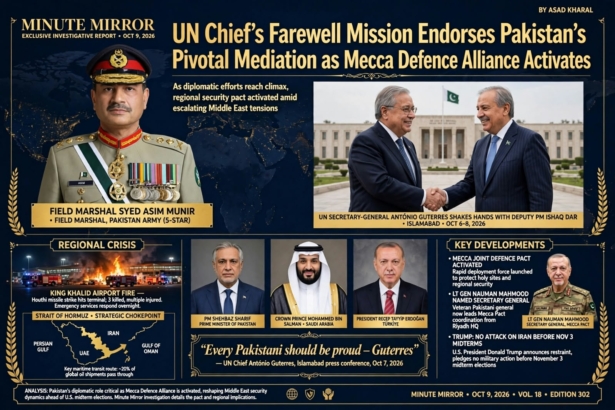
According to the information provided, four major developments have shaped the regional situation: the UN chief’s engagement with Pakistani leadership, the reported activation of a joint defence arrangement involving Pakistan, Saudi Arabia and Turkiye, alleged Houthi attacks in Saudi Arabia, and Washington’s stated preference for continued discussions with Tehran.
UN backs diplomatic engagement
Guterres visited Pakistan from October 6, 2026, following an invitation from the government. UN spokesperson Stephane Dujarric reportedly said the visit included discussions about Pakistan’s mediation efforts in the US-Iran conflict and its support for negotiations between the two countries.
During a joint press conference with Deputy Prime Minister and Foreign Minister Ishaq Dar on October 7, Guterres praised Pakistan’s efforts to facilitate dialogue. He also called on the parties to end hostilities, return to diplomacy and uphold navigational rights under international law.
The report states that an Islamabad Memorandum of Understanding was signed between Washington and Tehran in June, with Pakistan acting as a guarantor. The proposed framework reportedly focused on a ceasefire and reopening the Strait of Hormuz.
Guterres also met Prime Minister Shehbaz Sharif, President Asif Ali Zardari and Chief of Defence Forces Field Marshal Syed Asim Munir. Pakistan’s Foreign Office reportedly described Munir’s earlier visit to Tehran as part of the country’s mediation efforts.
Defence agreement enters implementation phase
Separately, the report says a joint defence arrangement involving Pakistan, Saudi Arabia and Turkiye has moved towards practical implementation. A meeting of the Strategic Political and Defence Committee in Riyadh on October 5 reportedly discussed the deployment of agreed military capabilities in Saudi Arabia.
The committee also reportedly appointed retired Lieutenant General Nauman Mahmood of Pakistan as its first secretary-general for a three-year term.
Turkiye’s Foreign Minister Hakan Fidan described the arrangement as defensive, according to the supplied account, and indicated that air defence, electronic warfare and technical assistance were among the areas under consideration.
Saudi security concerns and US-Iran talks
The report further alleges that attacks targeting Riyadh on October 8 killed three Saudi nationals and injured several others, damaging airport facilities and a Saudia aircraft. Houthi representatives reportedly claimed responsibility for missile attacks and issued warnings against Saudi Arabia. These claims require confirmation from authoritative sources.
Meanwhile, US President Donald Trump reportedly said Washington would not attack Iran before the November 3 midterm elections, citing productive discussions with Tehran. The report also says Brent crude prices declined following his remarks.
Iranian Foreign Minister Abbas Araghchi was reportedly reviewing a US response to Tehran’s proposal concerning the Strait of Hormuz, a critical route for international energy supplies.
Pakistan has maintained that its approach centres on regional stability, Saudi Arabia’s security and continued diplomatic engagement. However, the prospects for a lasting settlement will depend on developments in negotiations, security arrangements and freedom of navigation.
Further clarification from official sources is needed on the reported defence deployments, attacks and status of the US-Iran agreement.
We welcome your contributions! Submit your blogs, opinion pieces, press releases, news story pitches, and news features to opinion@minutemirror.com.pk and minutemirrormail@gmail.com