Summary
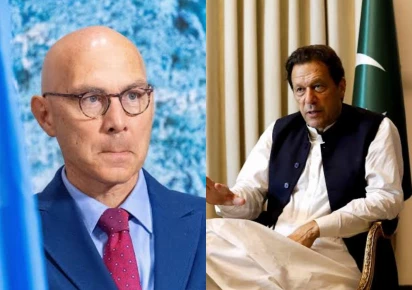
- United Nations High Commissioner for Human Rights Volker Turk has called on Pakistani authorities to release former prime minister Imran Khan, ensure his access to proper medical treatment and take measures to ease political tensions surrounding his imprisonment.
- Separately, Amnesty International has called on Pakistani authorities to provide adequate healthcare to Imran and Bushra, restore their regular access to family members and lawyers, and end what it described as the political persecution of Imran’s relatives.
- In statements, the rights organisation said restrictions on medical assistance, family meetings and access to legal counsel raised serious concerns about Pakistan’s compliance with its international human rights obligations.
United Nations High Commissioner for Human Rights Volker Turk has called on Pakistani authorities to release former prime minister Imran Khan, ensure his access to proper medical treatment and take measures to ease political tensions surrounding his imprisonment.
In an interview with CNN on Thursday, Turk stressed the need for immediate steps to address the situation, suggesting that Imran’s release could serve as an important confidence-building measure between the government and opposition.
“I call for his release. I call for his proper treatment, and I actually call for de-escalation,” Turk said.
He emphasised that political tensions surrounding the former prime minister’s detention needed to be reduced through dialogue and respect for international human rights standards.
Turk said Pakistani authorities should consider confidence-building measures to improve the situation, including allowing family visits, ensuring access to lawyers and providing adequate medical assistance.
He also called for the release of individuals who should not be in detention.
The UN rights chief said the concerns extended beyond Imran’s case, pointing to reports of arbitrary detention involving human rights defenders, journalists and members of the political opposition.
He stressed that Pakistan must uphold international legal protections for people deprived of their liberty and ensure that their fundamental rights were respected.
Imran and his wife, Bushra Bibi, are currently imprisoned at Adiala Jail in Rawalpindi. Both were sentenced to 17 years in prison on December 20, 2025, in the Toshakhana-II case involving their alleged unlawful retention of a Bulgari jewellery set gifted by the Saudi crown prince.
The former premier has remained in custody since August 2023 and is also serving a sentence in the £190 million corruption case. He faces additional proceedings under the Anti-Terrorism Act in connection with the May 9, 2023, protests.
Turk’s intervention comes amid growing concerns over Imran’s health and his access to medical facilities. The former premier recently appealed to senior judges to ensure the implementation of court orders concerning his treatment and prison conditions, warning that his health was deteriorating.
Separately, Amnesty International has called on Pakistani authorities to provide adequate healthcare to Imran and Bushra, restore their regular access to family members and lawyers, and end what it described as the political persecution of Imran’s relatives.
In statements, the rights organisation said restrictions on medical assistance, family meetings and access to legal counsel raised serious concerns about Pakistan’s compliance with its international human rights obligations.
Amnesty said Imran had not been allowed to meet his family since December 2025, apart from two meetings with his sister in August 2026. He had also reportedly been denied telephone contact with his sons since March 2026.
The organisation expressed concern over claims that the former premier had been kept in solitary confinement and increasingly isolated from human contact, potentially affecting his physical and mental well-being.
Its South Asia Regional Office also raised concerns about his medical condition, saying the 74-year-old had been experiencing serious blood pressure problems. It alleged that he had been denied access to independent doctors despite a Supreme Court order directing his transfer to a private hospital.
Amnesty also highlighted Bushra Bibi’s medical condition, warning that her reported eye problems required adequate treatment to prevent further deterioration.
The organisation cited Article 10 of the International Covenant on Civil and Political Rights, which requires that people deprived of their liberty be treated with humanity and respect for their dignity.
It also called for an end to the detention of Imran’s family members in connection with their efforts to advocate for his rights.
According to Amnesty, three of his sisters were detained on September 20 and 21 under Section 3 of the Maintenance of Public Order Ordinance, 1960, over concerns linked to a planned PTI march in Islamabad.
While two were subsequently released, Aleema Khan remained imprisoned at Lahore’s Kot Lakhpat jail, the organisation said.
Amnesty called for Aleema’s immediate release and urged authorities not to initiate further proceedings against Imran’s relatives for exercising their rights to freedom of expression and peaceful assembly.
Concerns over Imran’s health have intensified following a series of developments involving his eyesight and access to specialised medical care.
The issue gained prominence after the Supreme Court directed authorities on August 18 to transfer him from Adiala Jail to Shifa International Hospital for specialised treatment. However, he was taken to the Pakistan Institute of Medical Sciences (PIMS) instead and returned to prison following a medical examination.
PTI subsequently filed a contempt petition, alleging that the authorities had failed to comply with the court’s directions.
In January, Imran underwent a minor eye procedure at PIMS. Information Minister Attaullah Tarar later confirmed that doctors had examined his eyes and performed a procedure after obtaining his written consent.
PIMS subsequently disclosed that he had received an anti-VEGF intravitreal injection to treat right central retinal vein occlusion, a condition affecting blood flow in the retina.
A report prepared by Barrister Salman Safdar following a Supreme Court-directed meeting with Imran revealed that the former premier had told officials his right eye was functioning at only 15 per cent capacity.
Following the report, the Supreme Court directed authorities to provide access to his personal physicians at Adiala Jail and restore telephone contact with his sons, Kasim and Sulaiman.
A subsequent medical assessment, however, reported an improvement in his eyesight. According to the medical board, vision in his right eye improved from 6/36 to 6/9, while his left eye had 6/6 vision with glasses.
Bushra Bibi has also faced medical concerns during her imprisonment. An examination at Adiala Jail in March diagnosed her with posterior vitreous detachment in her right eye, along with myopia and astigmatism.
She was prescribed medication and eye drops and advised to undergo a follow-up examination. She later underwent eye surgery on April 16.
The latest appeals from the UN human rights chief and Amnesty International have renewed international attention on the couple’s detention, medical care and access to legal and family support.
We welcome your contributions! Submit your blogs, opinion pieces, press releases, news story pitches, and news features to opinion@minutemirror.com.pk and minutemirrormail@gmail.com