Summary
- The United States has declared its commitment to reaching a comprehensive agreement with Iran, but warned that no deal will be accepted if it compromises the security of Gulf allies or permits Tehran to levy transit charges on commercial shipping through the Strait of Hormuz.
- In Manama, the foreign ministers of the Gulf Cooperation Council (GCC) states issued a joint statement after a ministerial meeting with Rubio, insisting that lasting regional peace requires addressing the full spectrum of threats posed by Iran, including its ballistic missiles, drones, and proxy networks.
- The ministers also declared that any future trade and investment with Iran would remain completely conditional and reversible, depending strictly on Tehran’s compliance with the MoU, its adherence to a final agreement, and a total cessation of destabilising regional behaviour.
The United States has declared its commitment to reaching a comprehensive agreement with Iran, but warned that no deal will be accepted if it compromises the security of Gulf allies or permits Tehran to levy transit charges on commercial shipping through the Strait of Hormuz.
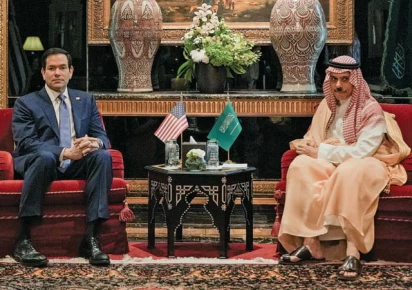
US Secretary of State Marco Rubio, speaking in Bahrain during a regional tour, stated that Washington desires an agreement with Tehran but “not at any price”. He emphasised that any final settlement must fully safeguard the stability, prosperity, and security of Gulf partners.
His remarks come as negotiations between the United States and Iran resume following a preliminary framework aimed at ending months of conflict that erupted after a major US-Israeli military campaign against Iran commenced on 28 February.
The preliminary accord has opened up complex negotiations expected to address Iran’s nuclear programme, sanctions relief, and the future of global energy flows through the Strait of Hormuz.
However, it remains highly uncertain whether the talks will encompass Tehran’s ballistic missile programme and its financial and military support for allied groups across the Middle East. These issues have long been regarded by Gulf Arab states and Israel as central security vulnerabilities.
Speaking during a diplomatic visit to Pakistan this week, Iranian President Masoud Pezeshkian explicitly stated that Iran’s missile programme remains entirely off the table. He added that because it was not part of the initial Islamabad Memorandum of Understanding, it will not be discussed at any future forum.
In Manama, the foreign ministers of the Gulf Cooperation Council (GCC) states issued a joint statement after a ministerial meeting with Rubio, insisting that lasting regional peace requires addressing the full spectrum of threats posed by Iran, including its ballistic missiles, drones, and proxy networks.
The ministers also declared that any future trade and investment with Iran would remain completely conditional and reversible, depending strictly on Tehran’s compliance with the MoU, its adherence to a final agreement, and a total cessation of destabilising regional behaviour.
Rubio agreed with these concerns, stating that Washington would not back any arrangement that counters the strategic interests of its Gulf partners. He focused a significant portion of his visit on the future of the Strait of Hormuz, through which roughly one-fifth of global oil consumption passes daily.
Although the critical waterway has reopened under the terms of the MoU, Tehran has since proposed introducing maritime service charges for vessels using the passage, whilst Iran’s Revolutionary Guards warned that unauthorised crossings would be forcefully dealt with.
Washington has flatly rejected any attempts to levy transit charges. Rubio asserted that Hormuz is an international waterway, stating that international waterways do not belong to any individual nation-state and calling it a foundational global principle without which the world would plunge into total chaos.
The GCC ministers also stressed that free, unconditional, and unrestricted navigation through the strait remains absolutely essential for regional and global economic stability. Under the current MoU, the waterway is scheduled to remain open toll-free for a temporary window of 60 days.
We welcome your contributions! Submit your blogs, opinion pieces, press releases, news story pitches, and news features to opinion@minutemirror.com.pk and minutemirrormail@gmail.com